


Use of AI in biopharma
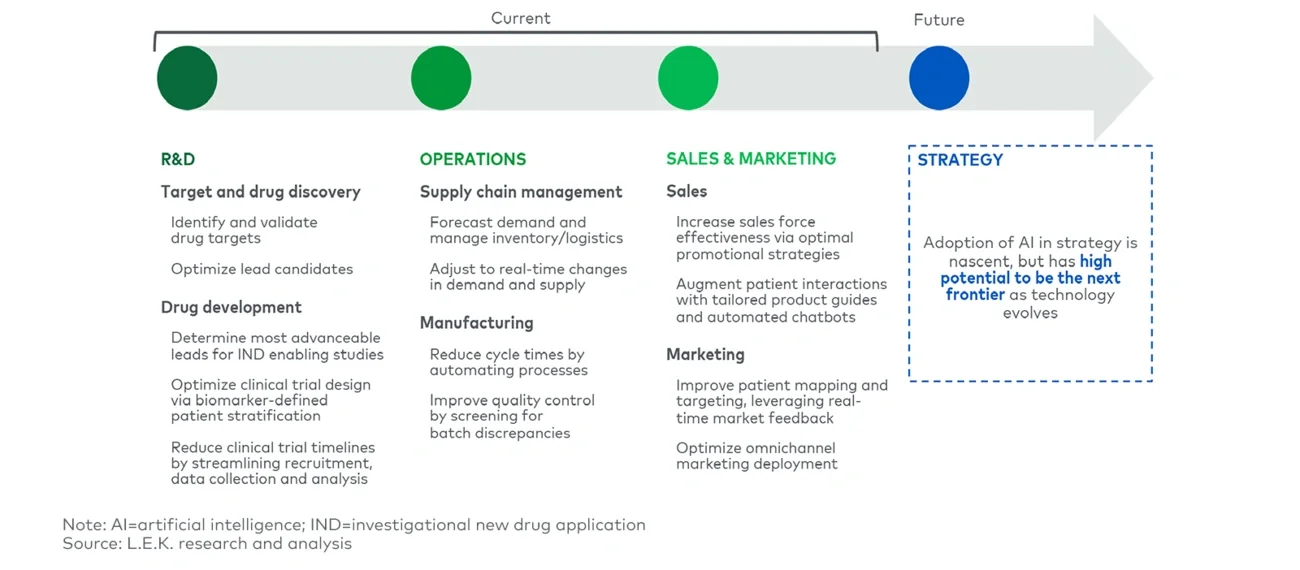
The current use of artificial intelligence (AI) in biopharmaceutical organizations is highly siloed in individual R&D, operational, and sales and marketing processes.
AI applications within R&D span the value chain. Key examples include tools that focus on improving the quality of drug candidates, optimizing clinical trial design, and reducing both the costs of clinical trials and their timelines (e.g., with virtual trial arms). AI has also seen adoption within supply chain management, with applications in demand forecasting and inventory/logistics as well as in manufacturing for robotic process automation and quality control (QC). Within biopharma sales and marketing functions, AI is used to enhance promotional strategies, improve patient support and optimize omnichannel marketing deployment. For more on existing applications of AI in biopharma, see Artificial Intelligence in Life Sciences: The Formula for Pharma Success Across the Drug Lifecycle.
Despite the adoption of AI in function-specific processes, its use in defining company strategy is nascent, due in part to the following:
-
The highly interdependent nature of strategy, spanning organizational layers, functions and inputs
-
A focus on long-term company goals instead of near-term objectives
-
Previous limitations on data availability and quality to train predictive models
However, recent technological advancements present a promising opportunity for overcoming these challenges and incorporating AI more effectively into strategic decision making. Generative AI technology has rapidly improved across all applications, including text-based (e.g., natural language processing and generation), quantitative (e.g., time series forecasting, predictive modeling), image/video/audio-based, and code-based AI. Text-based and quantitative generative AI are best suited to support biopharma strategy, given the ability to train these AI models with inputs from diverse sources and quantify multidimensional scenarios.
While the world is still trying to comprehend the true power of text-based generative AI since the November 2022 public launch of ChatGPT (GPT-3.5, and subsequently GPT-4), machine learning and predictive modeling are likely to enable critically valuable quantitative insights as the technology continues to improve (as noted in a recent L.E.K. Consulting special report, ‘Generative Artificial Intelligence (AI): Who (or What) Wrote This?’).
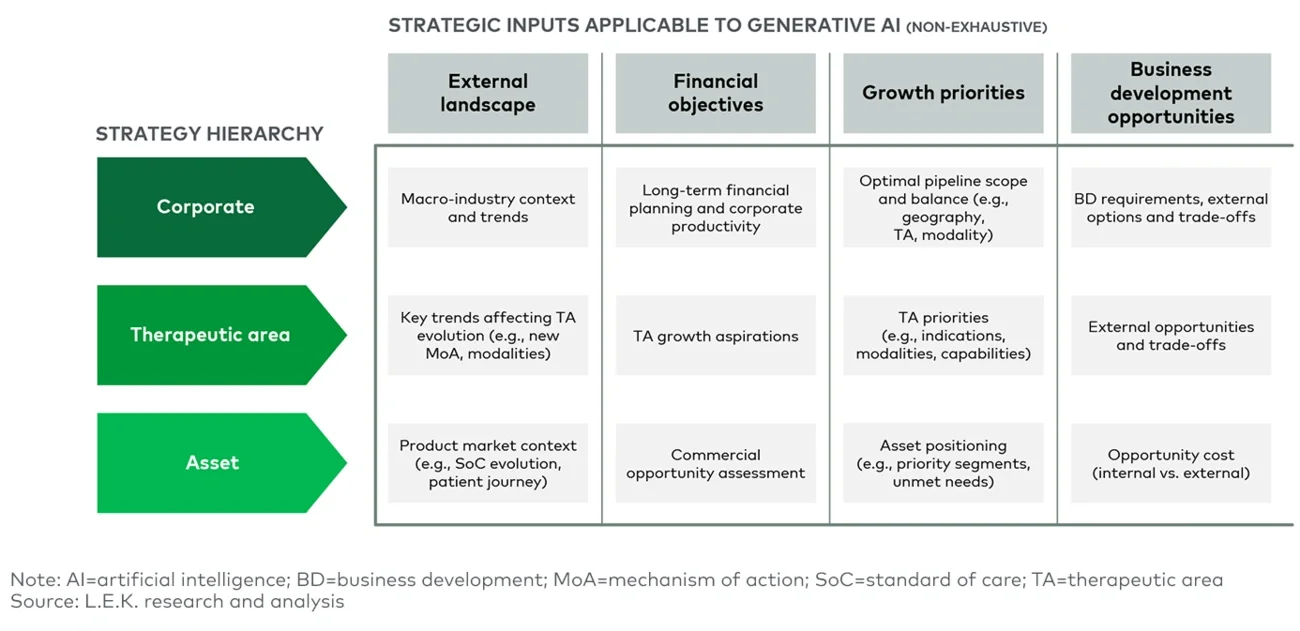
As AI adoption and technical capabilities continue to expand, biopharma executives should view these tools as an opportunity for differentiation and define their vision to integrate AI into strategic processes across all layers of their organization (see Figure 1).