
The global energy sector stands at a pivotal moment, balancing ambition and pragmatism as the energy transition recalibrates. While decarbonization remains a key consideration, companies are shifting focus toward commercially grounded decisions — prioritizing lower-carbon oil and gas operations and proven transition technologies like solar, storage and energy efficiency advancements while reassessing the viability of emerging solutions. This rebalancing reflects a growing emphasis on economic returns, reliability and system resilience, particularly in regions like the U.S., where infrastructure challenges and economic pressures are reshaping priorities.
The sector is witnessing a move from aspiration to moderation, as investments align more closely with practical outcomes and prioritize measurable results within shorter time horizons. Proven clean energy solutions, such as solar and storage, are advancing rapidly and often outperforming forecasts, while traditional energy sources like natural gas and nuclear are experiencing renewed interest as pillars of global energy security. At the same time, decarbonization remains a key focus, with oil and gas players integrating electrification, emissions reduction and carbon management into their ecosystems to meet climate goals while maximizing operational efficiency.
Clean energy investments reached $1.8 trillion in 2023, according to the International Energy Agency, highlighting the scale of financial commitment in the transition. However, this coincides with a rising demand for energy and oil and gas production, highlighting a dual reality: The energy sector is evolving strategically, favoring results-driven transformation over unchecked acceleration.
Amid this recalibration, the sector provides a compelling lens through which to understand shifting global priorities. Insights from L.E.K. Consulting’s Global Energy Study — capturing perspectives from over 320 executives spanning the oil and gas, utilities, renewables, and investment sectors — illustrate how industry leaders are rebalancing investments and driving actionable pathways for a sustainable, resilient and equitable energy future.
Steady investment amid uncertainty
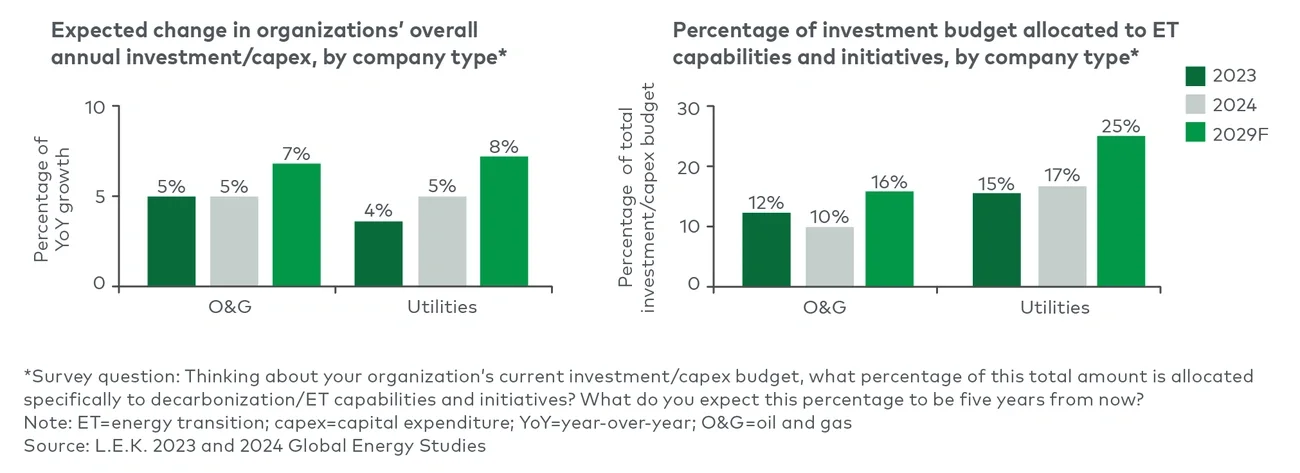
Capital expenditures across the energy sector are expected to grow to 7% annually by 2029, up from 5% in recent years (see Figure 1). This upward trajectory reflects a measured yet confident approach as companies invest in solutions that are scalable, reliable and commercially grounded. However, as energy transition investments continued to evolve in 2024, the focus has shifted toward stabilizing core operations and prioritizing proven technologies, balancing decarbonization efforts with economic and infrastructure resilience.