

As the demand for public transit continues to recover following the end of the pandemic, attention has been directed at the range of policy levers to support ridership growth.
It comes as no great surprise that some stakeholders have suggested public transit pricing can be used as a lever to support ridership recovery, particularly the notion of free or a (low) flat fare (where a single fare is applicable for all trips regardless of origin or destination, time of day, etc.).
More jurisdictions are adopting free fares
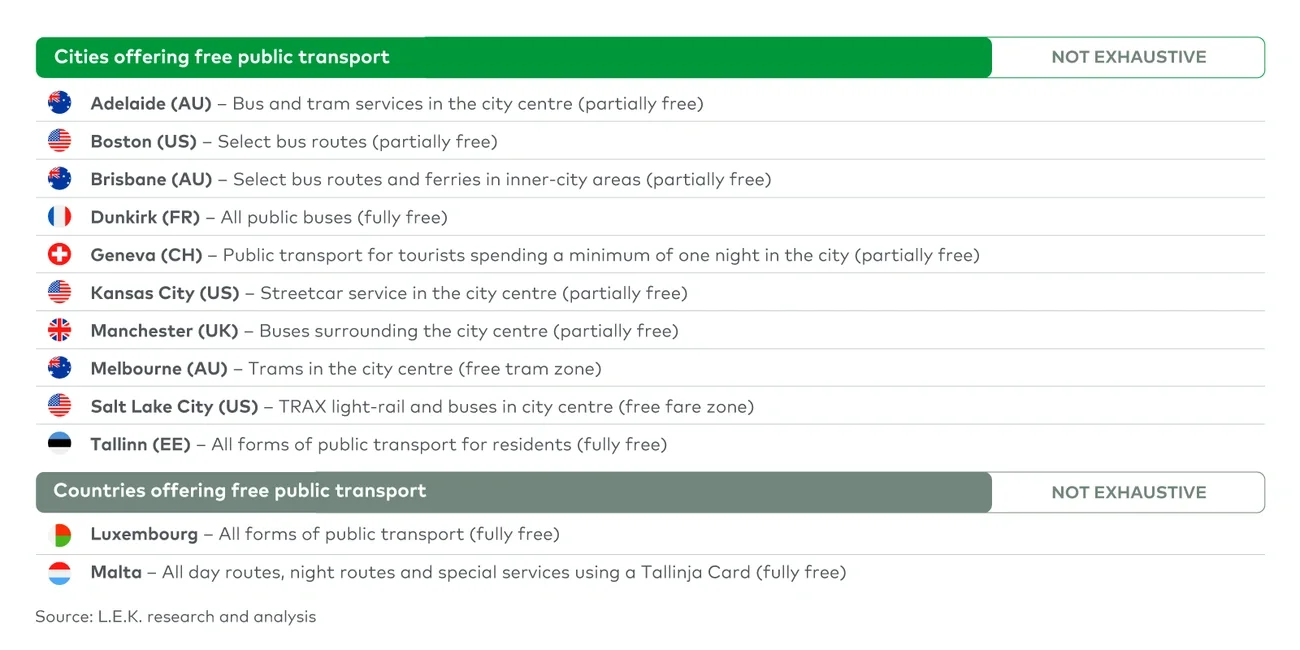
It is now estimated that around 100 cities offer some kind of partially or fully free public transport, with at least half of these in Europe. Examples include the long-standing policy in Tallin, Estonia, and nationwide free public transport in Luxembourg. Figure 1 presents selected cities that have adopted free fares.
Action climate change and social equity are often advocated as the primary motivations for a free fare policy (rather than any specific link to COVID-19 recovery). It is less clear that the hoped-for mode shift share away from cars to public transport has occurred where free fares have been adopted. For example, in Tallinn, car mode share over the past nine years has increased from 42% to 48%.
More recent examples of free fare systems have also emerged in the US. For example, Olympia, Washington, decided to move to free fares on the basis that the existing fare collection equipment was obsolete and, although there was a desire to move to a contemporary fare collection system, this could not be justified given the scale of the capital investment required to ‘protect’ farebox cost recovery of c.10%. Kansas City, Missouri, has also moved to free fares, citing the need to provide access to employment and education as the primary drivers.