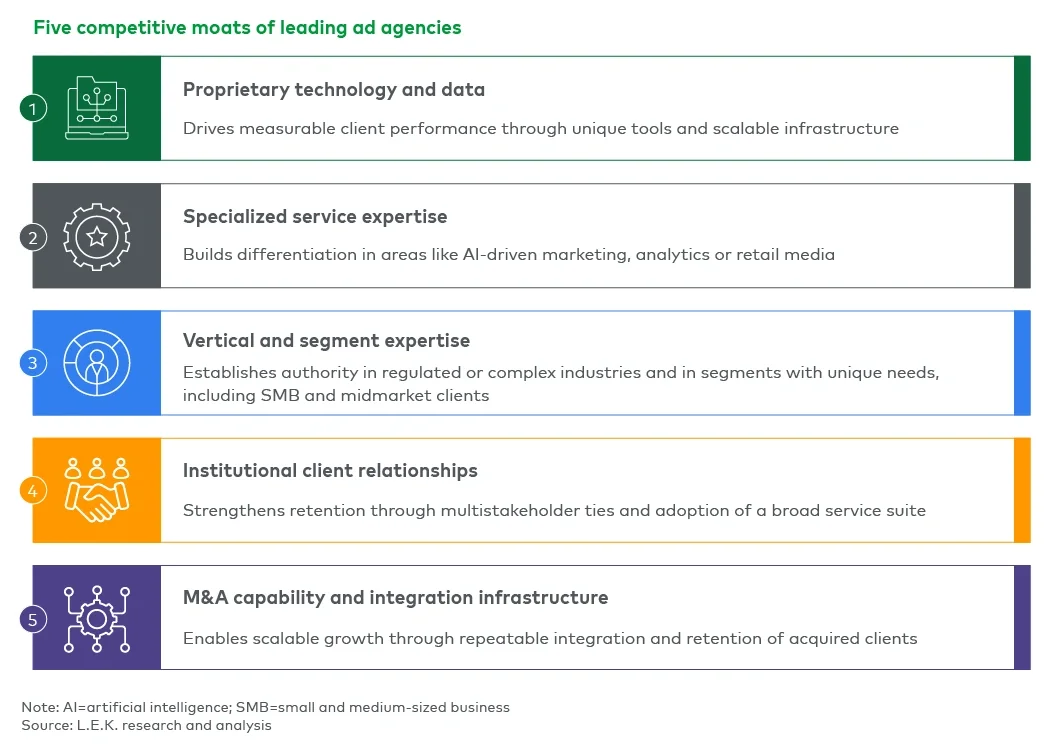
1. Proprietary technology and data
The most durable moats are built on technology infrastructure that competitors can’t easily match. Relying solely on off-the-shelf tools rarely creates meaningful differentiation.
WPP, the holding company behind GroupM, Ogilvy and VML, increased its investment in WPP Open, its AI-powered marketing operating system, from £250 million in 2024 to £300 million in 2025. The platform helped secure major wins including Amazon and Unilever.
PMG’s proprietary marketing operating system, Alli, is the result of a long-term technology investment and now manages $6 billion in media spend annually. It consolidates data from more than 30 sources per client and automates campaign optimization and creative analysis through AI.
The question for evaluating an agency’s tech moat isn’t whether they use AI but rather: Does the agency possess proprietary tools that enhance client performance in measurable ways? Can these capabilities scale without proportional increases in headcount?
2. Specialized service expertise
Capabilities in AI-enabled marketing automation, analytics tools, performance media (retail media, CTV) and influencer or social commerce are attracting strong buyer interest in M&A.
Accenture Song’s August 2025 acquisition of Superdigital added deep expertise in short-form video and influencer partnerships. Previsible’s July 2025 acquisition of Internet Marketing Ninjas brought legacy SEO and authority-building capabilities to its AI-native search platform. These specialized service capabilities enable differentiation and premium positioning in competitive categories.
3. Vertical and segment expertise
Agencies that specialize in serving clients in specific industry verticals or client segments tend to build stronger and more durable client relationships than generalists do. This focus enables agencies to deliver not only creative solutions but also industry insight, compliance precision and a deep understanding of the client’s priorities, all of which drives trust and retention.
In complex and highly regulated verticals, such as finance, legal and healthcare, specialization creates defensibility and differentiation. Agencies that have deep institutional knowledge and are compliant with regulatory frameworks and data privacy requirements are better equipped to command premium pricing and repeat business.
For example, in 2023, Amulet Capital Partners and Athyrium Capital Management formed Unlock Health through the merger of Eruptr and DECODE. The result is a $500 million healthcare marketing platform, illustrating how vertical focus strengthens defensibility and consolidation value.
The same principle applies to client-size segments. Agencies that serve small and medium-sized businesses (SMB) or midmarket clients can tailor offerings to limited budgets, faster decision cycles and hyperlocal targeting. Companies such as Scorpion, Thrive Digital and Hibu have built strong positions with regional SMB clients by packaging digital marketing, lead management and reputation services into scalable, high-retention programs.
For additional perspective on how digital-first strategies are redefining defensibility in marketing, see our recent piece “Is Your B2B Marketing Strategy Obsolete? Here’s How Leaders Stay Ahead.”
4. Institutional client relationships
Are client relationships institutional, rooted in the agency’s broader capabilities or dependent on a small number of individuals whose departure could jeopardize the account?
Top-performing agencies with deeply institutionalized relationships can reach client retention rates near 97%, while others struggle with constant churn. This directly influences valuation. Agencies selling at premium EBITDA multiples of eight to 12 times often demonstrate low client concentration and relationship longevity averaging around 22 years.
Defensibility increases when relationships are spread across multiple stakeholders, often across multiple business units or brands, and supported by a broad suite of adopted services. Agencies embedded in several teams through strategy, creative, media, analytics and technology work are far harder to displace than those limited to a single service line.
In contrast, relationships concentrated among a few senior leaders or tied to one niche offering are vulnerable to disruption, price pressure and internal shifts within the client organization.
5. M&A capability and integration infrastructure
The ability to successfully acquire and integrate other agencies has become a valuable moat. Consider successful exits: Croud completed five strategic acquisitions during its PE hold period, carefully staged over two years. Two Circles made three acquisitions within its first year. Both achieved strong exits because the acquisitions delivered material value.
Compare this with the broader market reality: Bolt-on acquisitions dropped 40% year over year in 2024, with more than a quarter of PE-backed firms (27%) now adopting organic-only growth strategies, often due to harsh lessons from botched integrations.
Agencies with genuine M&A capabilities demonstrate:
- Documented integration playbooks covering day-one operations through team and process integration
- Financial and operational systems built to absorb acquisitions without disruption
- Track records with measurable retention rates after acquisition
Without these capabilities, acquisitions fail to create the intended defensibility.
Implications for investors and agency leaders
Few agencies excel across all five dimensions, but those that lean into their strongest moats tend to build the most durable positions. We’ve outlined several key factors for investors and operators to consider when evaluating the defensibility of their company’s or a target’s market position.
For investors:
- Prioritize targets with at least two demonstrable moats backed by quantifiable metrics, not just claims in pitch decks.
- Assess moat durability under current market pressures. Is proprietary tech actually delivering measurable performance advantages, or is specialized expertise eroding as platforms democratize the capability?
- Evaluate transferability through ownership transitions. Client relationships dependent solely on the founder won’t survive the sale, regardless of earnout structures.
For operators:
- Audit current positioning against all five moats quarterly. Identify which dimensions are strengthening versus eroding.
- Choose battlegrounds deliberately. Becoming exceptional at service expansion requires different investments from those for building proprietary technology.
- Document institutional knowledge aggressively. The difference between a personal relationship and an institutional one is whether the departure of your top client lead would trigger account reviews.
Navigating today’s agency landscape takes perspective and experience. L.E.K. brings together advertising industry veterans who have advised many of the world’s leading agencies. We help investors and operators evaluate M&A opportunities, assess competitive moats and build defensible growth strategies. Learn more about our media industry expertise or contact us to discuss how we can help.
L.E.K. Consulting is a registered trademark of L.E.K. Consulting LLC. All other products and brands mentioned in this document are properties of their respective owners. © 2025 L.E.K. Consulting LLC