Uncertain ability to scale capacity
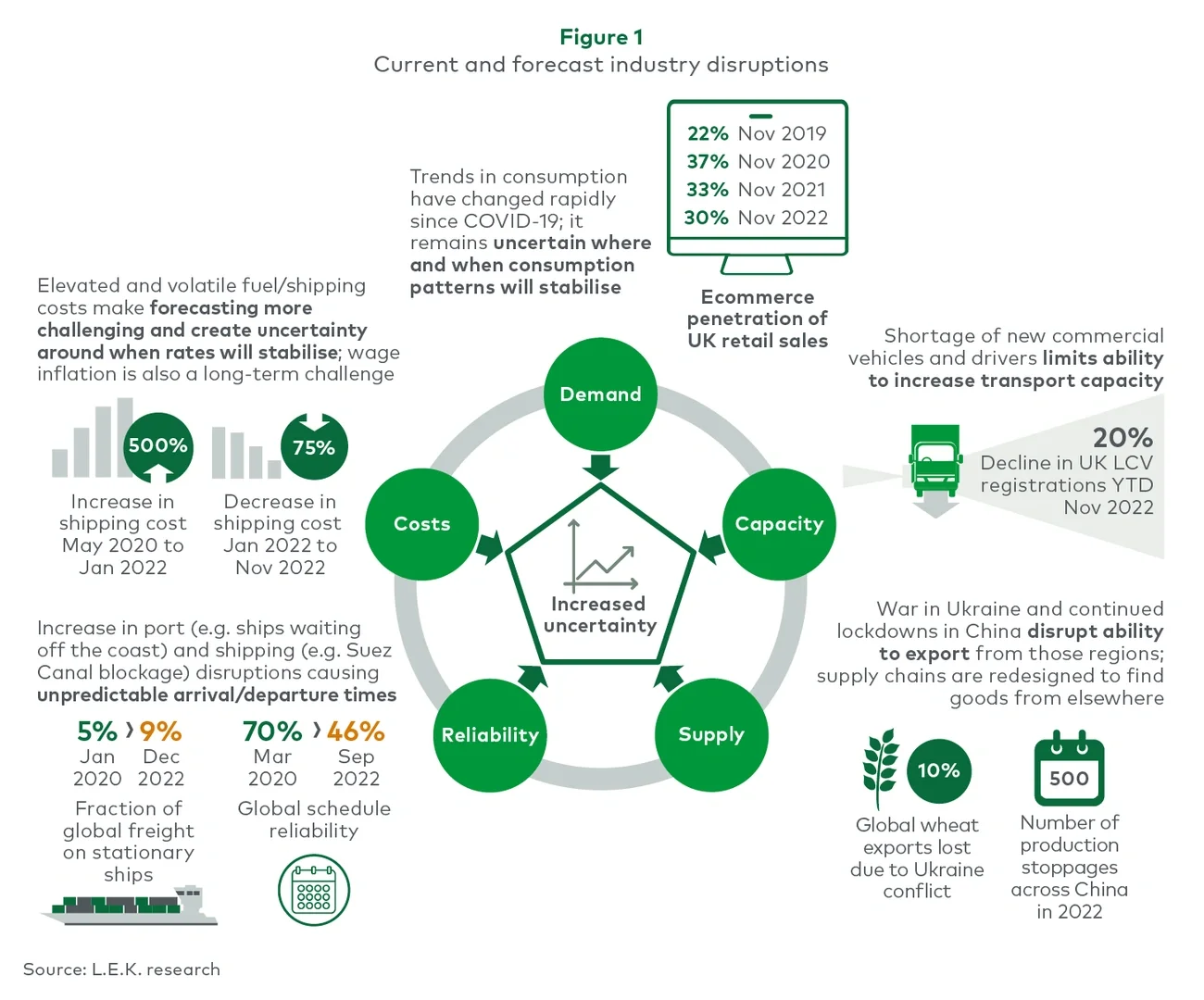
There is a shortage of new vehicles and drivers in the road sector. In the UK, road registration for Light Commercial Vehicles was down 20% this year compared to last year, and there are long-term challenges with the shrinking pool of Heavy Goods Vehicle drivers: c.49% of drivers are over age 50, and the challenges are exacerbated by union opposition to changing working patterns.
Supply of new vehicles has been constrained by the shortage of semiconductors, high energy prices lowering production in Europe, and German automotive suppliers risking a total halt in production. There are other risks too. For example, Germany’s largest producer of AdBlue exhaust cleaning fluid — required for diesel-powered trucks and lorries to comply with nitrogen oxide exhaust rules — was forced to stop production due to energy prices. In the words of the managing director of BGL (Germany’s association of transport and logistics companies), “No AdBlue means no lorries. And that means no supplies for Germany.”
These challenges look set to continue, due to a backlog of demand following the ongoing limits on production at vehicle factories in Europe due to the high energy prices and the global supply of vehicle-specific semiconductors which is expected to take time to catch up with growing demand.
Supply chain uncertainty caused by geopolitical events
COVID-19 significantly disrupted global supply chains due to increased shipping delays and continuing factory closures in China, which are impacting multinational firms. Apple’s latest factory shutdowns in November, for example, created Christmas supply shortages for the latest iPhone.
Combined with the impacts of the war in Ukraine, this has led companies to reconsider where their supply comes from, including diversifying to source from multiple countries or shifting production entirely. These changes all add further complexity to a company’s logistics and require significant reconfiguration.
More recently, energy price hikes in Europe have led to a decrease in industrial production that will reduce outbound logistics requirements.
Uncertain reliability due to port and shipping disruptions
Global shipping schedule reliability was at 45% in September 2022, an improvement on 34% in 2021 but worse than the pre-pandemic level of 77% in 2019.
‘Big stories’ have impacted this uncertainty in the past couple of years, with the Ever Given in the Suez as well as the closure of Chinese ports due to COVID-19 resulting in huge queues outside the ports. Even without any such stories, however, it seems that the ‘new normal’ includes more uncertainty around whether your shipments will arrive on time.
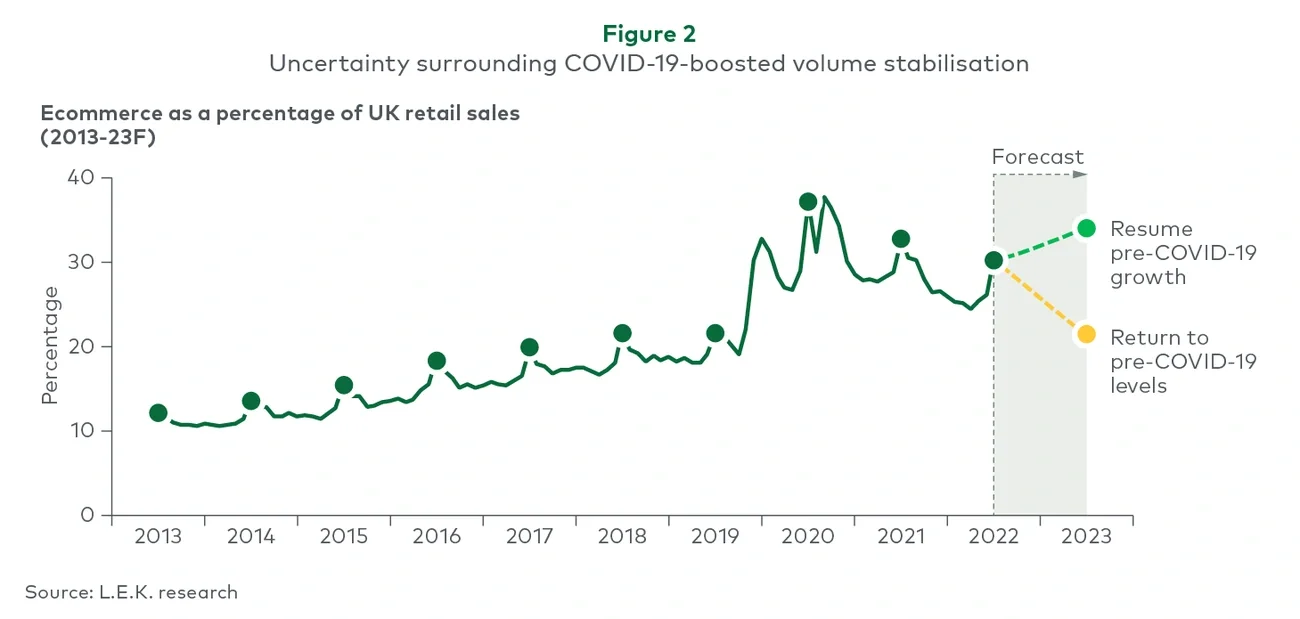
The reliability of last-mile delivery and service quality is likely to affect whether consumers continue to shop as much online, given the news about Royal Mail strikes and recent press about the performance of parcel delivery firms in the UK.
Uncertain cost outlook with volatile fuel and shipping prices
The average container freight rate increased fivefold between May 2020 and January 2022, reflecting a mixture of rising fuel costs, increased port congestion, and the imbalance between global demand and supply. Freight prices have since declined by c.75% this year as congestion has eased, and rates for China to the US West Coast have returned to pre-pandemic levels.
However, global shipping rates are still double 2019 levels, and it remains unclear how prices will stabilise, particularly in the face of increasing inflation and decreasing consumer confidence.
The declining volume of goods shipped due to lower demand is alleviating the congestion and pushing down rates even more. Further to this, shipping lines have used this cash cow of excess capital from the past one to two years to order new and bigger vessels, and the anticipated net increase in supply will place additional pressure on rates. The industry has gone through a boom-and-bust cycle before. Will this be a repeat of history?
Whilst the conditions described above clearly present a challenge for the logistics sector, they also provide opportunities.
Correctly configuring the freight network and delivery ecosystem to match future demand will have significant rewards for whoever gets it right.
For example, at times of increased concerns about reliability, those who can guarantee on-time delivery will gain share. This is true across logistics, for ports, rail freight and last-mile delivery service.
With significant cost pressures throughout the economy, those who can innovate operating models and leverage new technology to keep costs down will be able to offer lower prices and invest appropriately to enable future competitiveness.
When customers want to diversify their supply chain and start sourcing from elsewhere, being the best-placed potential partner will allow disruption of the traditional incumbent.