Effective functional blinding and minimisation of expectancy
Ensuring functional blinding is a core focus of late-stage psychedelics companies; unintentional unblinding can invalidate the outcomes of an entire study. Numerous companies have identified this as a focus area, sharing publicly their strategies to overcome it.
One approach is the use of three-arm trial designs across several doses with active placebo comparators. Use of subtherapeutic doses decreases the likelihood that participants will know whether they have received the therapeutic dose or not, mitigating the risk of unmasking (compared to inert placebos that do not have psychoactive effects). Recruitment focused on psychedelic-naive patients can further minimise this effect, as planned by Cybin for its upcoming Phase 3 trial.
Thorough masking of the study team can also minimise any potential expectancy. Remote, independent and blinded outcome assessors, who do not have knowledge of the dose received or the participants’ dosing experience, will reduce any bias in the conduct and interpretation of results.
Considering the potentially significant impact on data validity, many companies are leveraging multiple blinding approaches to manage this risk. Usona Institute and MindMed have also reported use of blinding/expectancy questionnaires to assess whether this has occurred.
Mitigation of the confounding effect of psychotherapy
Many psychedelic therapies, including all current Phase 3 assets, incorporate psychotherapy to enhance patient outcomes. While regimens can vary, trial participants are typically exposed to psychotherapy during some or all of the treatment regimen’s preparation, dosing and post-dosing phases.
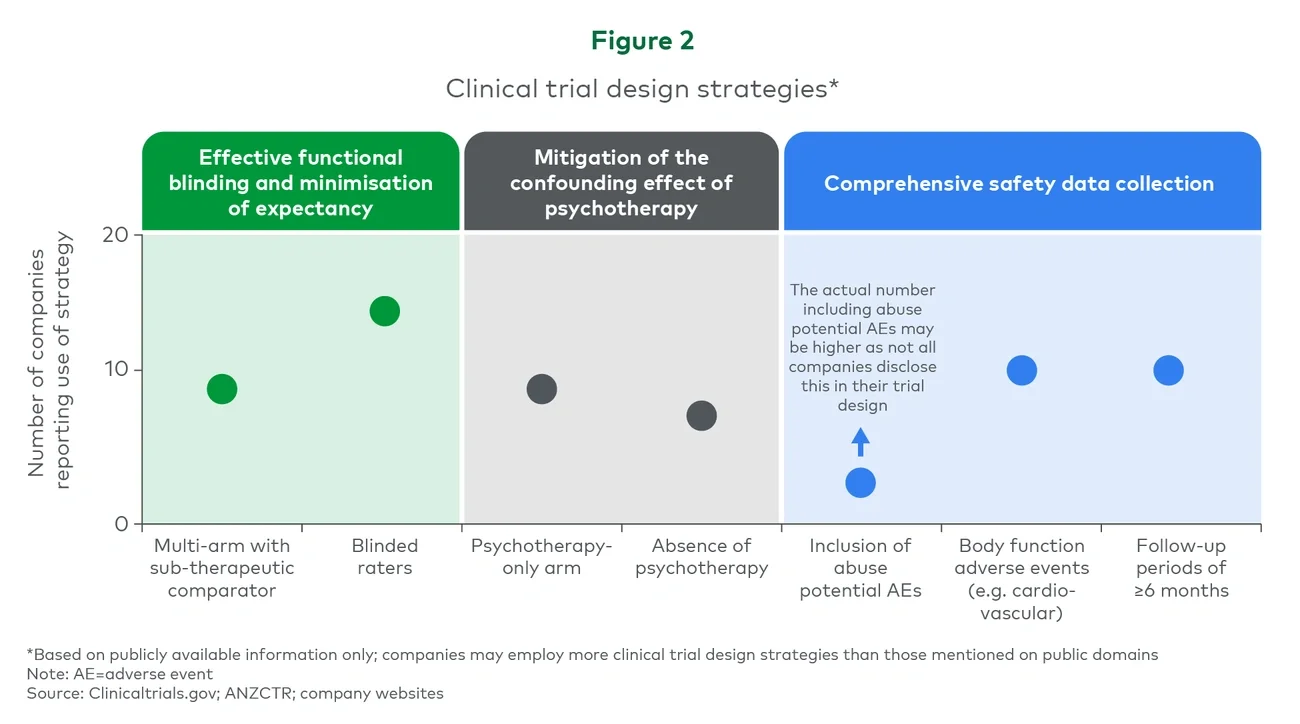
As a result, it is crucial that trial designs be structured to clearly distinguish the effects of the psychedelic compound from those of the psychotherapy intervention. Nine of the developers we reviewed are ensuring the inclusion of psychotherapy-only arms (plus placebo). AWAKN’s Phase 2 trial for ketamine in alcohol use disorder provided an example of this with two placebo arms: one with placebo and psychosocial support sessions and one with placebo and alcohol education.
Some companies have also opted for no psychotherapy elements to truly isolate the clinical benefits of the psychedelics. Seven of the companies we studied have not disclosed psychotherapeutic intervention in their clinical trial design; this is the case across a range of psychedelic types, such as LSD, DMT, 5-MeO-DMT and ketamine. MindMed has clearly emphasised that its Phase 2b trial contains “no psychotherapeutic intervention”, and atai’s upcoming Phase 2 trial excludes patients who are doing (or planning to do) psychotherapy.
“We had actually gone back and forth on that [psychotherapy] …. I think a lot of the benefit of these compounds comes from sort of, internal work, if you will. You uncover some things and you can process them yourself.”
— Srinivas Rao, co-CEO, atai
Comprehensive safety data collection
Given the current status of psychedelics as controlled substances, companies are also ensuring they put patient safety first in their trials.
Psychedelic companies are capturing comprehensive safety data, including broader body function data such as cardiovascular outcomes. This is particularly the case following concern from the FDA’s PDAC about potential cardiovascular and hepatoxicity issues in Lykos’ MDMA therapy. MindMed, for example, is capturing electrocardiogram parameters and planning a dedicated thorough QT study to measure cardiac rhythm.
Adverse events relating to abuse potential, such as euphoria and hallucinations, are also important in the context of psychedelics. However, it is not well disclosed how many companies are integrating this into their trials.
Furthermore, companies are using extended follow-up periods to monitor efficacy, durability and long-term safety. Of the companies we studied, 10 are implementing follow-up periods of six or more months. This will help detect any delayed side effects that may not have emerged during the initial study and provide an opportunity to assess long-term risks.
Conclusion
The psychedelics field remains in its infancy, and there are still many unanswered questions regarding the best research approach. As late-stage psychedelics emerge from the pipeline, additional clinical trial design strategies are likely to surface, as well as future FDA guidance to ensure the validity of these complex trials.
Ultimately, whether the implementation of these strategies will satisfy the FDA and other regulatory bodies remains to be seen. However, we remain hopeful that at least some of the concerns raised by the PDAC and FDA can be addressed satisfactorily.
Please contact us to discuss developments in this space further.
L.E.K. Consulting is a registered trademark of L.E.K. Consulting LLC. All other products and brands mentioned in this document are properties of their respective owners. © 2024 L.E.K. Consulting LLC