
Navigating the complexities of today's markets has made it harder than ever for private equity (PE) funds to deliver on expected investment returns. Continued uncertainty about the macroeconomic outlook in an inflationary environment has put many company valuations under pressure. With dealmaking outpacing exits in recent years, and the higher costs of capital now impacting deal economics, we’re seeing an overall slowdown in exits. Paired with the pressure to invest committed capital from limited partners, this presents several challenges for PE funds.
More than ever, PE funds must develop a strategic and robust plan that delivers operational value creation during the asset’s holding period.
At L.E.K. Consulting, we work closely with mid- and large-sized PE funds and have recently observed a shift in strategy from focusing on multiple expansions to prioritising operational value creation.
This article outlines the cornerstones of L.E.K.’s Value Creation Playbook, which supports PE funds with a structured, proven approach to rapidly identify value creation potential across commercial, operational, cash conversion and transversal levers. Identified and quantified initiatives are then consolidated into actions for the asset’s management team to implement.
How does L.E.K.’s Value Creation Playbook add value?
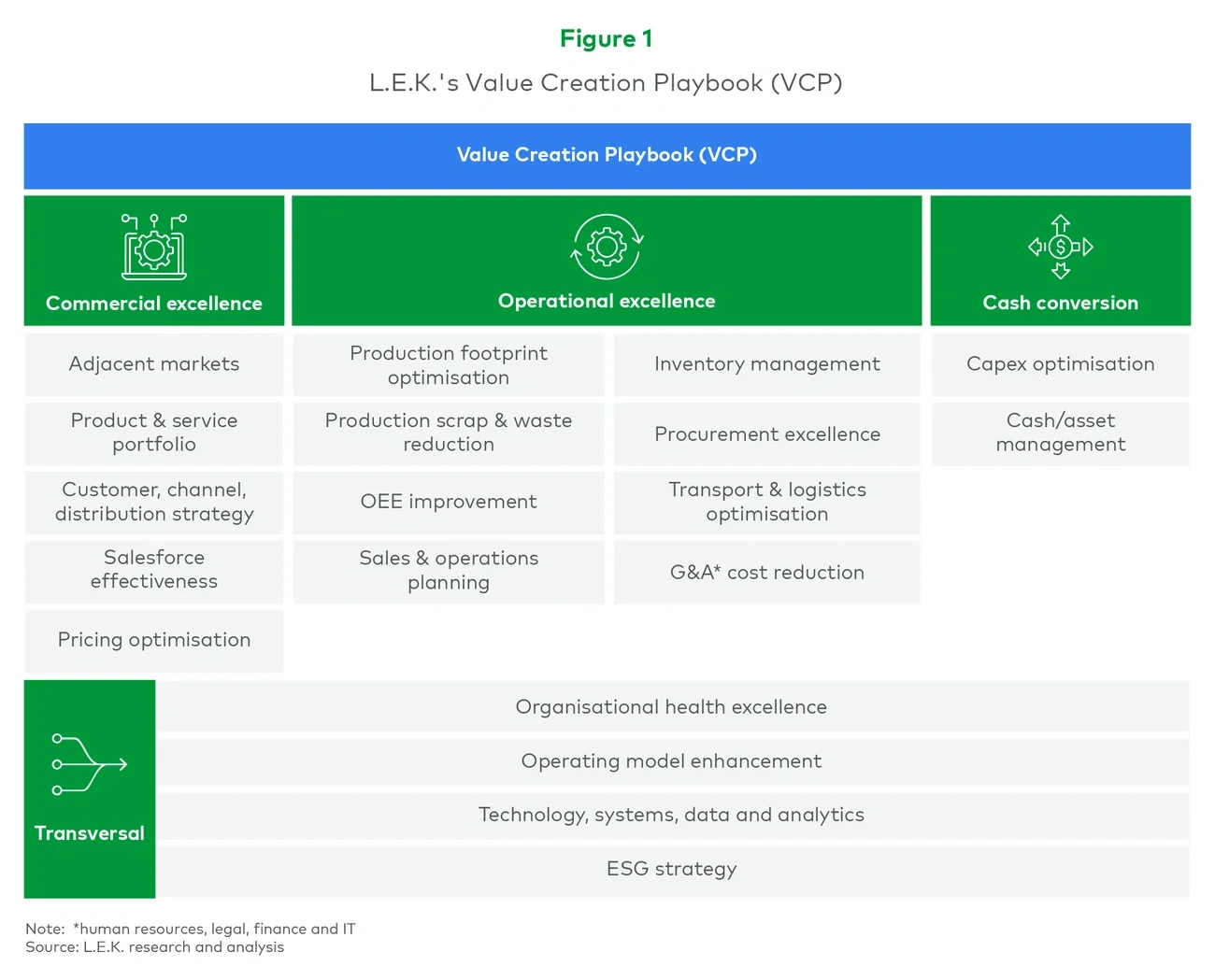
L.E.K.’s Value Creation Playbook is based on our experience working with PE funds and understanding the time criticality of one key question: ‘How can we create value with this asset?’ As Figure 1 illustrates, the Value Creation Playbook has four dimensions:
- Commercial excellence: Identifying adjacent market opportunities; optimising the asset’s product and service portfolio, taking into account customer requirements, and defining a targeted customer and distribution channel strategy; increasing overall salesforce effectiveness; and looking at the pricing optimisation potential.
- Operational excellence: Optimising the overall production footprint, including scrap and waste, and outlining additional overall equipment effectiveness (OEE) improvement potential; increasing efficiency in sales and operations planning processes or inventory management; leveraging cost potential through an optimised procurement and/or transport & logistics function (including processes); and highlighting general and administrative cost reduction potential across human resources, legal, finance and IT.
- Cash conversion: Liquidity is one of the most important measures, if not the most important one. Therefore, we analyse the potential in capex expenditures optimisation as well as cash and asset management.
- Transversal: The Value Creation Playbook has the most impact when the right operating model and organisational structures support the execution, enabled by the right technology and integrated systems fostering data-driven decision-making. Outlining a clear and overarching ESG strategy is also essential to achieve higher EBITDA multiples when exiting an asset.