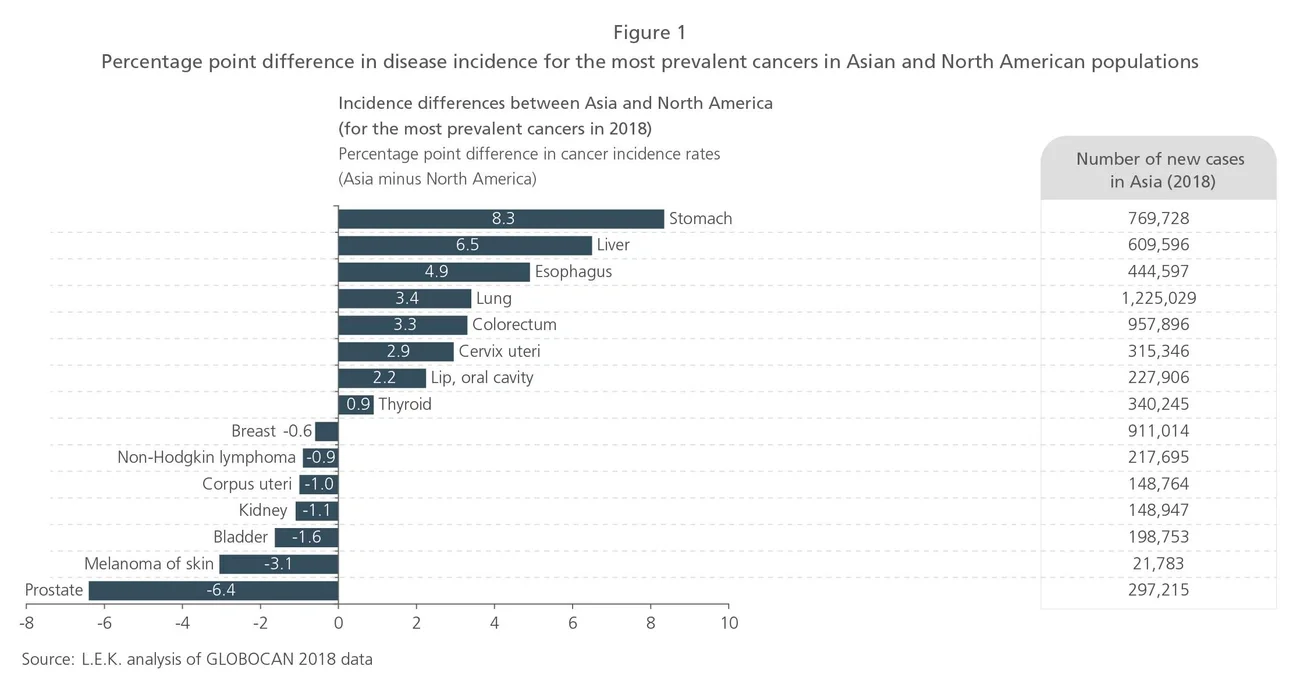
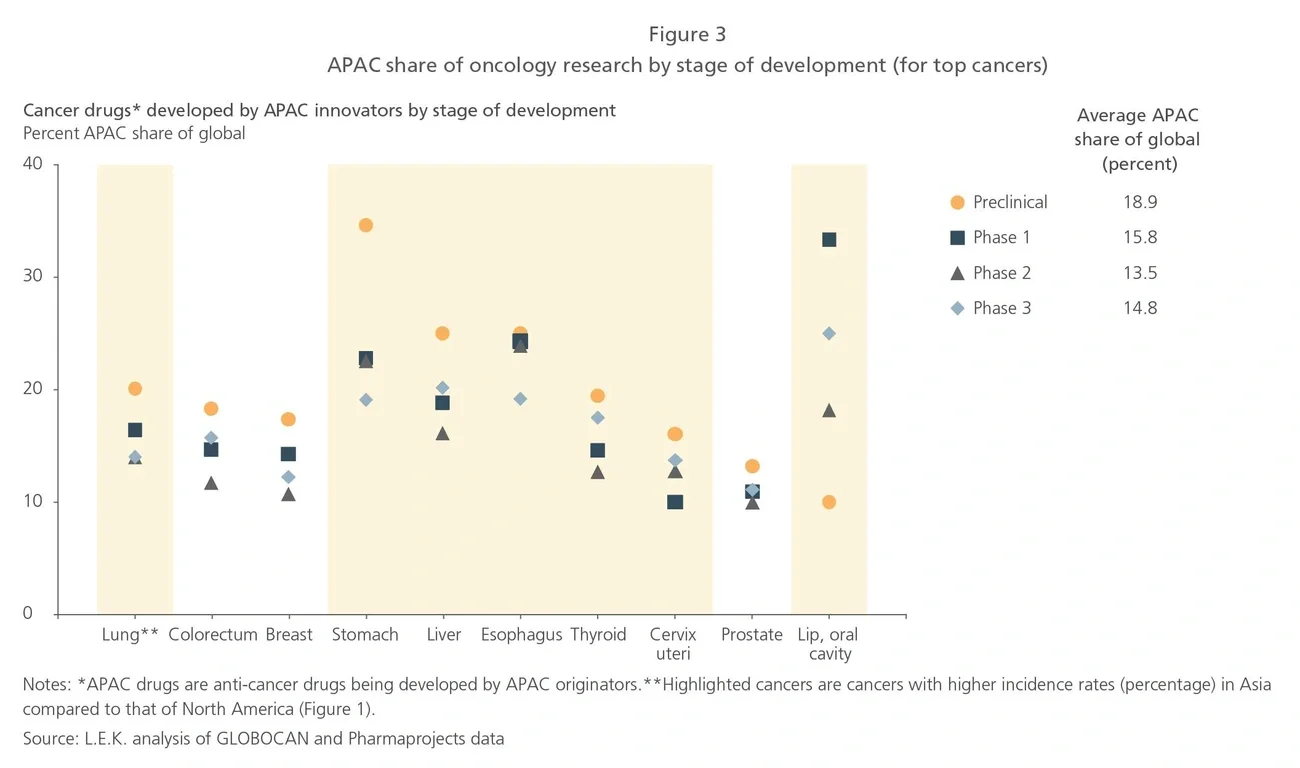
Leading the charge for clinical therapeutics research in APAC are Japan, China and Korea; more than 80% of innovative clinical therapeutics that enter the drug registration phase over the next three to five years are expected to come from these three countries.4 Australia and Singapore are also making significant investments in the development of first-in-class antibodies and differentiated treatment mechanisms for APAC-prevalent diseases.
China’s progress in recent years is a testament to the untapped potential that APAC-led innovation represents. With an enormous cancer burden, China has an oncology drug market that is expected to reach $18 billion by 2023.5 To address the massive need for clinical therapeutics, the Chinese government has accelerated its efforts to support indigenous innovation in biotech. There has been long-term policy support for the industry since the State Council listed biotechnology as one of the country’s key industries for national strategic planning in 2007. The government also announced in 2016 a dedicated investment of $9 billion by 2030 to encourage precision medicine research.6 Motivated by strong government support, local biotech companies have rapidly expanded their R&D investment. Pharmaceutical R&D spending by Chinese firms more than doubled in six years, from $4.0 billion in 2011 to $8.9 billion in 2017, showcasing Chinese firms’ resolution to lead the way in APAC innovation.7
Singapore has also established a vibrant ecosystem to incubate drug discovery and development. With investments made to foster local biotech innovation, the country experienced a ninefold increase in biotech R&D expenditures, which grew from $15 million in 2011 to $136 million in 2016. Furthermore, Singapore has recently announced its National Precision Medicine Programme, a 10-year initiative by the Ministry of Health that aims to address the population’s healthcare needs through treatment optimization and disease prevention.
APAC, with its expanding healthcare needs coupled with rising spending power, represents tremendous opportunity. Countries within the region are already taking steps to establish local environments that can harness local talent and attract foreign investment. There is value to be generated and shared across multiple stakeholders, including industry participants that can play a substantial role in facilitating drug discovery.
Accelerating APAC-focused research
While rising local companies are making strides in developing innovative biotech solutions for APAC, several hurdles will need to be overcome for APAC-focused clinical therapeutics research to continue to forge ahead. Nontrivial among them are the needs for more R&D investment, a strong pool of talent, and an ecosystem and infrastructure that can support innovation.
- Increasing R&D investment: Pharmaceutical R&D expenditure invested in APAC continues to be small, comprising only 3% of global R&D spend in 2017, whereas 78% of spend was in the U.S. For APAC to speed up innovation, an injection of funds will be essential. These funds would support not only drug discovery, but also the effort to translate research into a marketable asset.
- Boosting R&D talent: Overcoming global competition for world-class researchers requires deliberate action by public stakeholders to attract and retain talent. For example, China has stepped up efforts to attract overseas Chinese students and world-class researchers to address the gap in basic biomedical research. National and local governments offer various types of policy support to entice biopharma talents, with the incentives ranging from direct financial subsidies in Chengdu to “green channel” priority services in medical treatment, employment for spouses and education for children in Chongqing. Correspondingly, the research output from China has risen dramatically. For example, in 2017, China surpassed the U.S. for the first time in the annual number of cancer publications.8
- Strengthening the ecosystem and infrastructure: For APAC R&D to flourish, a closely integrated knowledge and technology exchange network that nurtures early phase drug development — involving public-private partnership research centers, biotech companies and academia — is essential. Progress is already underway where some APAC countries, notably China and Singapore, have developed ecosystems to incubate drug discovery and cultivate startups.
Hence, while APAC has begun to develop an innovative pool of clinical therapeutics that can treat Asian-prevalent cancers, the process of transitioning from drug discovery to clinical trials can be challenging. There are roles to play for various stakeholders in addressing these challenges, whether through public funding and policy change that can attract further investment, or through targeted investments and strategic partnerships.
Because most multinational corporations (MNCs) still anchor their strategic priorities in home markets in North America and Europe, few companies have ventured into APAC with localized therapeutic products to tap into the growing biotech potential. However, eyeing the long-term opportunity in APAC, MNCs can play a significant role in accelerating APAC innovation and, in return, can capture some of the untapped commercial value that the region represents. As innovators in the region continue to experience rapid growth, some forward-looking MNCs have already started to act. MNCs could consider a range of options.
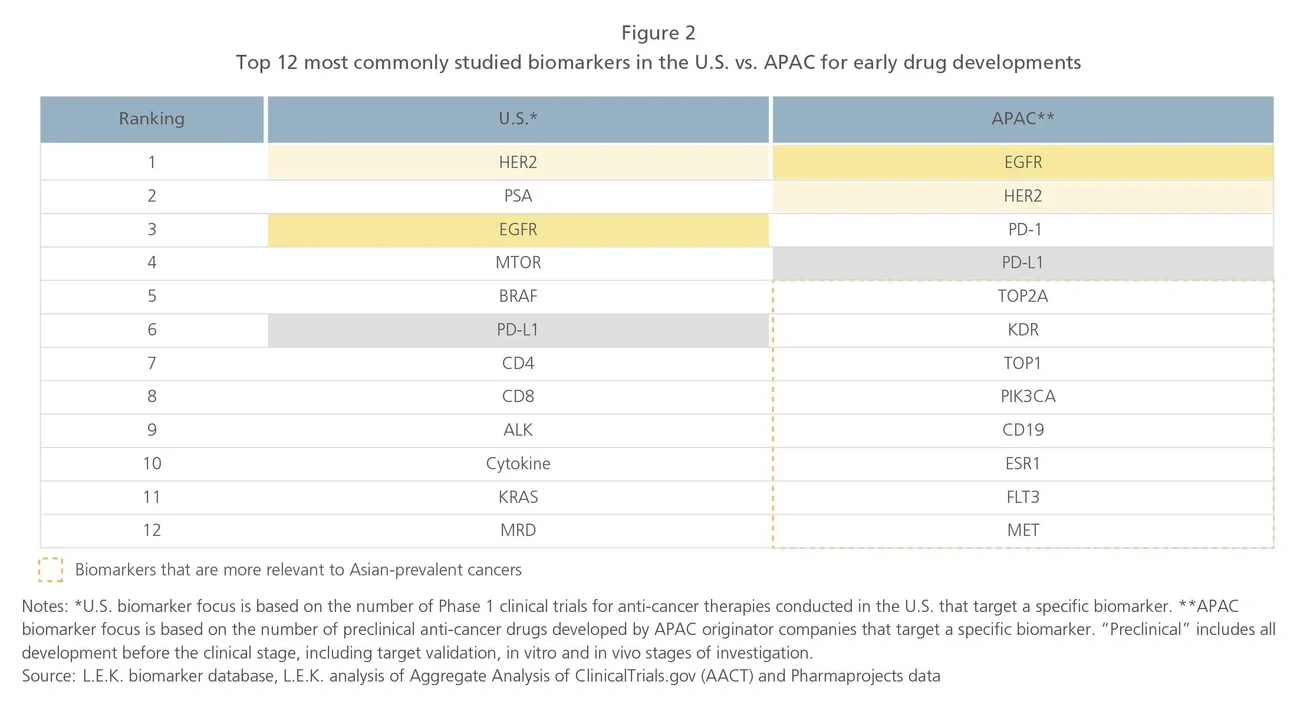
- Corporate venture capital: Provide funding for novel R&D on cancer markers that target Asian-prevalent cancers, such as colorectal, stomach, liver and esophageal cancers, where limited innovation has taken place to date. Successful venture funds in Asia include Medtronic-Sequoia China Healthcare Technology Venture Investment Fund and Novartis Korea Venture Fund.
- Accelerators: Offer time-boxed support, such as office space, mentoring, training and network-building opportunities, to speed up business development ideas and strengthen value propositions of APAC biopharmas.
- Incubators/innovation labs: Establish open collaborations with biopharmas to participate in the later stages of the drug development process, and invest financially to provide business support resources and services while working with biopharmas to build efficient and sustainable businesses over the longer term. An example is the Johnson & Johnson JLABS, which supports companies in commercializing innovations.
- Strategic partnerships: Form joint ventures or participate in co-development with biopharmas and academic institutions to gain earlier access to Asian biomarker cancer targets, bring forward development cycles and accelerate time to market. Examples include the research collaboration between BMS and Tsinghua University, as well as the strategic partnerships that Servier, AstraZeneca and Novo Nordisk have established with the Shanghai Institute of Materia Medica in China.
- Regional consortiums: Set up drug discovery departments or participate in regional R&D networks or consortiums within APAC to drive greater R&D efficiency in Asian-prevalent cancers. An example is the Asian Early Phase Oncology Drug Development Consortium formed by Japan, China, Taiwan, Singapore and South Korea, which focuses on Phase 1 studies.
- Innovation clusters: Participate in innovation clusters to provide infrastructure support to local biotech companies. This could include providing core technologies such as high-throughput screening and gene sequencing to expand R&D efforts. China has multiple government-facilitated biotechnology parks, where MNCs and local biopharmas can collaborate to support the fast-growing life sciences industry. A recent example is the government’s development plan for the Guangdong-Hong Kong-Macao Greater Bay Area, which aims to foster innovation in the city cluster for key industries including biotechnology.
Opportunities are abundant within the APAC innovation landscape, where clinical therapeutics targeted to the APAC population represent not just an underlying need, but also a significant untapped commercial opportunity. APAC innovators are already driving much of this innovation, but there is also a role for MNCs to play in accelerating clinical therapeutics research for APAC. Key considerations for MNCs in entering this space will include evaluating therapeutic focuses and prioritizing portfolios to align with APAC’s unmet needs, identifying capable local partners for potential R&D and commercial collaboration, and assessing internal expertise and talent capabilities to prepare for long-term opportunities in APAC.
Endnotes
1Zhou, W., and Christiani, D. (2011). East meets West: ethnic differences in epidemiology and clinical behaviors of lung cancer between East Asians and Caucasians. Chinese Journal of Cancer, 30(5): 287–292.
2Ibid.
3Ni et al. Identification of candidate biomarkers correlated with the pathogenesis and prognosis of non-small cell lung cancer via integrated bioinformatics analysis. Front Genet 2018 9:469.
4Ibid.
5IQVIA.
6China Ministry of Science and Technology.
7Ibid.
8Bernardo et al. The recent landscape of cancer research worldwide: a bibliometric and network analysis. Oncotarget 2018 9(55).