



The challenge
Scaling from a development-stage biotech to a fully commercial organization is a pivotal moment in value creation, but it also brings greater operational complexity and financial risk. To manage this inflection point, emerging biotechs often adopt intentionally lean commercial models, including small field teams, tight budgets, limited customer-support capacity and fragmented data infrastructure.
These choices allow companies to move fast and preserve capital, but their limitations become increasingly noticeable as the business grows. Advanced commercial capabilities become practical only when true scale is achieved — typically when a company has multiple products on the market. At that stage, organizations can fully benefit from sophisticated approaches such as broad omnichannel campaigns, vendor-driven analytics, enterprise next-best-action engines, and comprehensive patient and provider support services. Before reaching scale, however, these capabilities are often too expensive, too complex and misaligned with near-term ROI. As a result, emerging biotechs must learn to commercialize effectively with less — prioritizing targeted investments, streamlining operating models, and implementing pragmatic data and technology strategies that balance ambition with reality.
This article highlights a set of novel AI use cases, proven in large pharma, that can be adapted to smaller biotechs as they prepare for their first launch.
A focus on commercial efficiency
The promise of AI is, in part, to give smaller biotechs a practical way to narrow the commercial gap with larger pharma companies. But capturing the early value of that promise depends on focusing on a few targeted use cases — those that directly address the most pressing bottlenecks at launch.
A disciplined approach to AI enables biotechs to expand their operational capacity and impact without adding headcount.Three proven AI applications in drug commercialization consistently deliver positive returns and can be realistically implemented by biotechs preparing for their first launch.
1. Meeting efficiency and agentic field force copilots
The first suggestion is obvious. Make sure your teams have operationalized the meeting efficiency features that you probably already own! These include AI based meeting prep tools and meeting close out tools, such as transcription and CRM management features.
Beyond the basics, AI copilots can help lean sales teams operate with the efficiency of a much larger force — planning routes, sequencing HCP visits, generating compliant personalized content and linking CRM data to specific account activities. These capabilities boost day-to-day productivity, and they also strengthen the foundation for more advanced commercial processes.
One of the most important of those processes is dynamic targeting, which many biotechs rely on to find the right patients and prioritize the right accounts. Agentic copilots can enhance this system by feeding real-time signals back into the CRM targeting loop, improving both accuracy and efficiency. By drawing on broader data sources — claims, referral patterns, digital interactions — copilots can uncover insights such as predicting early adopters or emerging high-value accounts that would otherwise remain hidden.
Not every biotech needs copilot support, especially those selling into a small set of specialized centers with well-defined patient populations. But for lean field teams operating in more diffuse markets, copilots can be used selectively — for example, when prospecting beyond a core HCP call list — to extend reach without disrupting a relationship-driven model.
What the research shows
L.E.K. Consulting’s experience indicates that 10% to 15% of AI use cases deliver roughly 80% of the value, with field productivity consistently among the top drivers. Public examples support this pattern. J&J’s Rep Copilot, which manages automated call planning and routing, was one of the few pilots that proved ROI-positive. Several large pharma companies, including Takeda, Pfizer and Sanofi, have also adopted Salesforce’s Life Sciences Cloud, an agentic platform used for hyper-personalized HCP engagement, route optimization and automated sampling.
How this fits the biotech model
In a competitive landscape where large pharma sets the standard for launch excellence, biotechs can close the gap by systematically turning CRM insights into targeted, scalable commercial actions. Lean field teams can expand their effective reach by optimizing call plans, prioritizing high-value interactions and personalizing engagement through integrated CRM-driven insights.
Risks and mitigations
Buy rather than build. Start narrow (e.g., scheduling and call preparation). Ensure CRM data is clean.
2.Market access automation: Amplifying the reach of FRMs
Prompt and proactive handling of payer hurdles can shape a launch trajectory as much as prescriber willingness to adopt a new therapy. In specialty areas like rare disease and oncology, field reimbursement managers (FRMs) play a critical role in helping physicians and patients navigate prior-authorization requirements, denials, appeals and benefit verification. Yet biotechs typically have only a small FRM team, and limited support can lead to delays that put patients at risk and weaken a brand’s competitive position.
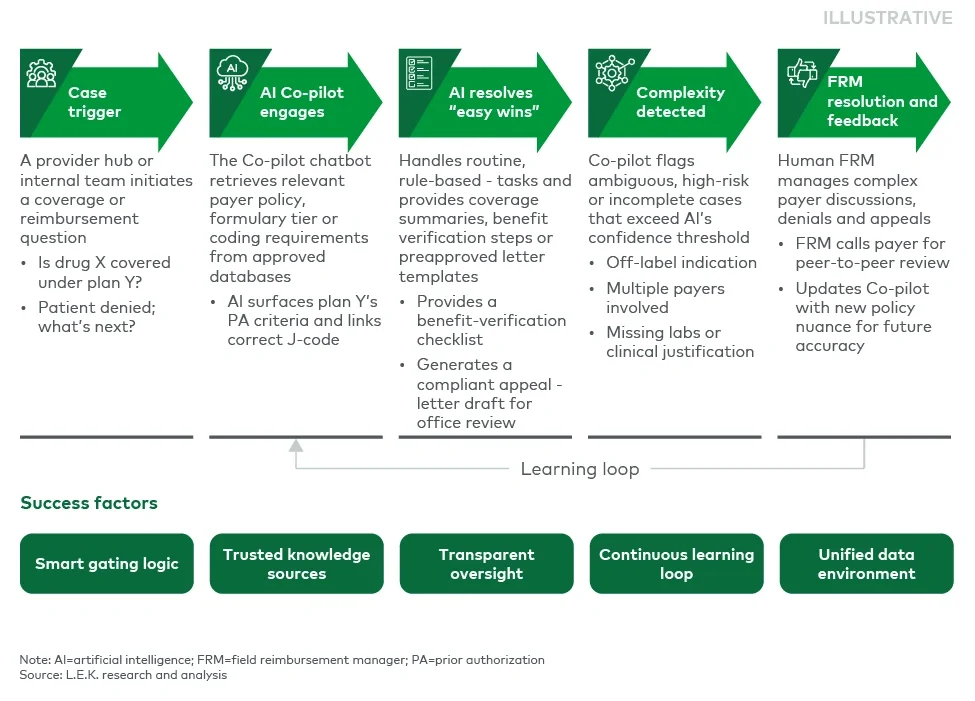
Compounding the challenge, large FRM deployments and practice support services have conditioned many practices to expect hands-on support for even routine PA steps. AI can help bridge this gap by extending the productivity and reach of reimbursement teams, enabling small FRM groups to manage more cases, support more prescribers and reduce time to therapy.
What the research says
Biotechs have several practical options for expanding reimbursement capacity through AI and automation. Many industries already use chat-based triage to route work efficiently, and similar tools can help FRMs prioritize cases. Paperwork can be scanned and basic fields auto-completed while preserving patient anonymity, and custom LLMs, as Novartis demonstrated with Alia in medical communications, can support compliance.
Existing networks such as Surescripts also enable “touchless” prior authorization and real-time benefit checks, reducing cycle times. Automation tools can pre-fill payer forms and generate real-time status alerts. And when claims are denied, AI-driven appeal solutions such as Waystar’s Altitude Create can automate appeal letters, surface insights on appeal pathways and escalate stalled cases — helping small teams manage a higher volume with greater precision.
Fit for biotechs
Instead of scaling FRM headcount linearly, AI copilots can take on the repetitive, time-consuming tasks of case management, allowing FRMs to concentrate on the complex situations that truly require human judgment. This creates meaningful leverage, enabling a small FRM team to support far more providers and patient cases across geographies.
Risks and mitigations
Transparency and oversight must be maintained. Poorly governed automation can trigger payer pushback, so all payer-facing materials must remain compliant and fully auditable. Compliance should be built early as an enterprise capability — even before a biotech’s first commercial launch — and applied consistently across new platforms.
3.Smarter commercial operations
AI can transform how biotechs access, analyze and act on commercial data. For lean organizations that cannot support large pharma’s full “customer 360” engines, the opportunity lies in adopting a focused orchestration layer that turns disparate data into clear, actionable priorities. With a disciplined approach, biotechs can own the intelligence while renting the underlying infrastructure, turning data into a true competitive asset.
Practical solutions include dynamic patient-finding and targeting tools that improve efficiency and help resolve growth slowdowns at the district or regional level. AI can also automate many of the manual dashboarding and data-management tasks that consume commercial and field-leadership time, allowing business insights teams to concentrate on higher-value analysis.
AI is likewise reshaping commercial content creation and approval. Without discipline, biotechs risk generating too much content with too little impact. Staying effective requires AI that accelerates the creation of high-value assets while streamlining MLR review and ensuring compliance.
What the research says
Industry analyses find that refreshing dynamic targeting weekly, instead of quarterly, accelerates the adoption of new insights and strengthens HCP engagement. Data and CRM providers also report that AI-enabled sales force effectiveness can significantly expand field capacity without increasing headcount.
Across our biotech work, we’ve seen business insights teams spend 15% to 20% of their time manually generating reports, often limited to lagging indicators. For a typical biotech BIA team, this can amount to one FTE each year — time and resources that should instead be focused on developing predictive insights for decision-makers.
Fit for biotechs
For emerging biotechs, the goal isn’t to replicate large-pharma complexity; it’s to build a lightweight, agile operating system for commercial execution. By owning the orchestration logic (targeting, prioritization, messaging) and renting data infrastructure, biotechs can stay nimble, scale efficiently and avoid vendor lock-in as the organization evolves.
Risks and mitigations
Start by owning orchestration and insights, not the raw data infrastructure. Ensure unified data governance (see Figures 1 and 2).
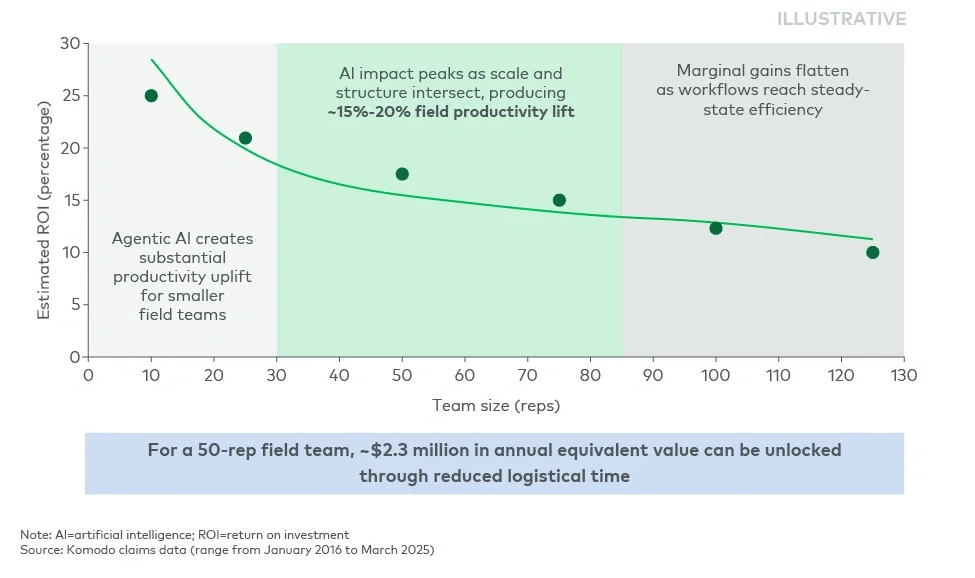
Copilots increase biotech field force efficiencies
Introducing an AI Rep Copilot can deliver substantial productivity gains. Below is an illustrative model based on conservative assumptions from industry pilots and benchmarks.