
For decades, vertical integration has been the hallmark of the insurance industry’s strength. Many carriers built closed systems and outsourced noncore processes/services to vendors governed by service-level agreements (SLAs). In many lines, insurers also relied on independent agents and other third parties as primary distribution, which further reduced direct customer interactions. While the model delivered predictable operations, these structures often left insurers one step removed from customers.
In a market that is increasingly defined by speed, data and interconnected experiences, that distance has become a competitive liability. SLAs created structural blind spots for insurers by separating vendor performance from customer outcomes. Additionally, new and expanded distribution channels (e.g., aggregators, marketplaces, consumer products) have further isolated insurers from the end customer. Without customer access, carriers are starved of the insight needed to innovate, differentiate and compete at market speed.
Legacy servicing and sales models can’t keep up. Incumbent service providers have been slow to adapt, burdened by legacy systems and a reluctance to build and sustain the partnerships needed for innovation. Their belief that emerging models wouldn’t stick has become a costly strategic misread, leaving insurers disconnected from the important moments that build loyalty and trust.
Ecosystems are now redefining value creation across connected home, mobility, health, wealth and small business. These ecosystems are interconnected networks of companies that collaborate to serve customer needs in a unified, seamless experience — often orchestrated through shared data, APIs and digital infrastructure. This model replaces fragmented, vendor-driven handoffs with aligned incentives and continuous engagement.
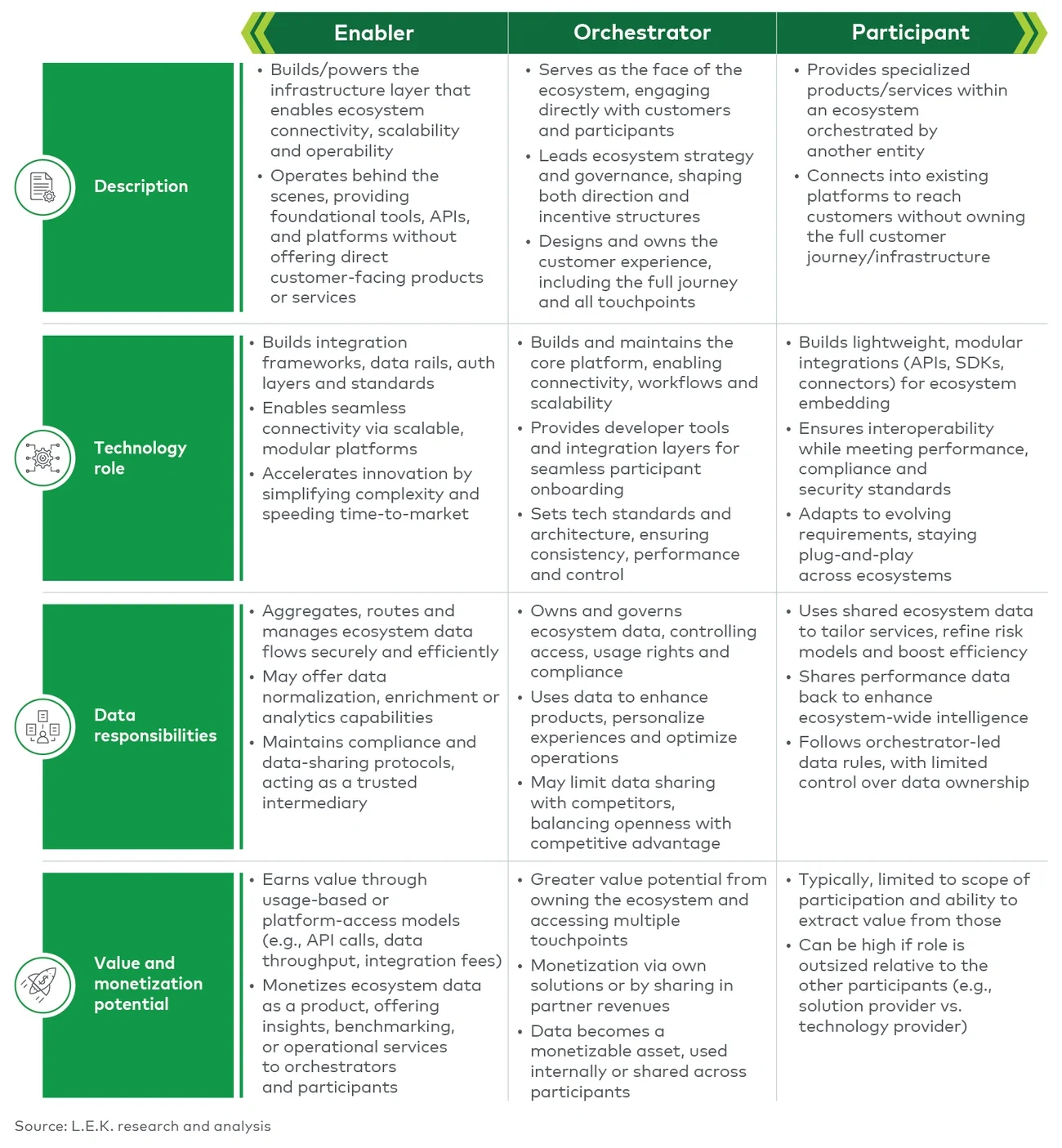
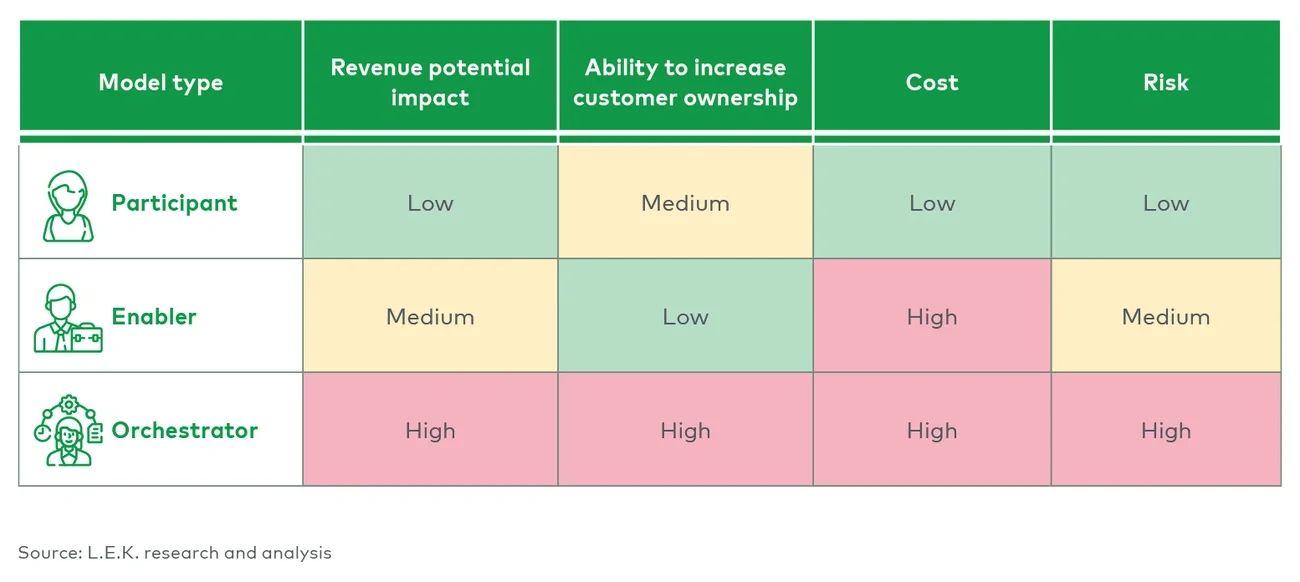
In this context, the question is no longer whether insurers should participate, but what role they will play. In this Executive Insights, L.E.K. Consulting examines the benefits of ecosystem participation, compares participation models and outlines a path for carriers to compete in a future defined by collaboration, not control.
P&C insurers must embrace partnerships to stay competitive
Historically, customers pieced together solutions on their own, buying P&C coverage here and benefits coverage there. Carriers catered to this by being product-driven organizations. Today’s buyers are different; they want solutions and experiences built specifically for them.
They’re no longer comparing insurers to other insurers. Instead, they’re holding the industry to the elevated experience and service standards set by Amazon, Uber and other digital leaders — holistic, personalized, always available, seamlessly executed and connected across a broader portfolio of needs.
Insurance companies that once dominated the industry, leveraging a vertical integration model, have lost their edge. To compete effectively now, they must overhaul operating models, integrate and update technology, and produce products that customers want. New models such as embedded distribution, usage-based offerings and integrated service platforms are reshaping how customers buy and engage. To close innovation and customer journey gaps, insurers will have to participate in ecosystems powered by strategic partnerships.
Winning insurers will stop asking “How can I serve my customer?” and instead ask “How can we, together, deliver what the customer truly needs at the moment they need it?” Insurers that continue to leverage a self-contained model will risk missing out on new customers, channels and capabilities. To capitalize, they need to stop treating service partners as vendors or interchangeable add-ons, and start seeing them as cocreators of a broader customer experience and solution, innovation collaborators and market extenders.
No insurer controls the customer journey alone. Today, success requires partnership.
Ecosystem leaders in action
These dynamics aren’t just theoretical. Ping An, Marsh and Uber are examples of how insurers can create competitive advantages by redefining their role in ecosystems.
Ping An
Ping An is one of the world’s most valuable insurance groups and has evolved into an ecosystem orchestrator serving more than 240 million retail customers. Since 2008, it has rebuilt its model around technology and connected ecosystems across financial services, insurance, banking and asset management, in addition to health, auto services and smart city solutions. This structure links internal platforms with a broad network of third-party partners to deliver more comprehensive offerings.
For example, the Auto Owner app brings together insurance functions and automotive aftermarket services, giving car owners a single place to manage claims, request roadside assistance, and book repairs or maintenance through an extensive network of external service providers. This integrated approach boosts cross-selling and retention. Customers holding four or more contracts have a 98% retention rate, far higher than single-product users.
By connecting services and channels across its ecosystem, Ping An makes it easier for customers to adopt multiple products, increasing overall stickiness.
Marsh
Amazon requires all third-party sellers to carry product liability insurance, safeguarding their businesses against costly claims or legal action resulting from defective products or accidental damage. To make coverage easier and more affordable, Amazon partnered with Marsh to launch the Amazon Insurance Accelerator. This program connects sellers with a curated network of top small-business insurers.
Through a simplified application process, sellers can obtain competitive quotes and policies that are both Amazon-compliant and tailored to their specific risks.
Uber
Uber has built a global mobility ecosystem that connects riders, drivers, vehicle providers and service partners on a single platform. Insurance plays a critical but embedded role within this ecosystem. To meet varying regulatory and risk requirements, Uber maintains commercial auto insurance on behalf of drivers, working with different insurance carriers across states and renewing these arrangements regularly so coverage aligns with local requirements. Coverage for drivers is integrated directly into the platform, activated dynamically based on trip status and usage, and designed to remove friction for both drivers and riders.
By embedding insurance into the broader mobility journey and coordinating with multiple carriers, Uber protects ecosystem participants while maintaining control over the customer experience. Insurance becomes an enabler of the broader ecosystem, not the focal point.
These case studies underscore that ecosystem success depends on understanding and reshaping the full customer journey, not just individual touchpoints.
Rebuilding the customer relationship through ecosystems
Many insurers engage at discrete touchpoints within noninsurance ecosystems such as by offering auto coverage at the point of sale. This reactive approach leaves pre- and post-interactions a mystery, driving limited engagement, inconsistent loyalty and overlooked opportunities.
Disintermediation and limited touchpoints have weakened customer loyalty. Retention can no longer be assumed; it has to be earned continuously. Insurers that continue to serve customers at distinct touchpoints, either directly or through third parties, won’t understand broader customer needs and therefore limit the value they can deliver.
In a more transparent market, customer buying power will only increase. Insurance companies must understand, anticipate and deliver against these needs to remain relevant in the new ecosystem. To be successful, these companies will need to revisit core value propositions, invest differently and commit to change.