Editor’s Note: This report originally ran on the Medtech Strategist website on May 30, 2023
Artificial intelligence (AI) will disrupt how medtech companies do business, whether or not they choose to embrace it. Organizations can either act and invest now or be left scrambling when time and resources are scant and the competition is well ahead.
AI is fundamentally a tool; there is a multitude of applications for it, and much of the challenge for your organization is to figure out to which specific use cases AI is most applicable in your organization. There are both internal applications (e.g., using AI to improve internal processes) and external applications (e.g., improving end products and services for customers). Externally, AI holds promise for further enabling the “quadruple aim” by improving patient outcomes, improving provider efficiency and costs, and improving the experience for both patient and clinician.
AI has transformative potential, and mobilizing your organization to identify high-impact opportunities, trial a few AI applications and build an AI-centric culture to guide the organization will be paramount to your firm’s success against the competition. AI applications appear endless, but to help you get started, a few key use cases for medtechs include operations, sales and marketing, and importantly, product- and service-related applications. Your firm’s first AI application may not be the most impactful one, but it will help your organization begin to build its capabilities and team for future applications.
External applications
Product- and service-related applications
AI has tremendous potential given the vast amount of untapped biometric data. This category may be the hardest to accept fully, which is why the next section outlines it in more detail. Broadly, AI is going to change healthcare in areas like real-time patient triage, image-enabled diagnostics, and cardiac and neural electroceutical therapy (i.e., cardiac rhythm management, neuromodulation). Some forms of AI will be the end product/service, while other forms will be part of the total service (e.g., services surrounding the algorithms).
If your product/device currently generates data or could one day generate data, AI should be an integral part of your strategy going forward. Devices leveraging AI may be better able to illustrate effectiveness, such as a heart monitor that more effectively detects atrial fibrillation (AF), a continuous glucose monitor (CGM) that predicts a likely patient crash based on a variety of inputs, or even an orthopedic implant that predicts and plots patient rehab recovery following a knee replacement based on physical therapy progress to course correct patient and healthcare provider (HCP) involvement more quickly.
From a service perspective for patients, AI-powered patient monitoring may substantially reduce emergency room visits (or optimize them when they occur), enhance the provision of real-time health information such as urgent care coordination (e.g., Viz.ai stroke care coordination) and improve chronic disease management.
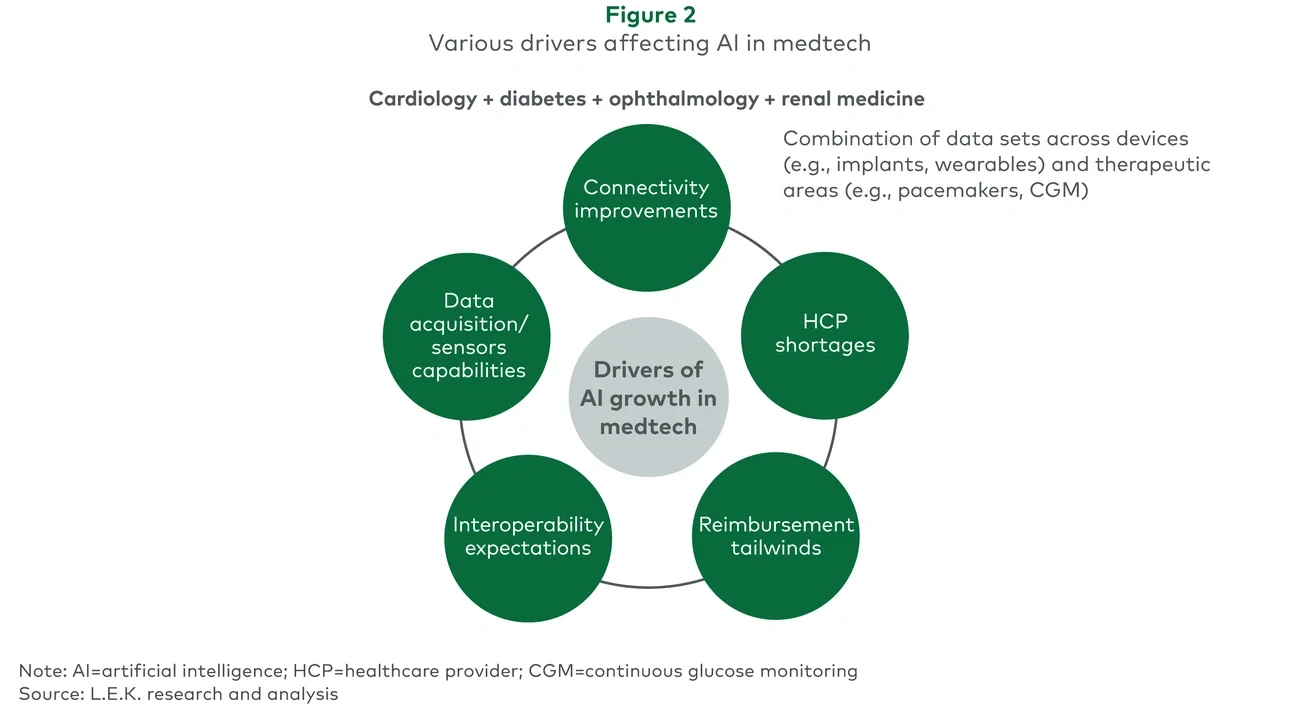
HCP shortage
As we ask doctors and nurses to cover more patients despite there being fewer HCPs, the historical hesitancy to adopt new technologies will give way to a generation of HCPs who grew up with smartphones and the internet. Insertable electronic devices (e.g., pacemakers, implantable cardiac monitors (ICMs)) are an excellent example of the use of intuitive dashboards through which vast amounts of data are being analyzed in real time and a single HCP can view their entire patient panel from a single station. As the U.S. population continues to skew older and sicker, HCPs will become increasingly reliant on — or perhaps empowered by — AI as a critical tool.
Internal applications
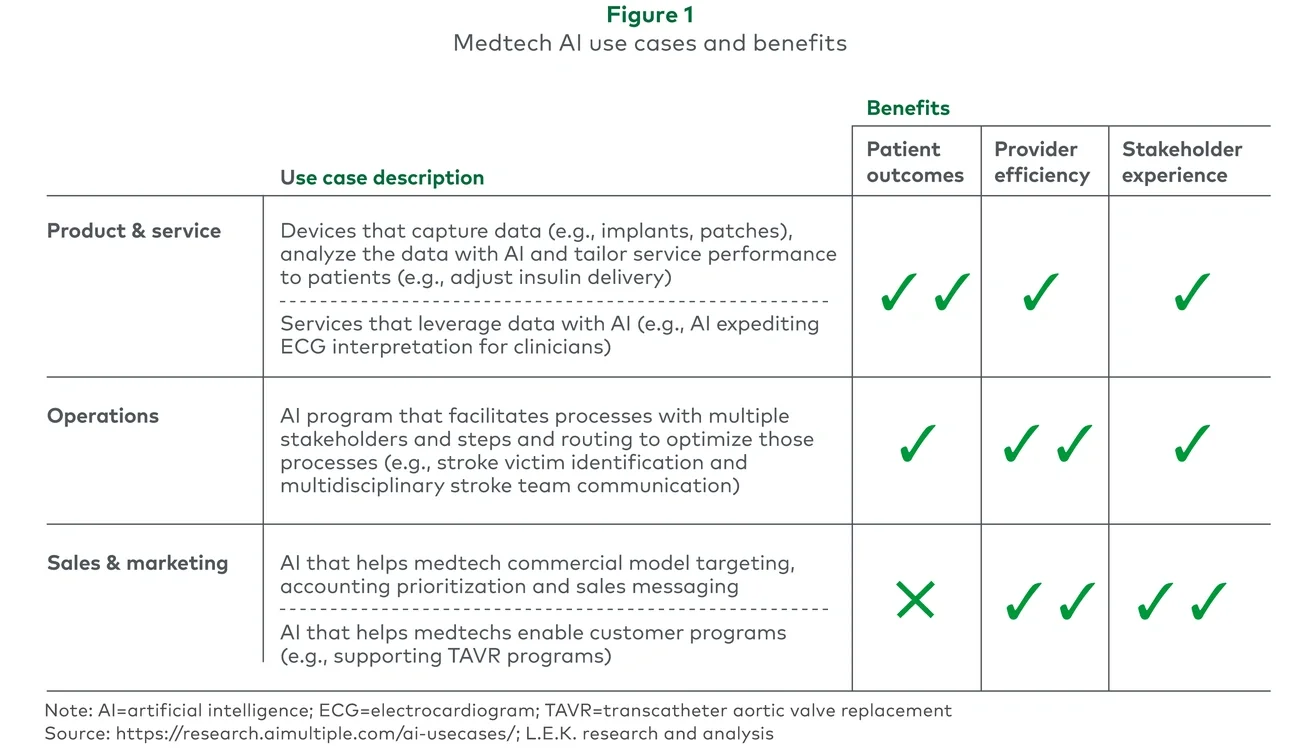
There are several internal applications for AI (see Figure 1).
Operations (e.g., Olive, Resilinc, e2open, MUUTA)
AI is well suited to operations, where processes generate vast amounts of data and repeatable, rule-based decisions or tasks occur. Examples are robotic process automation, process mining, manufacturing predictive maintenance and analytics, inventory and supply chain optimization, and even invoicing (see Medtech Strategist’s Generative Artificial Intelligence: Who (or What) Wrote This?).
Customer service
AI can be a front-line customer service tool, providing customers a better experience for faster and more fulfilling answers to their questions while also providing the classic backstop/bailout for customers who prefer to “press 0 to speak to a customer service representative.”
Sales and marketing
AI is curiously becoming increasingly relevant in sales and marketing. The potential includes sales examples such as sales forecasting, lead generation, chatbots, AI-based sales coaching for sales employees, sales analytics, faster sales quoting, expedited bidding cycles for hospital purchasing groups and even sales compensation incentives. Marketing has in some ways also been a proven testing ground for AI, and leveraging AI in marketing analytics, personalized marketing and context-aware marketing for medtech customers will be crucial to bringing medtechs closer to their customers in the future.