

In most states, managed services organizations (MSOs) let investors deploy capital into law firms without violating ethics rules that prohibit nonlawyer ownership. Recent regulatory opinions have clarified how these structures can work within existing rules.
For more on how MSOs are structured, see Part I of our series. Part II focuses on the investment case: deal economics, practice area fit and what separates successful platforms from failed ones.
MSO payment models
MSO investors deploy capital through infrastructure acquisition (office leases, technology systems, equipment, operational contracts) and growth investments (marketing spend, intake operations, business development). The MSO is compensated through a management fee defined in the management services agreement.
Two payment structures dominate:
Flat-fee model: A midsize firm generating $20 million in annual revenue might pay an MSO $18 million annually to handle all nonlegal operations. If the MSO’s actual costs are $15 million, it earns $3 million in profit while the firm retains $2 million. The fee remains fixed regardless of firm performance.
Cost-plus model: A smaller personal injury practice with $5 million in revenue might use cost-plus pricing, reimbursing the MSO for operating costs plus a 15% margin. If the MSO invests $8 million to scale marketing, driving firm revenue to $12 million, the MSO earns $1.2 million in profit. The structure remains compliant because the margin is fixed, not tied to legal revenue percentages.
The critical variable is durability. Investors underwrite the management services agreement as the foundation, typically a long-term contract with renewal and termination protections. Since the MSO fee is paid before partner distributions, successful deals build alignment through fair market value fees, scope adjustment terms and rollover equity.
Value creation at the MSO level
Returns come from two mechanisms:
Margin expansion: Operational efficiencies from standardized processes, vendor negotiations and technology deployment allow the MSO to reduce costs while maintaining service levels.
Platform scalability: Shared services across multiple firms or practice groups create economies of scale. Centralized intake, unified technology systems and consolidated vendor relationships spread fixed costs across a larger base.
Practice area characteristics determine where these mechanisms create the most value.
MSO suitability by practice area and investment criteria
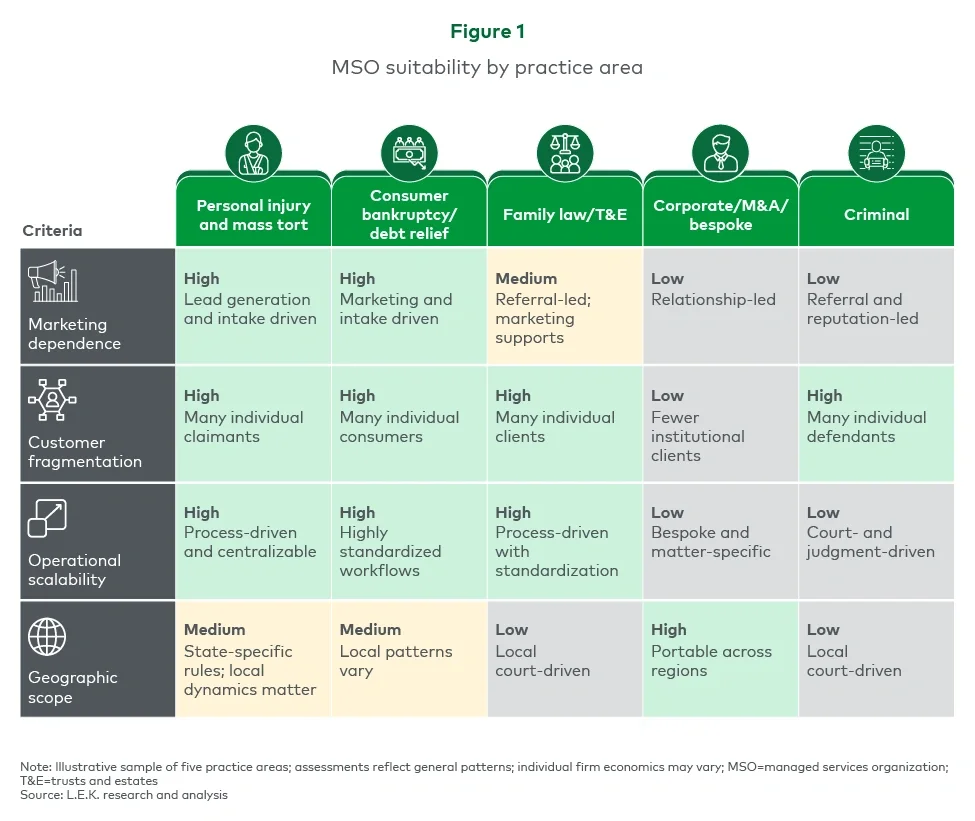
Not all legal practices benefit equally from MSO dynamics. Practice areas can be evaluated for fit across several criteria, including:
- Marketing dependence: The degree to which scalable marketing investments generate client flow as opposed to relationship-driven or referral-based acquisition
- Customer fragmentation: Whether the practice serves a high volume of individual clients or concentrates on fewer, larger relationships
- Operational scalability: The degree to which workflows are repeatable and can be standardized across cases
- Geographic scope: Whether the practice can operate across multiple jurisdictions or is tied to local courts and relationships
Evaluating a nonexhaustive sample of practice areas illustrates how these criteria shape MSO fit (see Figure 1).
High-fit practices
High-fit practices share common characteristics. Practice areas such as personal injury, mass tort, consumer bankruptcy and debt relief combine marketing-driven demand, fragmented customers, repeatable workflows and sufficient portability to support centralized services. Other practice areas with similar characteristics may also demonstrate strong MSO fit.
The “programmatic plaintiff” model illustrates this dynamic. The MSO centralizes intake, marketing, case screening and shared services, while the law firm focuses on execution. Significant costs such as advertising and working capital sit with the MSO without triggering fee-sharing concerns.
Low-fit practices
Low-fit practices typically involve bespoke work, partner-dependent outcomes and relationship-led growth. Practice areas such as corporate M&A, complex commercial litigation and Big Law-style advisory work demonstrate these characteristics.
Criminal defense faces additional structural constraints, including heightened court scrutiny, tighter regulation of marketing and economics, and strong local dependencies.
Family law and trusts and estates sit between these extremes. Marketing plays a role and workflows are partially standardizable, but local court dynamics limit scalability.
MSO case studies and diligence risks
The MSO model is still emerging. Recent transactions show how the structure is being deployed:
Rimon PC entered one of the first notable MSO deals with Alpine Investors, which invested in an MSO (NovaLaw) that took over firm operations in 2021. The structure provided capital to modernize technology while preserving lawyer-partner equity. Rimon’s CEO later characterized the deal as a success, citing it as evidence that MSOs can fund legal tech growth while aligning investor and lawyer incentives.
Certum Group, a Texas-based litigation finance specialist, launched Certum Legal Solutions in October 2025 following the acquisition of an MSO, partnering with several mass tort firms on a fee-for-service basis. The move reflects growing investor interest in MSO platforms within high-volume consumer practices.
Cohen & Gresser explored private equity financing in late 2025 via a $40 million convertible note that could convert into MSO equity, illustrating how firms can bridge capital needs ahead of a fully established managed services entity.
Failed MSO structures: Lessons from the legal and healthcare sectors
Regulatory failures provide cautionary tales.
UpRight Law operated a nationwide bankruptcy business where nonlawyer staff handled significant client interactions with inadequate attorney supervision. The Department of Justice found this led to misleading practices. UpRight paid over $300,000 in consumer relief and was barred from representing bankruptcy clients in Montana for six years.
Avvo Legal Services operated a platform in which clients paid Avvo for legal services, Avvo paid participating lawyers and the lawyers paid Avvo a marketing fee. State bar authorities raised concerns that the structure involved impermissible fee-splitting or referral arrangements, and Avvo ultimately discontinued the service in 2018.
Cautionary tales also exist in healthcare. Envision Healthcare, Northfield Medical Center and Orthodontic Centers of America all faced challenges when their MSO structures exerted de facto control over professional decisions or extracted economics that functioned like profit-sharing.
At the same time, healthcare MSOs such as Heartland Dental (backed by KKR, supporting 1,800-plus locations nationwide) demonstrate the model works at scale when professional independence and arm’s-length economics are rigorously maintained.
Success factors and warning signs
MSOs succeed when they offer operational expertise beyond capital and work within high-volume practices needing infrastructure discipline. They fail when investors prioritize quick exits over firm culture or when agreements drift toward impermissible control. Red flags for due diligence include:
- Pressure for profit-linked compensation
- Influence over lawyer hiring
- Terms edging toward nonlawyer ownership or control
- Weak compliance controls
- High attorney departure risk
- Structures where lawyers have minimal equity
- Key person concentration without retention protections
What this means for MSO investors
Investors evaluating these opportunities should consider several factors:
Practice fit. The strongest returns come from high-volume consumer practices with marketing-driven growth, repeatable workflows and business-to-consumer economics. Practice areas including personal injury, mass tort, consumer bankruptcy and debt relief fit this profile, allowing centralized intake, data-driven case screening and standardized operations that create measurable value at the MSO level. Bespoke advisory work presents structural challenges.
Deal structure. Investors buy equity in the MSO, often alongside partner rollover equity. Capital gets deployed to acquire nonlegal infrastructure and fund growth through marketing and intake operations. Returns come from recurring management fees, margin expansion and platform scalability. Because the MSO fee is paid before partner distributions, alignment mechanisms are critical to prevent attorney departures. Regulatory compliance must be rigorous and jurisdiction-specific.
Diligence. Regulatory scrutiny focuses on operational reality, not legal structure. Investors should underwrite the MSO’s contracts, nonlegal assets and management fee cash flows. Understanding where value gets created, how talent is retained and whether the separation between law and business is genuine separates viable platforms from regulatory exposure.
As we’ve covered in this two-part series, legal MSOs offer investors a regulatory-compliant path into an attractive and growing market. L.E.K. Consulting helps investors evaluate opportunities in legal and compliance markets, assessing deal fit, structuring diligence frameworks and supporting M&A decisions.
Reach out to discuss how we can help.
L.E.K. Consulting is a registered trademark of L.E.K. Consulting LLC. All other products and brands mentioned in this document are properties of their respective owners. © 2026 L.E.K. Consulting LLC
02272026140245