
The legal services market is large and fragmented and generates consistent demand. Yet law firms have historically underinvested in technology and back-office infrastructure, operating more as attorney-led partnerships than modern service businesses.
This underinvestment is becoming harder to sustain. Client acquisition has grown more competitive, technology expectations have risen and compliance requirements have expanded. But traditional partnership structures constrain the capital needed to keep pace.
The barrier has been regulatory: ABA Model Rule 5.4 restricts nonlawyer ownership, fee sharing and control of law firms across most U.S. jurisdictions. Rather than wait for those rules to change, firms and investors have organized around them through managed services organizations (MSOs).
Momentum is building. Uplift Investors formed Orion Legal MSO with Dudley DeBosier Injury Lawyers in 2025, and legal industry observers report that roughly a dozen MSO deals closed in 2025, primarily in personal injury and mass tort practices.
L.E.K. Consulting has written previously about alternative business structures (ABSs), which allow direct equity investment in a handful of states. But MSOs remain the more established pathway, working across jurisdictions without requiring new regulatory approvals.
The legal MSO model: Definition and context
The MSO model originated in healthcare, where regulations prevent nonphysicians from owning medical practices. MSOs emerged as a workaround: A separate entity handles administrative functions while physicians retain ownership and control of the clinical practice. The structure has since scaled across dentistry, ophthalmology and other healthcare specialties.
In the context of legal services, an MSO is a separate operating company that provides back-office services to a law firm under a long-term management services agreement. Under this agreement, attorneys control all legal work while the MSO owns and runs the business infrastructure, typically handling marketing and intake, technology and data systems, finance and accounting, human resources (HR) and recruiting, facilities and procurement, and administrative operations. The MSO often employs and sets performance metrics to manage the firm’s entire nonlegal workforce.
How MSOs differ from ABSs and traditional outsourcing
ABSs allow direct equity ownership in law firms, whereas MSOs maintain separation; investors own the MSO entity, which contracts with the attorney-owned law firm to provide services.
Traditional outsourcing handles discrete tasks such as payroll, information technology (IT) support or bookkeeping. MSOs take over the entire business side: all back-office operations, technology infrastructure and administrative functions under a single long-term contract.
Some platforms, such as Federate, Legal Back Office or Delegate.Legal, provide MSO-like operations through an outsourced service model. Investor-owned MSOs are built around an investable entity with long-term contract economics.
Law firm functional taxonomy and MSO structure
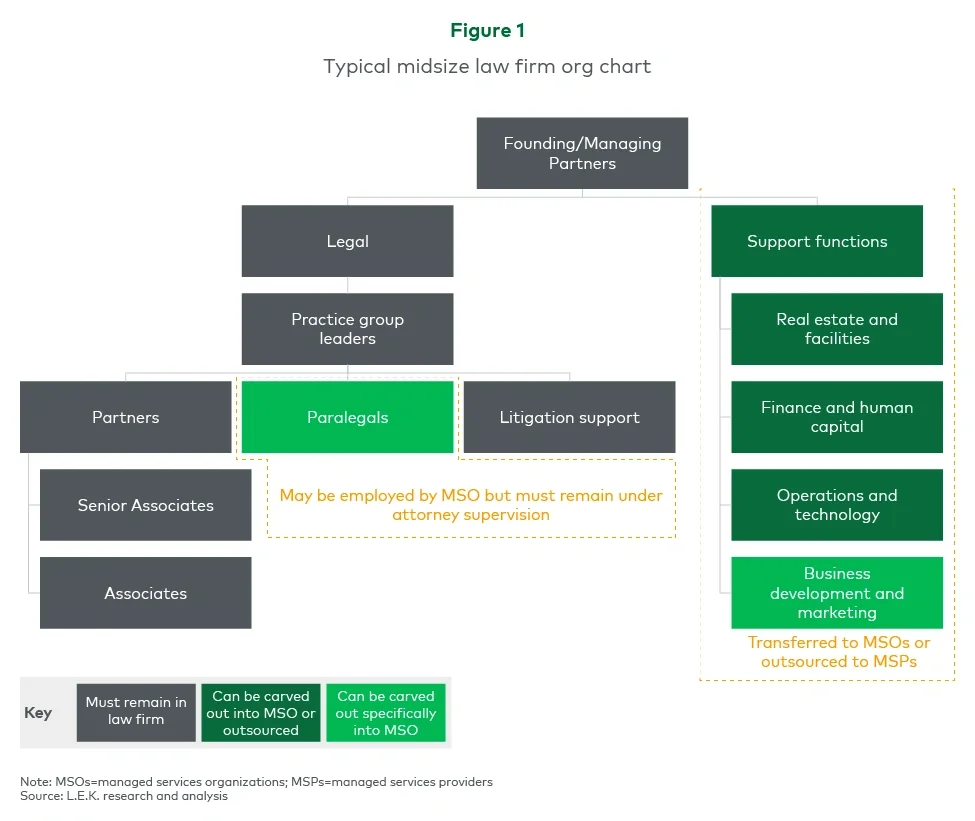
Law firms operate across six functional areas. Under the MSO model, legal work and attorney-supervised roles remain with the firm. Everything else moves to the MSO: marketing and intake, technology and data systems, finance and accounting, HR and recruiting, facilities and procurement, and administrative operations.
These functional areas break down as follows:
- Legal delivery and professional judgment. All attorney work, legal strategy, case decisions and supervision of substantive legal work must remain with the attorney-owned law firm under ABA Model Rule 5.4.
- Client relationships and regulated activities. Client engagement agreements, client files, trust accounts and conflicts management must stay with the law firm because they involve fiduciary duties that cannot be delegated to nonlawyers.
- Business development and marketing. Lead generation, intake operations, call centers and advertising spend can move to the MSO. Synergies emerge from scale, data infrastructure and specialized expertise that many firms cannot build internally.
- Operations and technology. IT systems, case management platforms and process automation can move to the MSO. Synergies come from centralized purchasing power and access to specialized technical talent.
- Finance and human capital. Accounting, HR, recruiting, payroll and benefits administration can move to the MSO. Synergies include economies of scale in benefits negotiation and centralized payroll systems.
- Real estate and facilities. Office leases as well as equipment, facilities management and vendor contracts can move to the MSO. Synergies arise from bulk purchasing and lease negotiation leverage.
The paralegal question. Paralegals sit at the boundary. They may be employed by the MSO but must remain under attorney supervision from the law firm and cannot provide independent legal advice. North Carolina State Bar guidelines confirm that paralegals can be employed by entities other than law firms as long as they perform substantive legal work for which a lawyer remains responsible.
The organizational chart below illustrates how these functional areas split between the law firm and the MSO in a typical midsize firm.