What value does simplification drive?
Simplification drives operational performance improvement, transformational outcomes and growth enablement for F&B manufacturers:
Simplification as a performance improvement and cost unlock
Proper complexity management can unlock value by improving E2E performance:
- By optimizing the portfolio and product changeovers, a manufacturer identified a 60 basis point margin uplift, primarily through labor and waste reduction.
- An F&B manufacturer realized 25% savings by bringing case packing in-house, reducing interplant movements and reliance on contract manufacturers.
- Simplification efforts enabled a manufacturer to target high-overuse product lines and stock-keeping units (SKUs), creating opportunities to improve gross margin by 500+ basis points.
Simplification driving transformational outcomes
The identification and management of bad complexity enables businesses to prioritize investments that drive transformational outcomes:
- Portfolio simplification freed up capacity at a manufacturer and allowed them to internalize a previously contract-manufactured product, lowering external costs while improving agility and control.
- A simplified product portfolio helped an F&B manufacturer strategize allergen labeling and align the offering to optimize allergen management in production.
- Following simplification, a food business unit was able to reallocate resources to accelerate digital transformation initiatives, transitioning from firefighting to leading the company through the digital change curve.
Simplification enables growth
Capacity and resource constraints often prevent businesses from pursuing new product innovation and other critical growth opportunities. This challenge is magnified in complex product portfolios where resources are diverted to support poorly performing SKUs. By eliminating bad complexity, businesses can focus on new growth opportunities through innovation and new product offerings:
- An F&B manufacturer eliminated underperforming seasonal SKUs to focus on fewer, high-performing SKUs in high seasons and new offerings in underpenetrated seasons, enabling a key retailer to change its end-cap configuration and increase sales.
- Simplification enabled a manufacturer to combine three product lines into one new line that resonated more strongly with consumers.
- Capacity that increased through simplification enabled an F&B manufacturer to launch new variety packs that met consumer demand and opened access to additional retail channels.
How L.E.K. Consulting’s simplification capabilities help clients create value
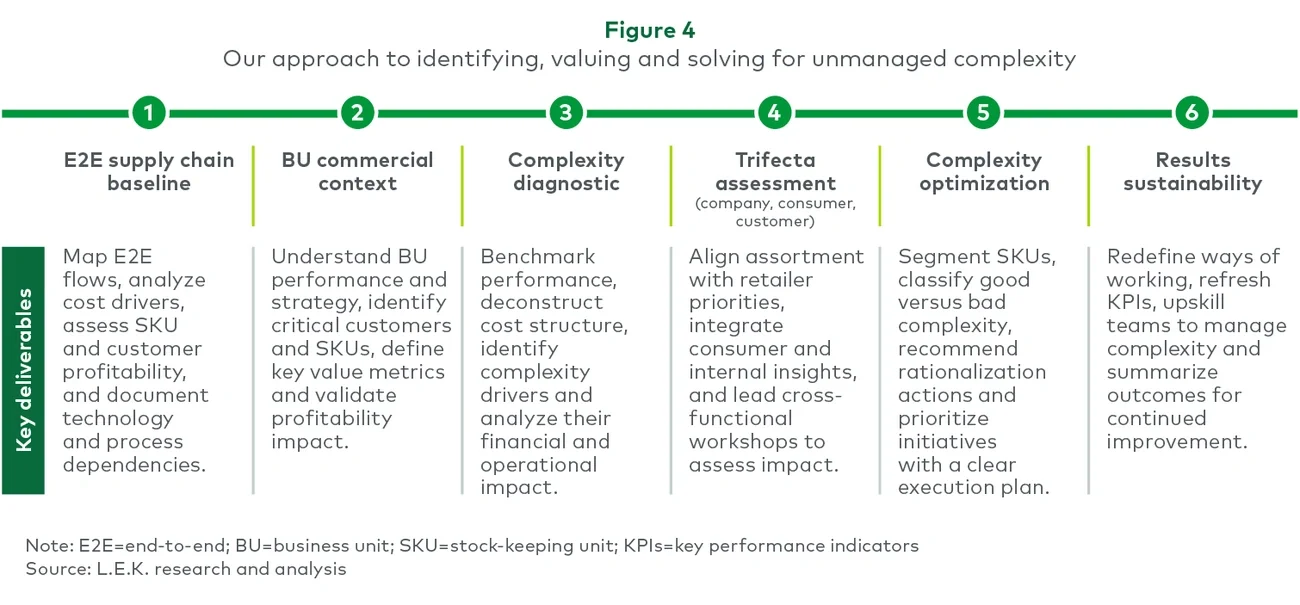
We take a collaborative and data-driven approach to identifying and addressing unmanaged complexity. We work closely with clients to baseline the E2E supply chain and establish commercial context, enabling us to quantify the quantitative and qualitative drivers of complexity for each business unit.
Using a tailored complexity composite scoring framework, we diagnose complexity and integrate findings with consumer and customer insights through a trifecta assessment (see Figure 4). This process categorizes SKUs based on good and bad complexity.