

Executives and leadership teams are looking to agile as a methodology for driving organisational transformation, and as a strategy to address three critical business issues that are endemic in global companies today:
- Speed to market. Markets move fast and global competition across sectors has grown exponentially, driven by the proliferation of digital technologies and solutions. Global events also have the power to upend markets overnight and accelerate change — the unprecedented economic and social disruption caused by COVID-19 is a prime example, and further disruptions will follow.
- Organizational complexity. Many international companies have become so large that siloed operations are now ubiquitous, making it nearly impossible to establish cohesive and effective leadership. Mistakes, delays and failures are commonplace because management is too far removed from critical decision-making.
- Technological revolution. Technology is a driver of rapid change across all industry sectors. Incumbents that are slow to adapt find their business disrupted by competitors with more nimble approaches, including new market entrants. The software development industry has demonstrated to other sectors that there’s a more effective way to manage operations — one that is less hierarchical, entirely iterative, and more collaborative and team driven. The success of this approach for software developers has inspired action from C-suites across an array of industries as business leaders explore new avenues for organisational improvement.
But where to start? How should leaders think about agile, and which, if any, of the frameworks for scaling agile working methods in large organisations should be applied? These are challenging questions to answer and require a nuanced understanding of an organisation’s strategy, its internal culture and context, and the countless agile methods and techniques that have been developed over the years.
This Executive Insights is the first in a series on agile transformation and aims to show executives how agile can benefit their companies. The ensuing publications will address how to design and scale an agile transformation journey, and the different approaches companies can apply to accelerate and spread an agile mindset across teams.
Understanding agile: key outcomes and benefits
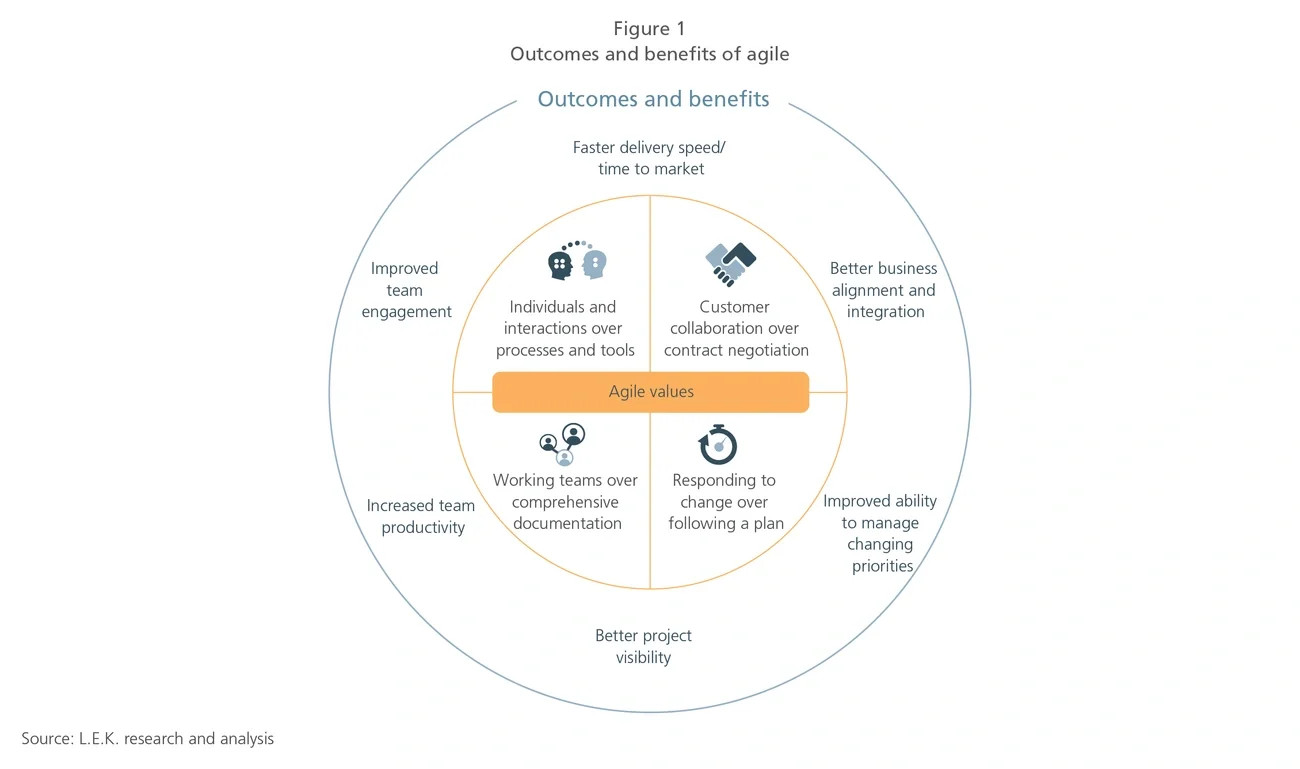
Agile was developed in 2001 in the software development industry, and its principles are defined in the Agile Manifesto. The birth and evolution of agile has been well documented and will not be covered here. It is helpful, however, to consider its key values and benefits, which largely centre on faster and more cost-effective delivery of outcomes valued by customers (see Figure 1).