OpenMarkets
The current way equipment is procured is not just inefficient; it lacks transparency and standardization. Not only can hospitals within the same health system each have different processes for capital budgeting, procurement and inventory, but they lack a scalable, systemwide equipment formulary that ensures end users (e.g., clinicians, biomedical engineering, construction management) select preferred suppliers and equipment models and are quoted the contracted prices. There is also a lack of visibility into the quote requests emanating from end users.
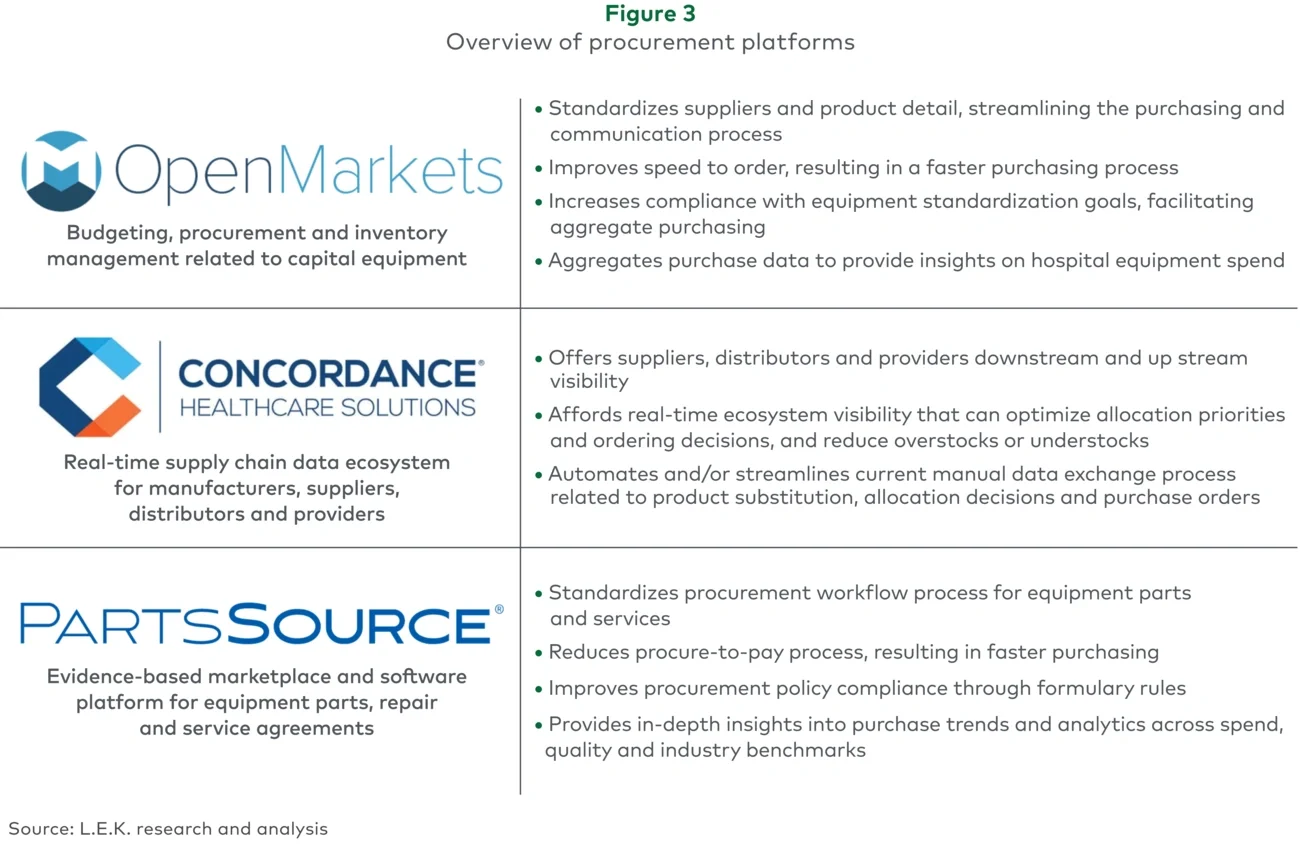
Benefits of OpenMarkets’ platform
OpenMarkets’ platform creates a true supplier-provider partnership, with benefits to both parties. For providers, it enables strategic sourcing by standardizing supplier and product detail. Doing so not only streamlines the procurement process; it also reduces rework and results in a faster purchasing process (e.g., a 15%-20% improvement in speed to order).
It also increases a provider’s ability to set — and meet — supplier compliance and standardization goals (standardized equipment is, after all, crucial to patient safety, worker productivity and the bottom line); contract compliance improves, on average, 10%-12% a year. The platform also streamlines communications and gives users the confidence that they are performing all the necessary steps accurately, as well as providing easy digital access to products and commercial support.
For suppliers, OpenMarkets allows them to manage their product information 24/7, and in an environment used by a hard-to-reach audience. Suppliers can impact provider procurement workflows, increasing both speed to order and margins, and can ensure the contract compliance of providers. The shared platform creates a range of new, real-time performance reporting capabilities to better understand what the customer is looking for and how the supplier’s team is meeting its needs.
Concordance (Surgence)
When providers have no upstream visibility into the data inventory of manufacturers and distributors, they leave themselves open to unpredictable availability and lead times for essential supplies. Meanwhile, manufacturers and distributors without downstream visibility into providers’ inventory levels, utilization and demand for products risk making suboptimal production and allocation decisions. And all three parties end up communicating in a siloed, analog, reactive and ad hoc manner to address challenges throughout the supply chain.
Concordance, together with Palantir, is building the first fully integrated medical supply chain ecosystem, named Surgence, that brings together inventory and supply chain data from manufacturers, distributors and providers into a single real-time platform. Users will be able to communicate within the ecosystem, and will have access to real-time, data-driven alerts and recommendations related to procurement, inventory management and utilization decisions. The ecosystem provides first-class data security and governance, allowing each partner within Surgence to control which data other partners in the ecosystem can see. Today, data is transformed into enriched information with real-time alerts brought to decision-makers throughout the supply chain, but in the near future, Surgence also plans to unlock the power of artificial intelligence (AI) throughout its applications as partners of the platform are ready for those next steps.
With Surgence’s offering, the network will be able to use current and historical provider and distributor inventory levels to anticipate upcoming shortages so that it can provide automated alerts — and even trigger reorders. It will also provide visibility into stocking times and capabilities from manufacturers and distributors along with inventory data from providers that will help those providers make informed supply chain decisions. It will even provide alternative product suggestions where necessary, along with insights into the quality of those alternatives. While this platform will be particularly valuable for consumables, it could also be used for procuring and managing direct supply channels, such as patient preference information, equipment and other supply channels.
Benefits of the Surgence platform
With Surgence, providers will use a single platform through which they can communicate, manage and analyze purchase orders issued to multiple manufacturers, replacing any existing manual processes. The automated alerts and/or reorder notifications they receive will not only alleviate manual work for their supply chain team, but will also reduce the number of stockouts, resulting in greater efficiency while also reducing risk. Combined with the visibility into manufacturer and distributor inventory they will receive, providers will be able to avoid overbuying, thereby reducing upfront supply costs and lowering the downstream costs of excess and expired products. Meanwhile, Surgence will allow product substitution options to be a collaborative effort in a shared application, reducing labor costs for all parties. The extensive manual research process and back-and-forth with suppliers and distributors to find substitutes will become a thing of the past.
Manufacturers will also benefit by leveraging end user inventory and utilization data to better forecast production, demand and allocation of inventory. Doing so will not only allow them to move product across the supply chain more efficiently, but also help them mitigate any potential shortages, better supporting patient care. Indeed, manufacturers today consider visibility into providers’ inventory levels to be an unmet need. Having real-time downstream supply chain visibility can help better inform demand levels and allow them to do real-time production and supply planning. It can also help them reduce lost sales for out-of-stock items through improved planning and proactive reorder management. Having more visibility into provider needs and inventory status will also allow manufacturers to more efficiently allocate products and gain visibility into at-risk sales.
PartsSource
Hospital supply chain and procurement teams source replacement parts and obtain parts from multiple manufacturers, which is time-intensive and costly — biomedical engineers can spend hours looking for a specific part. The process is also slow, requiring multiple steps, from the requisitioning process to payment to delivery.
PartsSource is an evidence-based marketplace and software platform that offers replacement parts from over 6,000 original equipment manufacturers (OEMs) and suppliers, enabling more than 5,000 healthcare providers to procure replacement parts and equipment repair services on a single platform. PartsSource integrates with health systems’ enterprise resource planning (ERP) systems and computerized maintenance management systems (CMMS), improving procurement process efficiency and promoting standardized workflows. The PartsSource Pro analytics dashboards give hospitals in-depth insights into purchase trends and analytics related to equipment parts and services. Customized dashboards enable department leaders with visibility into spend, quality data and industry benchmarks to promote data-driven decision making.
Benefits of PartsSource’s platform
As a one-stop-shop platform, PartsSource provides a streamlined purchase process that allows users to compare a wide variety of products, which makes it easier for hospitals to purchase quality parts at competitive prices. Its integration with hospital ERP/CMMS systems decreases the administrative burden, ensures necessary stakeholders stay informed, and increases efficiency by automating and standardizing the procurement workflow, reducing time to completion and saving hospitals significant time compared to the manual procure-to-pay process. According to studies conducted by PartsSource, the time per order is reduced from 89 minutes to 4 minutes with PartsSource Pro, freeing up technicians to perform higher-level work. The platform also enables standardization of enterprise procurement preferences, improving compliance and cost control.
Its analytics capability helps hospitals track spend and reduce costs by identifying the root cause of any unusual spend increases across health system. The analytics also identify missed savings opportunities and track purchases by individual employees in order to effectively manage parts spend on a granular level. Additionally, it tracks and manages inventory to help inform hospitals’ future purchasing decisions.
Suppliers also benefit from PartsSource’s platform as it provides broader access to hospital customers and systems that are beyond the reach of OEMs’ sales teams and provides access to robust portfolio analytics. Indeed, OEMs with limited distribution networks and capabilities view PartsSource as a key channel partner when it comes to gaining access to customers.
The solution is the platform
Truly effective procurement platforms such as those from OpenMarkets, Surgence and PartsSource not only save money; they save lives. They make necessary data visible, standardize and streamline the purchasing process, and strengthen the supplier-provider relationship. Hospitals can ensure the safety of their patients only when they have the right equipment at the right time. Now, more than ever, that requires the right procurement platform.
L.E.K. Consulting would like to thank OpenMarkets, Concordance and PartsSource for their collaboration on this Solutions piece.
OpenMarkets is the preeminent platform for buying, selling and managing healthcare equipment. Leading hospitals and equipment suppliers use OpenMarkets to work together, better, in the $80 billion healthcare equipment market.
For more information, please contact healthcare@lekinsights.com.
L.E.K. Consulting is a registered trademark of L.E.K. Consulting LLC. All other products and brands mentioned in this document are properties of their respective owners. © 2023 L.E.K. Consulting LLC