





This article is part of a series that analyzes key themes from L.E.K. Consulting’s eighth annual U.S. manufacturer survey. It makes clear how manufacturers can incorporate digital/artificial intelligence (AI) investment to drive differentiation.
Digital adoption in the industrial manufacturing space has moved into a new phase, with many players now investing significantly in digitizing their core business operations as well as in digital product development. These manufacturers seek to elevate the B2B customer experience, establish and potentially monetize their data tracking capabilities, and address labor availability and other operational challenges.
But given the broad range of potential digital options, manufacturing companies seeking to move up the digital maturity curve must make strategic decisions as to which opportunities provide the greatest return in light of their investment priorities.
Impact drives adoption
Industrial companies across segments are expanding their adoption of digital solutions. This expansion is being led by larger players investing significantly in digital technology that optimizes their internal processes and enhances their existing digital products (e.g., enterprise apps, customer data solutions, cybersecurity measures). For many of the digital leaders in industrial manufacturing, dedicated executive leadership is tasked with helping drive a cohesive digital strategy for their organization.
Notably, the priority level of digital initiatives tends to correlate with the adoption level, as companies have focused on adopting the solutions they perceive as having the highest potential impact on their business (see Figure 1).
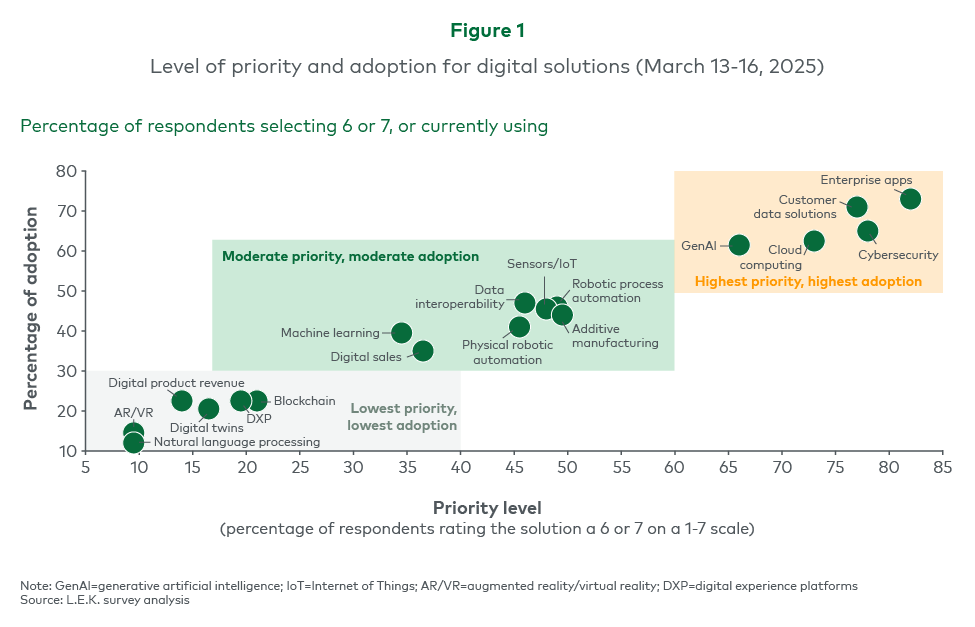
Such investments have typically supported a broader digital strategy in order to advance core competencies that maximize value creation, such as digital manufacturing, automated design and testing, cloud-based technologies, and automation of day-to-day work processes. These initiatives offer quick digital wins that prove out capabilities and set the groundwork for broader investments in areas such as AI and cloud computing.
The AI Delta
The role of generative AI (GenAI), and how to maximize its potential and effectiveness, is top of mind for many industrial manufacturing leaders. Given the new and developing nature of AI’s capabilities and related deployment among manufacturing companies, the top factor preventing AI users from realizing its full value is an imagination gap relative to AI’s potential.
The gap between these two scenarios — growth from successful AI adoption and erosion from poor strategy or execution — is something L.E.K. calls the AI Delta. The Al Delta is a value blind spot: a potentially existential unknown in a company’s prospects.
Current GenAI users fail to utilize the full functionality of their offerings because of a perceived lack of alignment with their organization’s business needs. This tendency is likely driven, at least in part, by a lack of awareness when it comes to advanced AI functionality use cases. But it presents an opportunity for more adoption of AI and, with increased education and awareness, more AI-based value creation. This is evidenced by the current focus among AI users on increasing internal efficiency via automating previously manual tasks, such as sales quotes and other back-end processes, to help drive productivity and speed (see Figure 2).
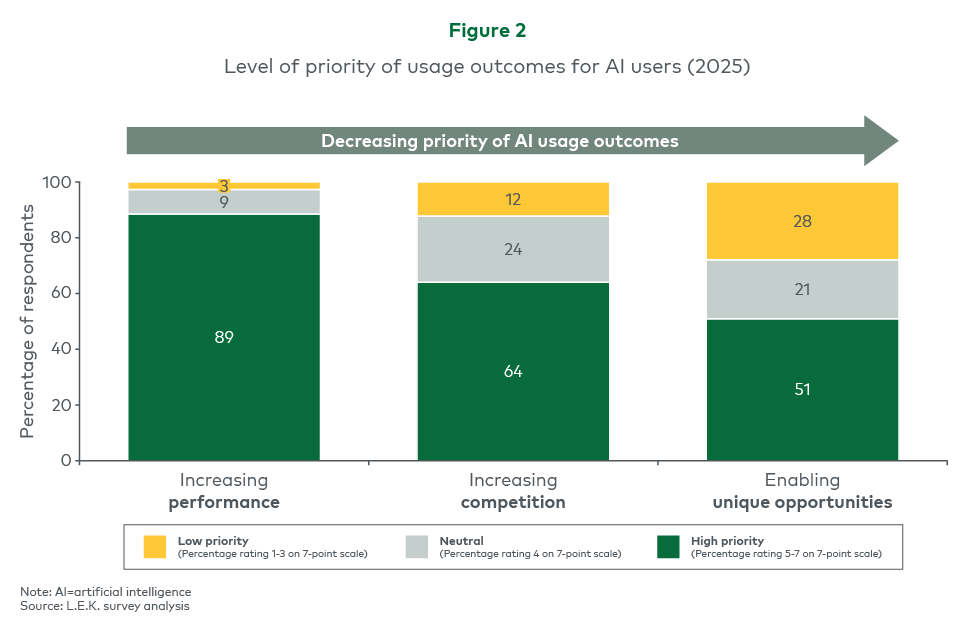
While increasing competitiveness and enabling new revenue streams are currently lower priorities for manufacturing companies, these goals are likely to attract focus as such companies become more comfortable with implementing AI and step up their use of advanced functionality.
L.E.K. has a dedicated digital industrial practice that partners with manufacturers across industrial end markets to effectively navigate challenges and opportunities associated with the digital transition. We have proprietary benchmarking tools to help companies assess their progress against digital objectives, and we partner with companies to design and execute bespoke strategies to meet short- and long-term digital goals.
For more information, please contact us.
L.E.K. Consulting is a registered trademark of L.E.K. Consulting LLC. All other products and brands mentioned in this document are properties of their respective owners. © 2026 L.E.K. Consulting LLC.
01162026140126