



For today’s health systems, patient access and system capacity are inseparable. The ability to meet community demand depends on getting both right. In L.E.K. Consulting’s 2025 Health System Executive Survey, more than 90% of U.S. executives said they face significant challenges on these fronts, from dropped referrals to workforce shortages.

These issues directly shape health systems’ growth and long-term resilience as well as the patient experience. In this edition of Executive Insights, we explore what executives tell us about the access and capacity challenges they are facing, the actions they are taking to address them and how leaders can better position their systems for sustained long-term growth.

The access challenge

Access barriers continue to frustrate hospitals and health systems, with executives citing three as most pressing (see Figure 1):

  1. Breakdowns in referral handoffs: Patients often fail to pursue follow-up or specialty care after an initial diagnosis, leading to treatment gaps. These breakdowns reflect gaps in care coordination across providers and sites and highlight the lack of consistent navigation support once patients leave the initial care setting.
  2. Outreach effectiveness: Outreach programs frequently fail to demonstrate return on investment and often struggle with patient engagement, scheduling follow-through and addressing transportation barriers. This is particularly challenging in underserved communities where the need for access expansion is the greatest.
  3. System capacity limits: Leaders see provider and site capacity constraints as a critical barrier, because patient demand is met with scheduling delays that undermine timely access to care.
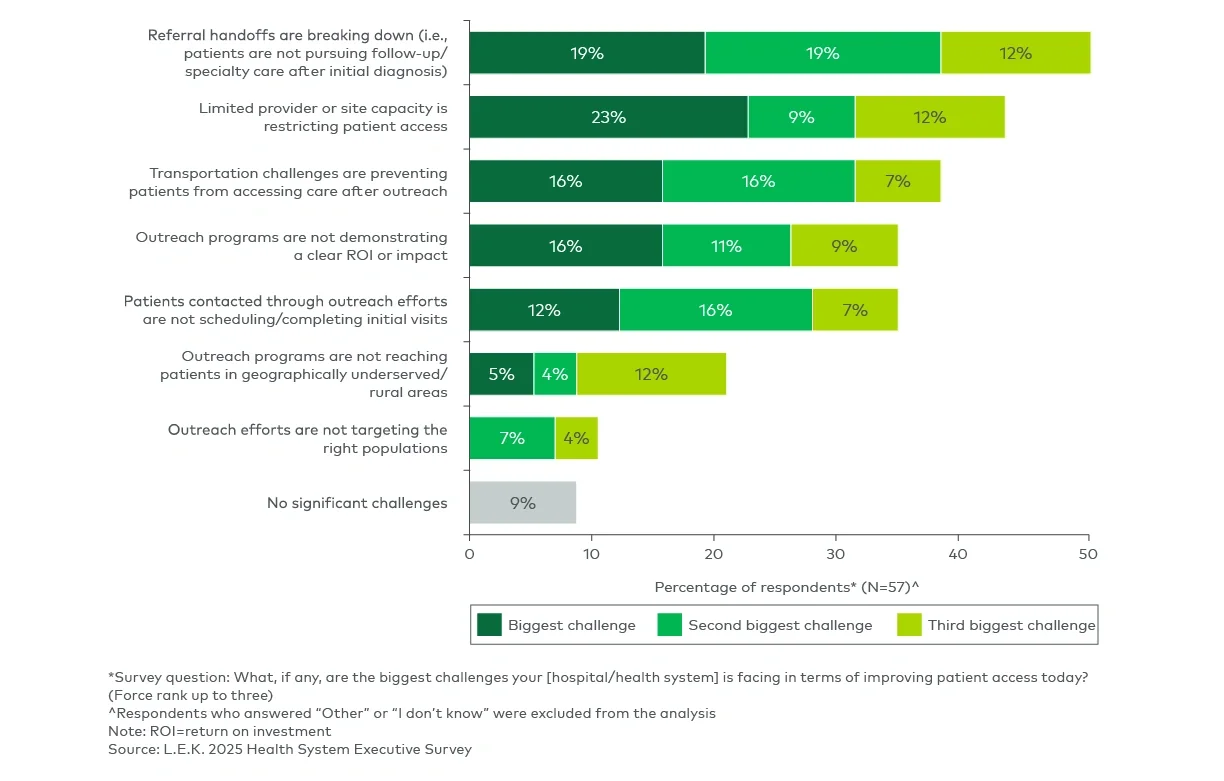
Executives see patient access as a multidimensional challenge, with barriers across coordination, capacity and outreach that ultimately shape trust, outcomes and financial performance.

The capacity challenge

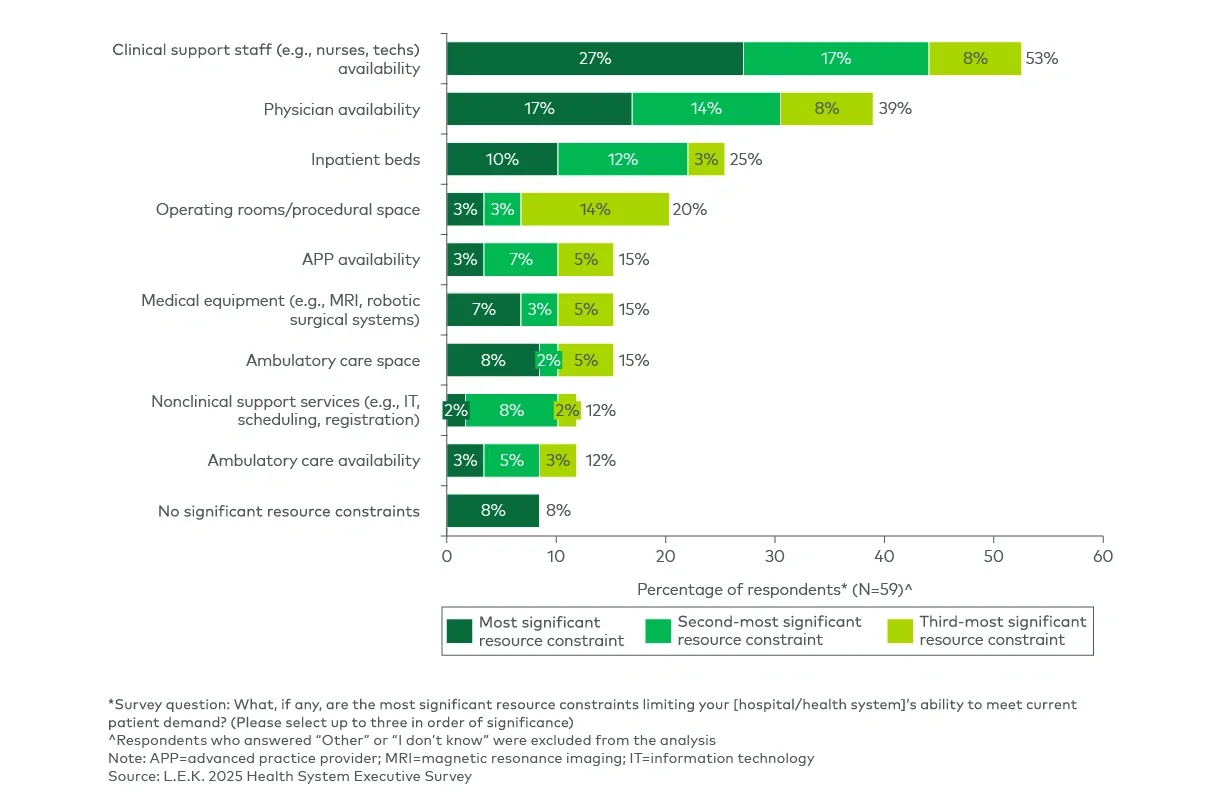
These access challenges do not exist in a vacuum. Even the most effective navigation programs or outreach campaigns can fall short if hospitals lack the staff, beds or procedural space to absorb additional patients. In our survey, executives cited two primary capacity challenges — staffing and infrastructure shortages (see Figure 2):

  • Staff shortages: A lack of clinical support staff availability was the most frequently cited bottleneck, followed closely by a lack of physician availability. Gaps in nursing and other clinical support staff roles strain day-to-day operations, making it difficult to maintain safe staffing ratios and consistent patient flow, which can force hospitals to delay procedures or divert patients. Ongoing staffing shortages also increase burnout risk for existing teams, creating a cycle of turnover that compounds access challenges.
  • Infrastructure shortages: Constrained physical assets, such as inpatient beds, operating rooms and procedural space, remain a major challenge for many systems. Inpatient bed capacity is increasingly misaligned with today’s patient population; older, higher-acuity patients drive demand that existing infrastructure cannot absorb. As a result, many hospitals face delayed admissions, emergency department (ED) boarding and/or more frequent diversions, leaving little flexibility to manage fluctuations in volume.

How are health systems addressing these challenges?

For health systems, effectively addressing access and capacity challenges is critical to improving patient outcomes while maintaining financial sustainability.

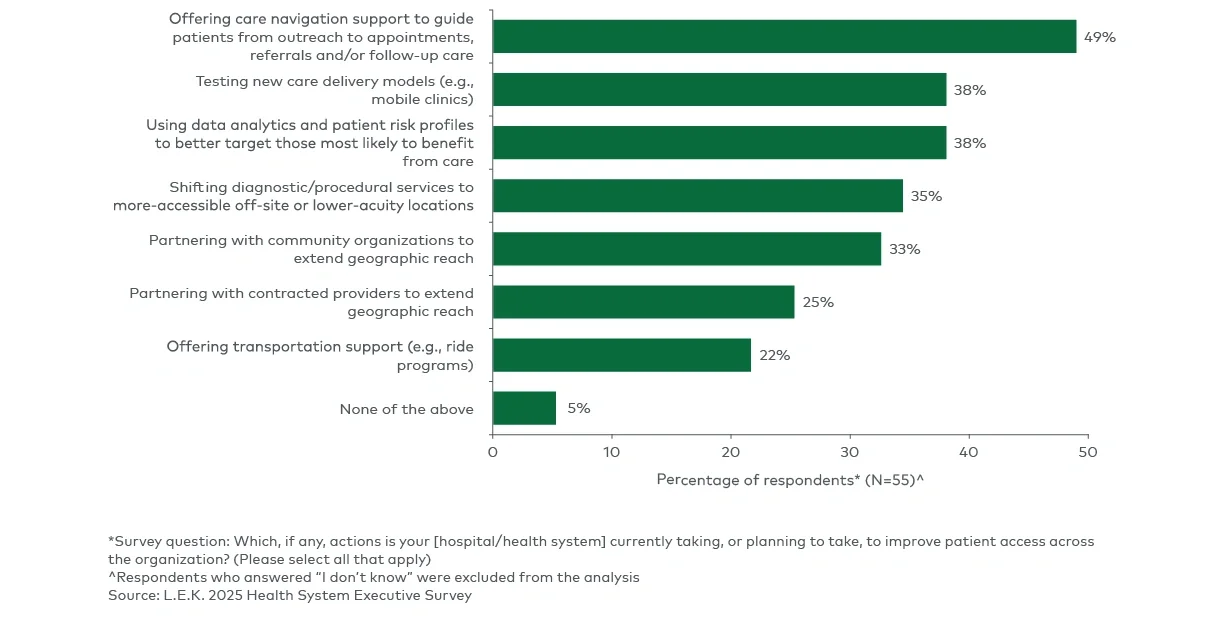
Health systems are taking a range of actions to break down access barriers (see Figure 3). The most common action is offering care navigation support (e.g., digital self-scheduling portals, automated appointment reminders, nurse or care management coordinators) to help patients move more seamlessly from outreach to appointments and follow-up care. Others are piloting new care delivery models, such as mobile clinics, to extend their reach into underserved communities. A growing number of organizations are also leveraging data analytics and patient risk profiles to ensure programs are focused on those most likely to benefit from them.

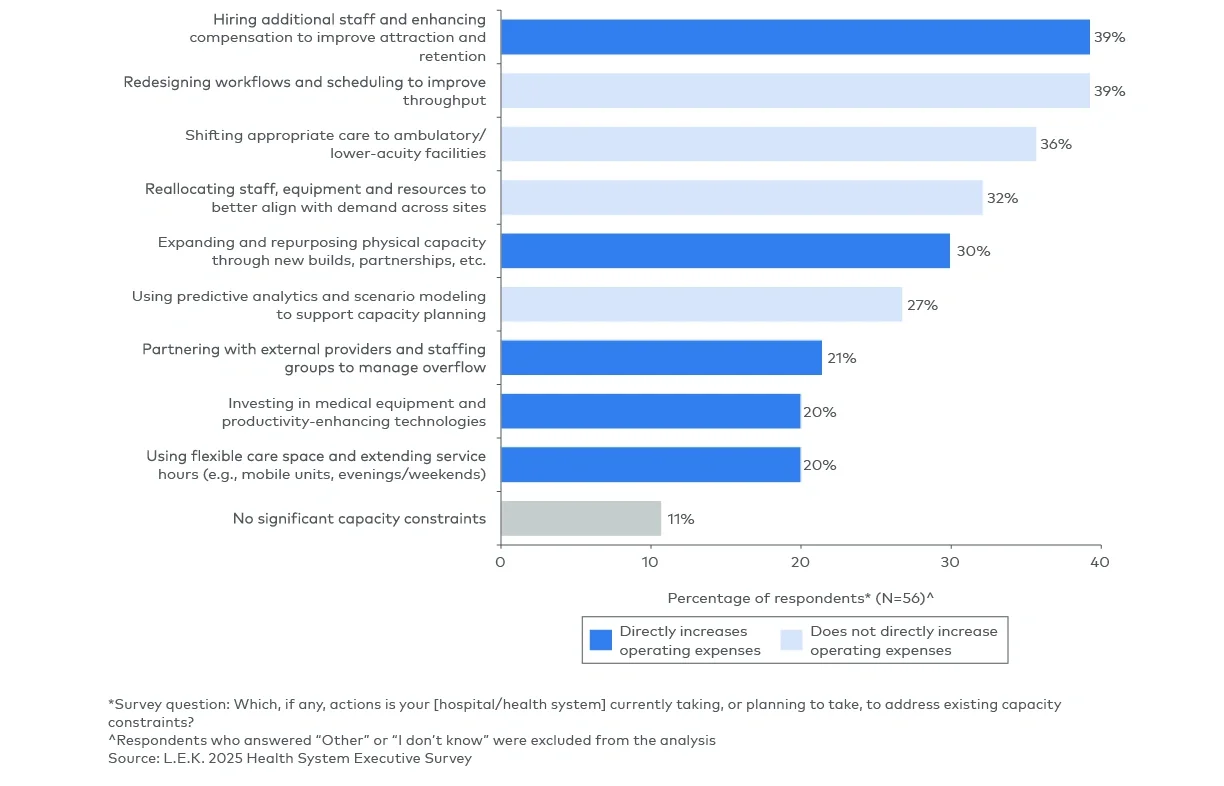
At the same time, leaders are investing in strategies to ease capacity constraint. Hiring and retaining staff remains a top priority, with executives citing recruitment and enhanced compensation as critical levers for stabilizing the workforce. Yet adding staff alone is not enough, as workforce supply remains constrained and patient demand will continue to outpace available capacity.

Nearly 40% of respondents are redesigning workflows and schedules to improve throughput, such as creating fast-track ED pathways, using artificial intelligence (AI)-driven scheduling tools to maximize provider availability and standardizing discharge processes, to ensure that limited resources can accommodate as much demand as possible.

More than a third of health systems are shifting appropriate care to ambulatory or other lower-acuity settings in order to alleviate overcrowded inpatient units. By strengthening care management and triage processes (e.g., hybrid ED-urgent care models), hospitals can ensure patients receive care in the most appropriate and lowest-cost setting based on their needs. Others are reallocating staff, equipment and resources across sites to better match demand.

Not all these strategies have the same financial implications (see Figure 4). Some — such as expanded recruitment efforts and wage increases, physician infrastructure expansions or a reliance on external staffing partners — can place additional pressure on margins. By contrast, initiatives such as workflow redesign, site-of-care shifts and staff reallocation can improve efficiency and margin performance over time.

This divergence highlights a central leadership challenge: how to pursue essential access and capacity strategies while preserving financial health. At L.E.K., we have worked with health system leaders to navigate these trade-offs, from addressing physician and human capital shortages to optimizing site-of-care models and deploying enabling technologies. Our experience shows that when margin-neutral or margin-negative moves are required, disciplined execution and complementary strategies can mitigate downside risk and set systems on a stronger long-term trajectory.

Conclusion

The goal for health systems and hospitals is straightforward: ensure patients can reliably enter the system and receive care when and where they need it. Access without capacity leaves patients waiting; capacity without access leaves resources underused. Which of the actions we’ve covered is your health system already pursuing? Which should your organization be considering next? If access or capacity challenges are on your agenda, let’s connect to discuss how your organization can take the next step.

To discuss access and capacity challenges and how we help health systems determine and execute their strategic priorities, please contact us.

The authors would like to thank Jenny Mackey for her contributions to this article.

Note: AI was used in the drafting of this article.

L.E.K. Consulting is a registered trademark of L.E.K. Consulting LLC. All other products and brands mentioned in this document are properties of their respective owners. © 2026 L.E.K. Consulting LLC

Related Insights