Shaping the pricing resilience story: Essentiality and frequency
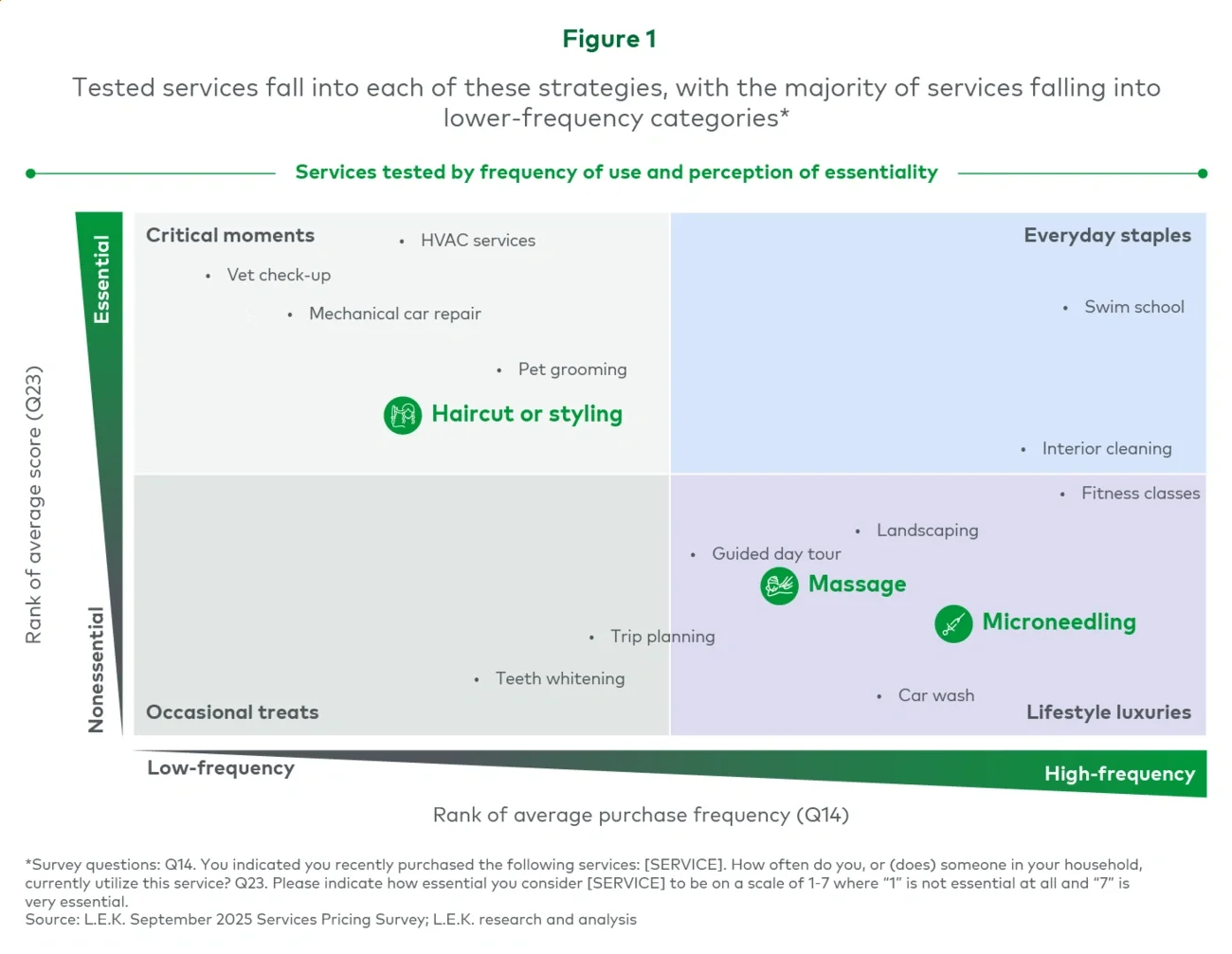
When a service is both frequent and perceived as essential (see top left “Critical moments” in the figure), it is more resilient to (although not completely unaffected by) price changes driven from macroeconomic impacts such as inflation. In these categories, the challenge is usually not whether people will still buy, but whether service providers can ensure predictable demand.
On the flip side, when a service is less frequent or more discretionary, price sensitivity typically rises because consumers have the option to delay the experience or to simply decide they can live without it for now. In these categories, it becomes less about small price moves and more about whether the perceived quality or consistency of the experience justifies the spend.
Finally, the highest-price, lowest-frequency services face the steepest drop-off when prices rise, but they deliver strong margins when value is well articulated.
This pattern is consistent with what we have seen in other fixed-capacity service domains. In a tougher macroeconomic environment, price change resilience increasingly depends not just on category, but also on how effectively businesses lock in repeat behavior and concentrate demand among their most loyal customers. For example, in the car wash sector, disciplined menu design, smart memberships and clear price governance help operators keep volume and cash flow steady, especially when inflation puts pressure on both consumers and operators.
Drivers of willingness to pay
Across beauty services, the study revealed a simple truth: Consumers pay for what feels good and what feels fair. Providers often overestimate the role of branding and underestimate the basics.
Haircuts tend to behave like a staple. They are high-frequency, socially visible and hard to postpone indefinitely without feeling the trade-off, which is why demand is typically more resilient to price changes. In practice, this means haircut pricing can often sustain demand even when prices increase. But consumers still expect the salons to be clear about what is being paid for, with whom they are booking and why one option costs more than another (e.g., stylist experience level). The opportunity is not to complicate pricing, but to reinforce predictable behavior through value structures that feel natural for a routine purchase.
Massages usually exhibit mixed results in terms of price change resiliency because they can be maintenance expenditures for some customers and indulgences and/or gifting occasions for others, even for those within the same income bracket. This also results in consumers’ dependency on consistent quality, since they will pay when the experience reliably delivers but will trade down or space out their visits when quality feels variable. In short, pricing power is earned through service quality and repeatability.
Microneedling is typically a premium, lower-frequency service, and that combination tends to create the sharpest thresholds. Consumers expect a clear value proposition — with service speed and ease of scheduling playing outsized roles — because they are making a deliberate, higher-stakes purchase rather than following a routine habit. More importantly, the higher-stakes purchase is also based on the trust a consumer has in a provider who has the experience, training and equipment to ensure the microneedling is done correctly.
For operators, this has two practical consequences. First, if service quality is really the product, then the consumers’ experience with an individual provider becomes the core economic unit because consumers will follow a person more readily than they will stay loyal to a brand. Second, if transparency is what builds trust, then unclear pricing, inconsistent inclusions and surprise fees tend to trigger immediate elasticity, even in categories where consumers are otherwise willing to spend.
A frequently missed dimension: Workforce segmentation
Beauty services are fixed-capacity businesses where the binding constraint is practitioner time, and not all time is equal. When consumer budgets tighten, the highest-performing and more experienced stylists and practitioners tend to drive outsized retention, higher tickets and greater resilience. This means pricing strategy should explicitly support their retention. Stylist capacity is not interchangeable.
For salons, this creates a clear imperative: Pricing, loyalty and scheduling strategies should explicitly support the retention of top talent, not just the acquisition of new customers. Effective talent strategies increasingly combine flexibility and earnings potential, with income covering a range that encompasses base compensation, variable upside, benefits and demand stability. Segmenting the workforce by value contribution (rather than tenure alone) allows operators to align pricing, loyalty benefits and growth investments with the stylists who most directly drive customer lifetime value and reinforce the consumer relationship with the talent and, by extension, with the salon.
Pricing strategy: One model does not fit all
Because the value perception and buying cadence are different, consumers do not expect the same pricing model across all beauty services. For haircuts, straightforward upfront pricing tends to remain the anchor, but there is a growing trend toward bundles or memberships that reward routine behavior with predictable scheduling or preferred-provider access rather than blunt discounts. For massage, multi-visit packages and loyalty tiers can work well when they reinforce consistency and reduce friction, especially if the benefits feel like access and convenience rather than price cutting. For microneedling, structured series packages can resonate with customers who want a treatment plan, while clear per-session pricing and transparent policies matter more to customers who are cautious about upfront commitments.
Across categories, loyalty programs and memberships represent a growing lever to stabilize demand, smooth revenue and increase customer lifetime value (particularly as consumers become more selective in where they spend). However, the point is not to push everyone into memberships, but to use the right mechanisms to make value apparent through features such as priority booking and preferred-provider access.
The hidden revenue engine: Add-ons and bundles
We found a striking insight in the study across all three services — consumers’ openness to add-on or ancillary services, which is a revenue lever underutilized by many providers. Add-on interest runs high across categories: approximately 47% for haircuts (conditioning, scalp treatments), about 53% for massage (aromatherapy, facials) and approximately 67% for microneedling (Botox, filler, facial upgrades). These add-ons can expand the ticket without forcing a base price increase that consumers may see as a fairness test, and they can also help operators create tiers that feel grounded in real value. Bundled services (e.g., hair + nails, massage + facial, microneedling + skincare) can help justify premium pricing while reinforcing perceived value.
In beauty, add-ons do more than drive revenue per visit. They create a way to further monetize services provided by top-tier talent while keeping an accessible entry point for newer practitioners. They also can make premium pricing feel justified because the consumer sees a fuller outcome rather than a higher line item.
What it all means for beauty operators and investors
Pricing in beauty works best when it starts with how consumers budget, and not with how operators wish they would buy. In an environment where consumers are more selective, resilience to price changes increasingly depends on building trust through transparency and ensuring willingness to pay by providing consistent quality, along with designing pricing strategies that drive demand among consumers with their go-to providers.
L.E.K. Consulting is a registered trademark of L.E.K. Consulting LLC. All other products and brands mentioned in this document are properties of their respective owners. © 2026 L.E.K. Consulting LLC