


A professionalized industry meets a new reality

Few local service sectors have attracted as much private equity interest as car washing. A fragmented, owner-operator market has been reshaped by sophisticated chains, improved branding and data-driven management. Investors saw predictable demand, scalable operations and repeatable returns.

Yet this wave of professionalization now faces a tougher equation. Inflation in labor, chemicals and utilities, coupled with rising land and capital costs, has compressed margins. Meanwhile, competition remains intensely local, with core prices highly visible from the street.  

Driving profitable same-store growth is harder than ever. Operators can no longer rely on throughput alone or blanket price increases. Instead, the winners will be those who use precise pricing architecture and membership design to optimize yield from a finite inventory of tunnel time — monetizing every hour of capacity while maintaining customer value perception.

The car wash market therefore serves as a broader case study in how fixed-capacity services — whether gyms, pet grooming or site-based leisure — can use tiering, transparency and subscriptions to balance utilization and profitability. As part of a quantitative study of consumer service users, which captured perspectives from over 3,000 U.S. consumers, we picked apart insights about the car wash market and how it compares to other services.

A lifestyle luxury that functions like a staple

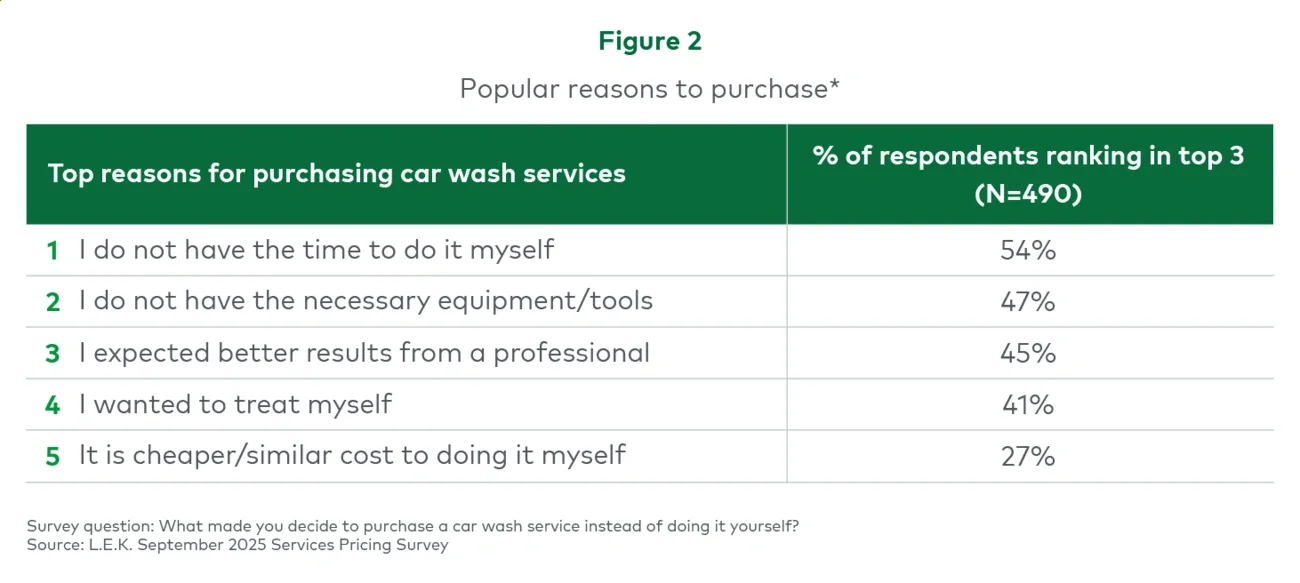
Car washing occupies a unique emotional space: a small luxury that saves time. Half of consumers say they could wash their car themselves, but most choose not to. Survey data shows time savings (54%), lack of equipment (47%) and superior results (45%) as the top purchase drivers, ahead of “treat myself” motivations (41%). DIY difficulty averages 3.4/7, suggesting consumers recognize that it is, of course, feasible to wash a car at home, but also inconvenient.

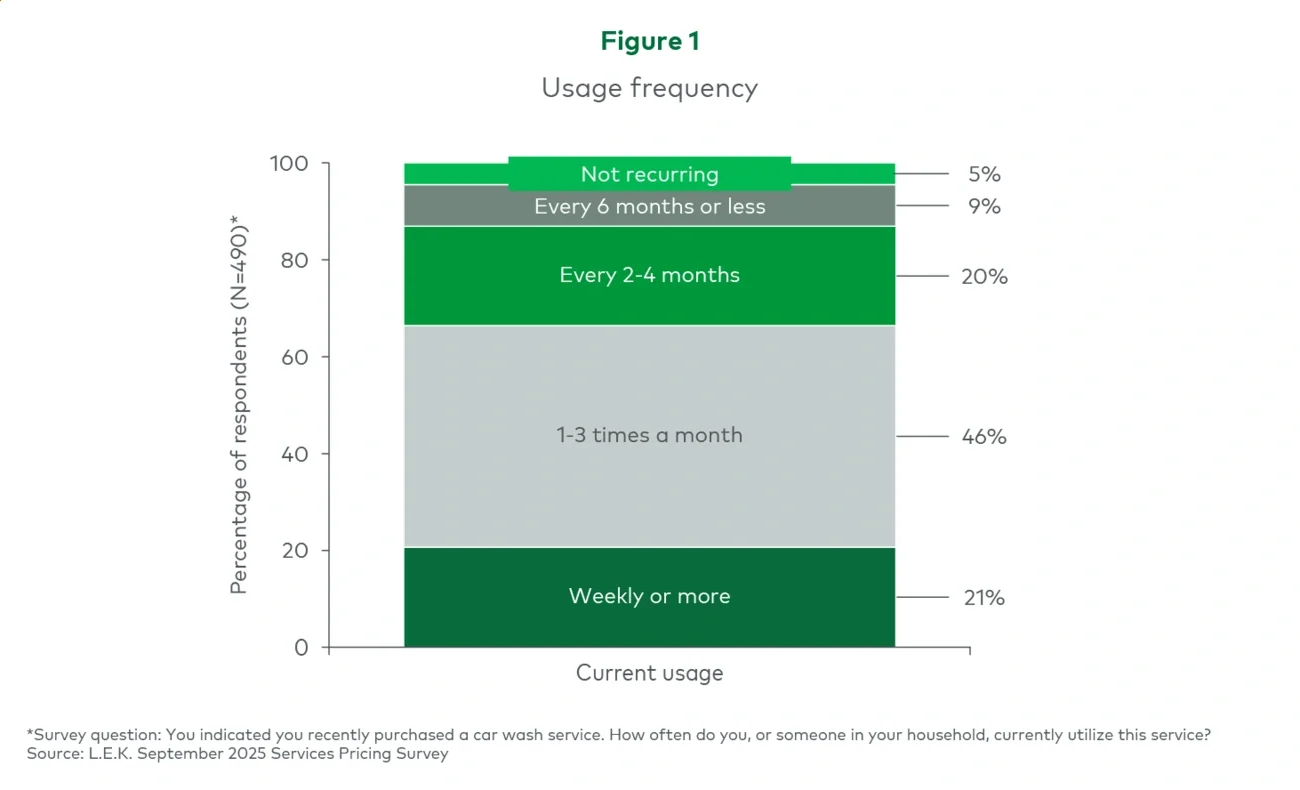
Frequency is high and stable: Around one in five customers wash weekly or more frequently; nearly half wash one to three times a month; and three-quarters report no change year over year (see Figure 1). 
Even in a cost-conscious environment, a car wash remains a habitual purchase because it delivers both convenience and satisfaction (see Figure 2). This reliability gives operators a steady demand base — but also heightens expectations around fairness and value.

How consumers define value

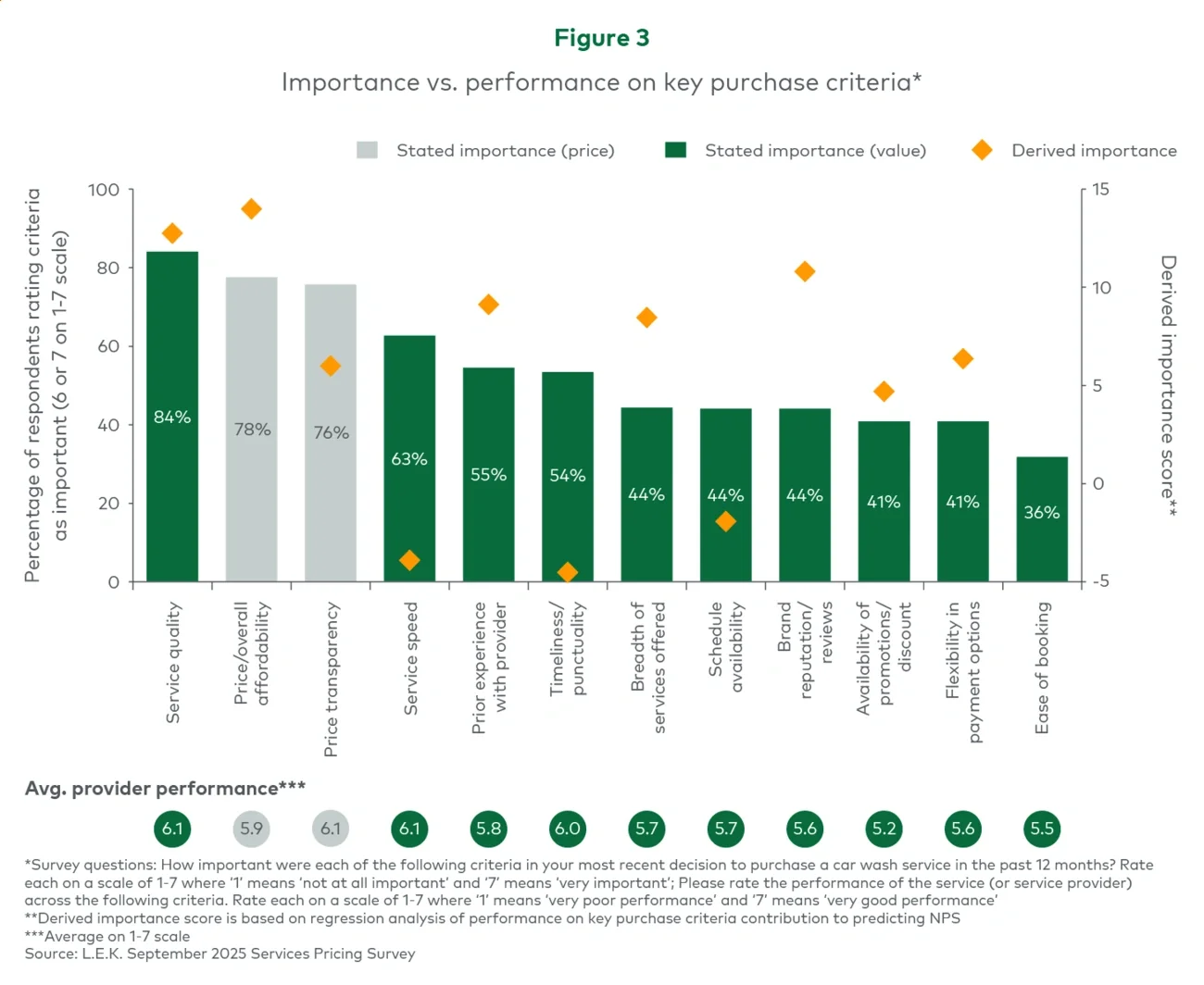
When choosing a provider, consumers emphasize service quality (84%), affordability (78%) and price transparency (76%). Speed and timeliness follow. Derived-importance analysis reveals deeper drivers: Prior experience, breadth of services and brand reputation are stronger predictors of advocacy than their stated ranks imply.  

In essence, customers “buy the wash” but recommend the brand that feels reliable and complete. Encouragingly, satisfaction scores show providers performing well on value for money, suggesting that current menus and price points are appropriately calibrated (see Figure 3).

An equilibrium worth protecting

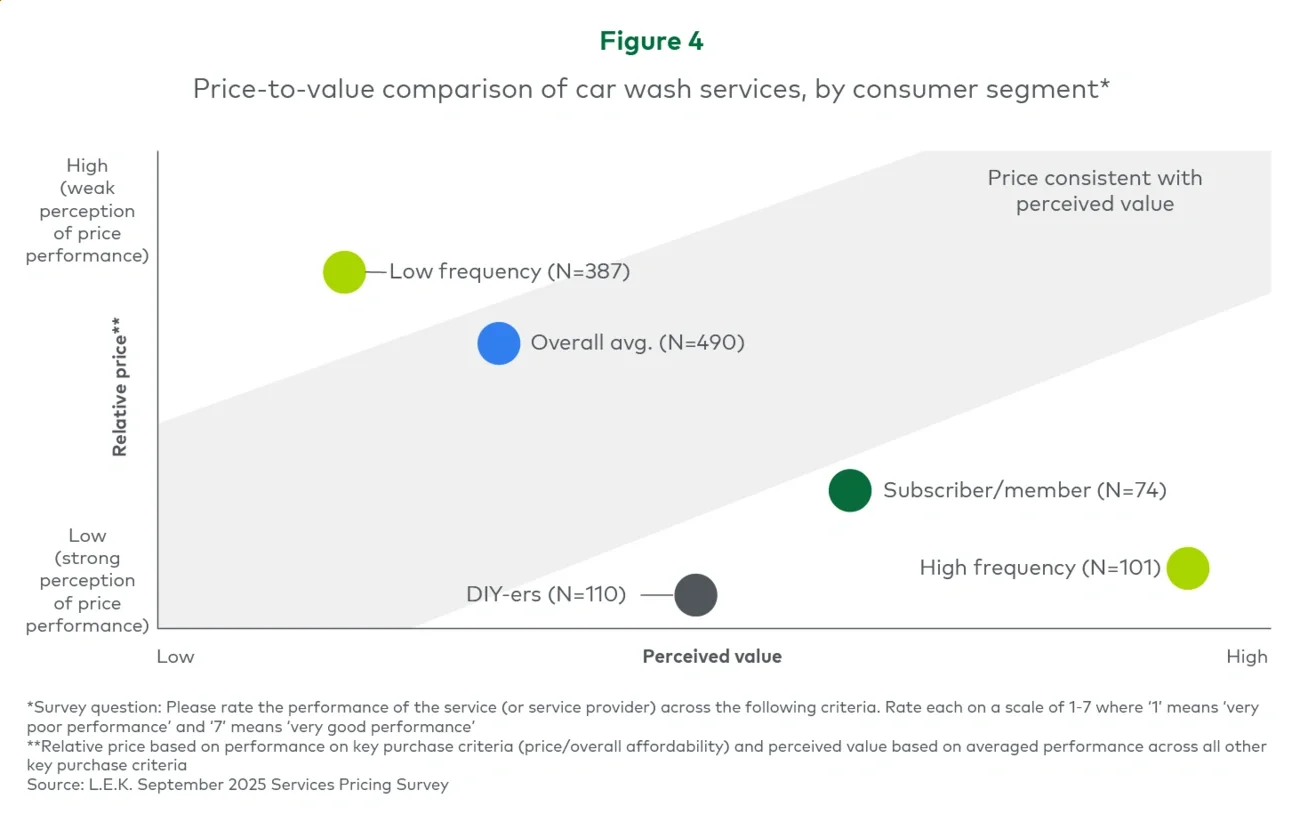
Across segments, consumers find different value in the car wash with high-frequency customers, and particularly those who are subscribers/members perceiving a higher value relative to the amount they paid.  However, average and low-frequency consumers are more value-challenged, indicating some price elasticity risk with this group (see Figure 4).
 

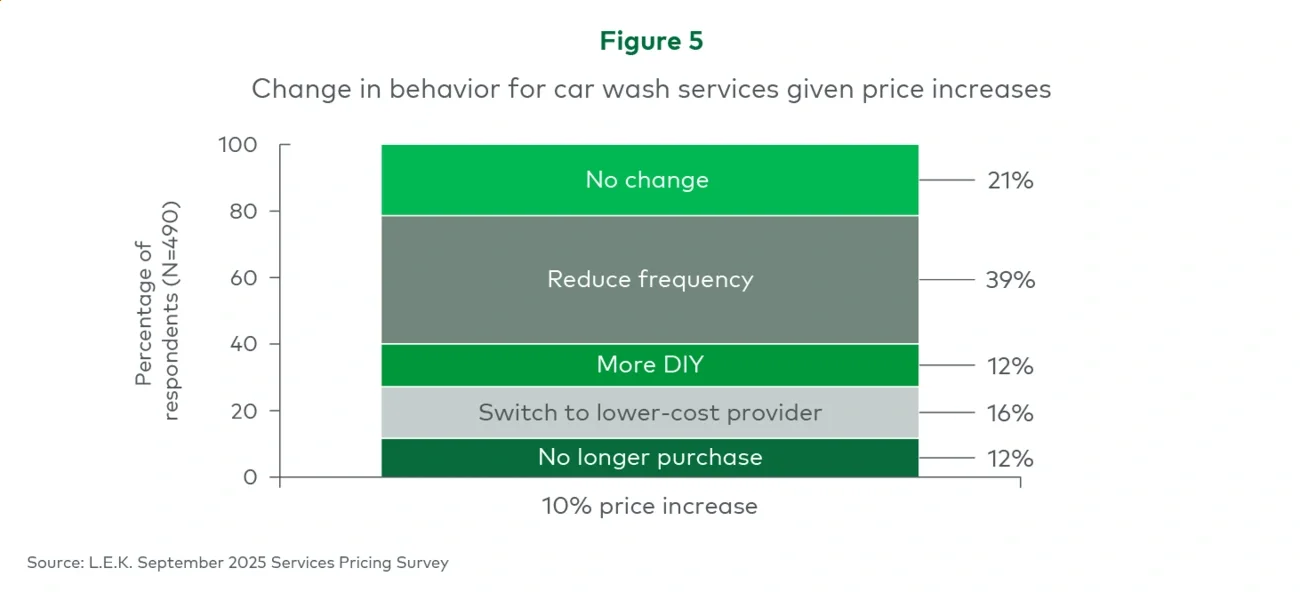
This elasticity is consistent with how consumers say they will react to a price increase. On this stated basis, a 10% price increase would prompt roughly one in five consumers to reduce frequency, 16% to switch or trade down, and another quarter to DIY or stop entirely. While behavior is likely overstated, the fact that only 4 in 10 say they would continue unchanged does suggest real revenue risk from across-the-board price increases (see Figure 5).

The implication is clear: The entry-level wash anchors demand. It must remain competitively priced to sustain traffic. The path to profitable growth lies not in pushing the floor up but in pulling the ceiling higher through tier upgrades, memberships and add-ons.

Tiers and transparency: The cornerstones of pricing architecture

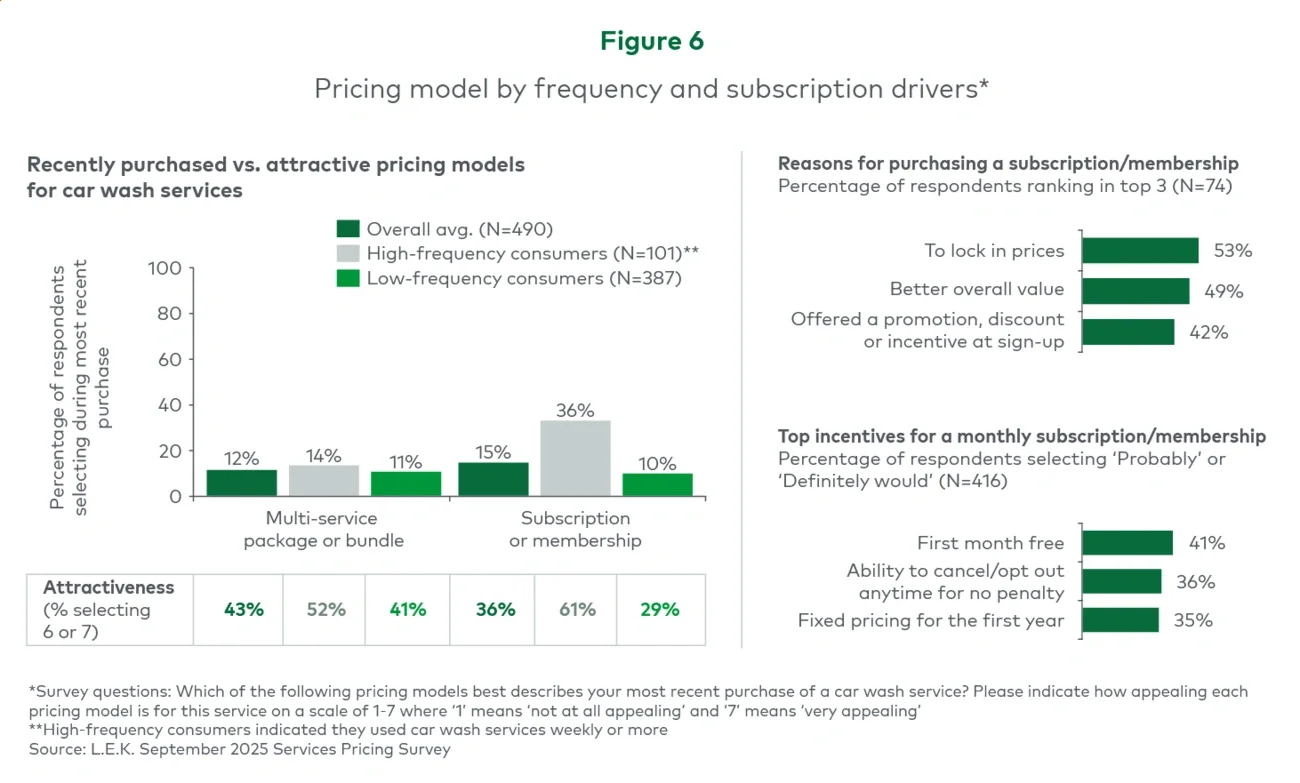
The modern car wash has embraced simple, outcome-based tiers — “Clean,” “Protect,” “Shine” — that let consumers self-select. Roughly 63% of recent purchases are single, up-front transactions, reflecting the importance of a visible, no-commitment entry point.

Among high-frequency users, however, subscriptions are key. These customers see the logic of locking in unlimited access and eliminating decision friction. They cite better value and access to premium features as primary reasons to join.

For nonmembers, certainty and trial matter most. Offers such as a first-year price lock, one-month free or one-week trial significantly increase willingness to subscribe without cheapening the product (see Figure 6).

The message for operators:

  • Maintain a clear, attractive single-wash offer.
  • Use transparent good-better-best tiers to capture willingness to pay.
  • Deploy subscription and “lite” membership variants to segment frequency and valued features to stabilize revenue.

Monetizing the moment: Bundles and attach

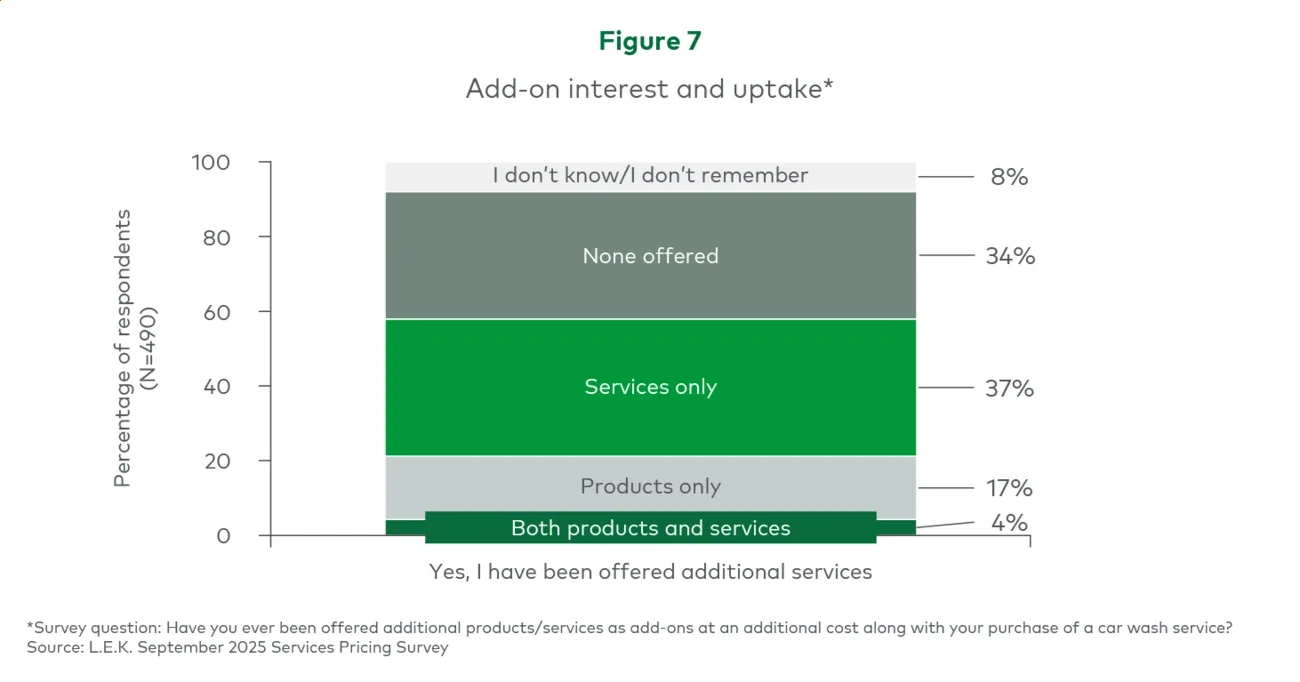
Beyond memberships, add-ons and bundles provide meaningful upside (see Figure 7). Around 58% of customers have been offered extras, and 70% express interest when prompted. The highest-impact items are those that extend the feeling of quality: interior quick detail or vacuuming, wax/shine coatings and tire treatments.

Some operators go further, linking with adjacent categories. Convenience stores will often bundle a car wash with a fuel purchase discount for their loyalty members. The principle generalizes to freestanding car washes: When add-ons are relevant, quick and visibly priced, they reinforce perceived value while increasing ticket size.\

Strategic priorities for operators

While individual market dynamics vary, several imperatives are consistent across networks and independents alike:

  • Protect the entry
    Keep the base wash accessible and clearly priced; it anchors fairness and drives funnel volume.
  • Clarify the ladder
    Use outcome-based tier names and concise visual design to guide trade-ups.
  • Match membership to behavior
    Focus unlimited tiers on high-frequency users; pilot “light” versions for moderate ones; use fixed-price guarantees and free trials to acquire new subscribers.
  • Productize add-ons
    Standardize add-ons — vacuuming, wax, interior detail — so staff can upsell consistently and customers can see value instantly.
  • Govern locally
    Benchmark competitors quarterly. Adjust benefits first, pricing last.

Lessons for other fixed-capacity services

The car wash model underscores three enduring truths about modern service pricing:

  • Tiering and transparency enable choice and create trust. Clear choices reduce friction and invite self-selection.  
  • Memberships thrive on frequency. Predictable users value commitment; occasional users require flexible options.  
  • Add-ons complete the experience. Complementary services lift satisfaction and yield without alienating price-sensitive segments.

Across industries, inflation and fixed-capacity demand the same response: Engineer value, don’t just price it. While there is still variation across the industry, high-performing car wash operators, through disciplined menu design, smart memberships and careful price governance, have been able to keep tunnels and cash flow full.

Contact us to learn more about how lessons from the car wash industry can help transform your pricing model, protect margins and elevate customer value.

L.E.K. Consulting is a registered trademark of L.E.K. Consulting LLC. All other products and brands mentioned in this document are properties of their respective owners. © 2025 L.E.K. Consulting LLC

Related Insights