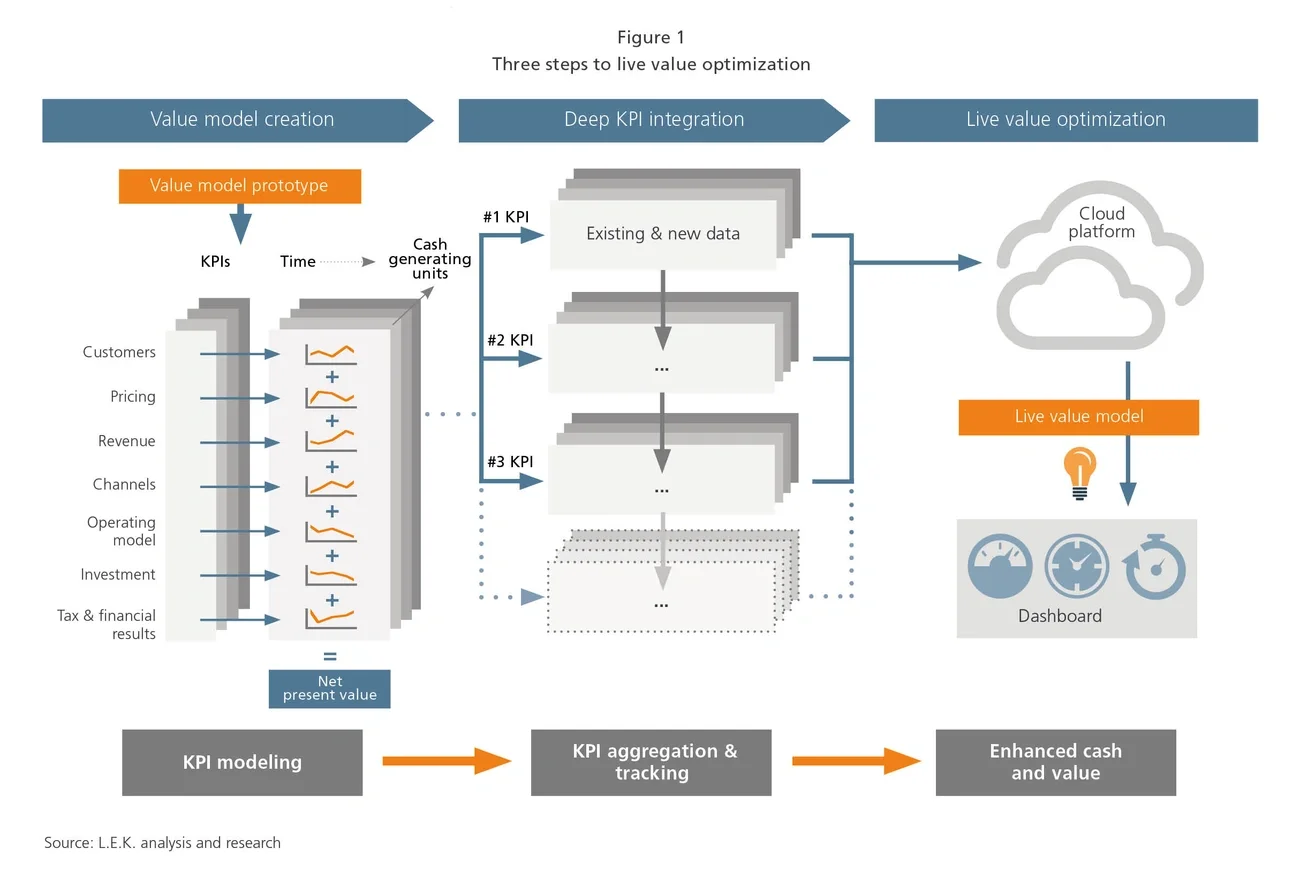
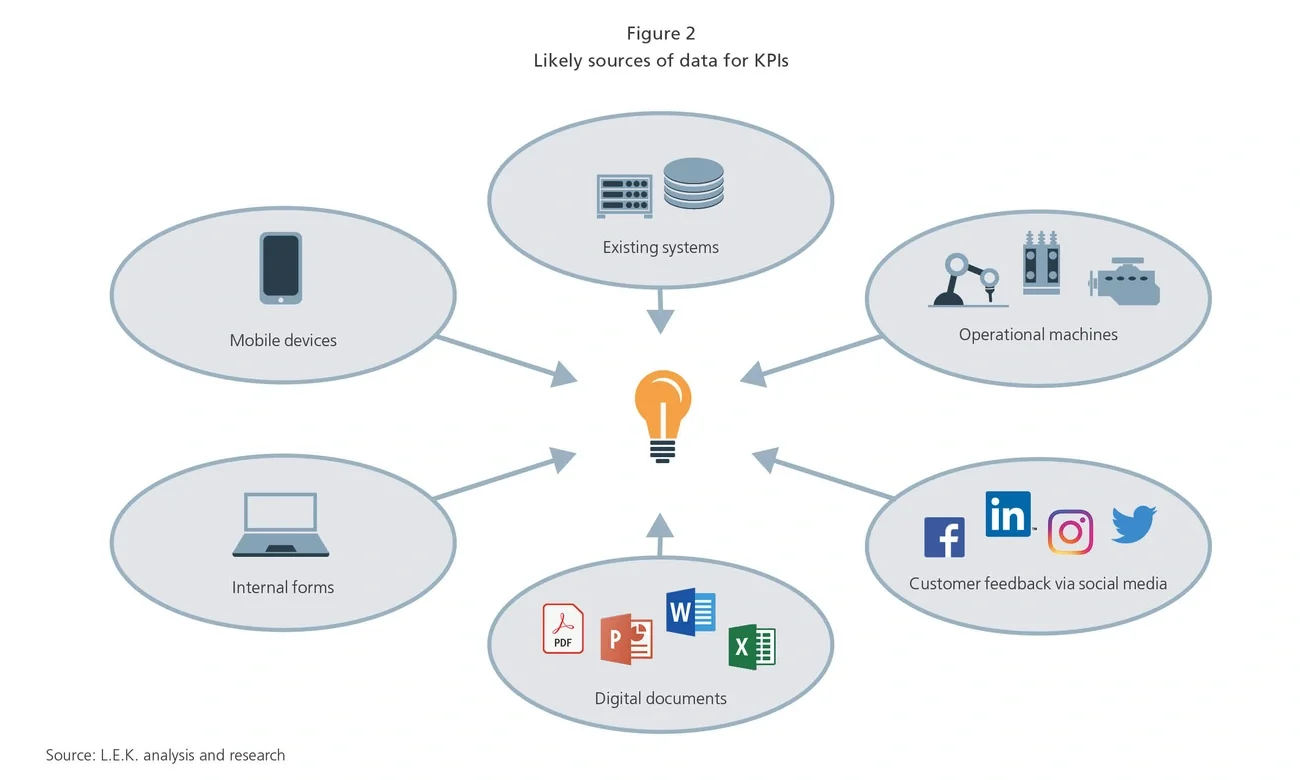
Collecting new data and leveraging previously untapped sources of information have become much simpler with recent advances in analytic tools and cloud technologies. Machine learning algorithms have evolved to the extent that they can identify patterns in business-specific metrics that are undetectable by the human eye, delivering competitive, real-time advantage. The rate of development continues at pace, so it is critical that businesses are fully aware of the opportunities available and use the right tools to optimize the commercial benefits of their data.
Step 3. Live value optimization
The heart of live value optimization is a scaled-up version of the step 1 value model creation. It is a calculation engine drawing on all the data assembled and created in step 2, with a dashboard cascading operational KPI metrics to business users on their communications devices. Dashboards and their KPIs are designed to meet the specific needs of different types of users.
Once the system is in place, the business can optimize its performance. By focusing the management debate on the KPIs in the dashboard and monitoring the impact that actions have on the KPIs, the business can start a positive feedback loop that is self-reinforcing and creates a range of benefits. This information becomes the basis on which the business aligns budgeting and long-term scenario planning, incentives for management, suppliers and customers, and key decisions about investments and other strategic initiatives.
The ongoing migration to the cloud enables straightforward standardization of this solution and more rapid deployment as it is no longer constrained by legacy IT systems.
Providers such as Inawisdom — with which L.E.K. works closely — are critical to this process. Without the data and analytics tools outlined, it is unlikely that the levels of complexity, connectivity and agility could be mastered to deliver a live analytical solution at an acceptable cost and time frame and with the direct control of the initiating management team.
Common problems
Even when businesses have identified the correct set of KPIs and modeled their interrelationships, there are frequently major obstacles and delays in creating a live solution: There is often no single source of truth; the required data can prove difficult to access and is of poor quality; IT resources are often diverted to other projects; and the business can become distracted by urgent but less important issues. Furthermore, many businesses do not have the ability to report against multiple structured and unstructured data sets, or have the time and resources to visualize data. Finally, companies also tend to isolate their digital and data expertise from the commercial side of the business when they should be collaborating closely to design commercial solutions.
Organizations must work hard to overcome these challenges, and commitment by an organization’s most senior management is critical to success.
Transformation awaits
Cracking live value optimization is not straightforward, but continued advances in data analytics and cloud technology mean that new solutions can be developed, tested and deployed much faster than before, often in a matter of weeks. The approach is cost-effective, secure and scalable to manage the most complex data sets.
This agile and iterative process enables businesses to unlock opportunities to differentiate, increase operational efficiency, cut costs, and boost sales and profits. We have seen these benefits at a wide range of organizations, with value created through price optimization and realization, procurement savings, operational and overhead cost reduction, and the negotiation of better commercial terms through having a single view of sales and customer spend across business units, among many other mechanisms.
For management teams with a clear performance improvement agenda, and the vision and drive to embrace new analytical tools and techniques, live value optimization provides transformational business opportunities and sustained competitive advantage.