

Executive Insights

Four Ways to Improve Capital Planning Effectiveness

March 19, 2018

Image
Nickel mining project overruns
Image
Nickel mining project overruns

One thing is certain: Do the same things again and again, and you will keep getting the same (if not worse) results. Yet this has become the norm in CapEx handling — project leaders rely time after time on the same construction techniques, contractual arrangements, work habits and relationships.

The most impressive results will come from a serious questioning of the factors that drive CapEx effectiveness. Successful stakeholders, from project owners and sponsors to engineering and construction firms to investors and governments, will defy the old recipe for failure. By using new frameworks for project design and approval, contracting, construction planning and execution, and project management, they will see outstanding returns instead.

For instance, L.E.K. Consulting often sees engineering departments with a limited ability to understand and mitigate market uncertainties that can destroy project returns. Yet we have seen great benefit in designing and including options in supply contracts of megaprojects (those above US$1 billion in CapEx spending) that can minimize relevant uncertainties.

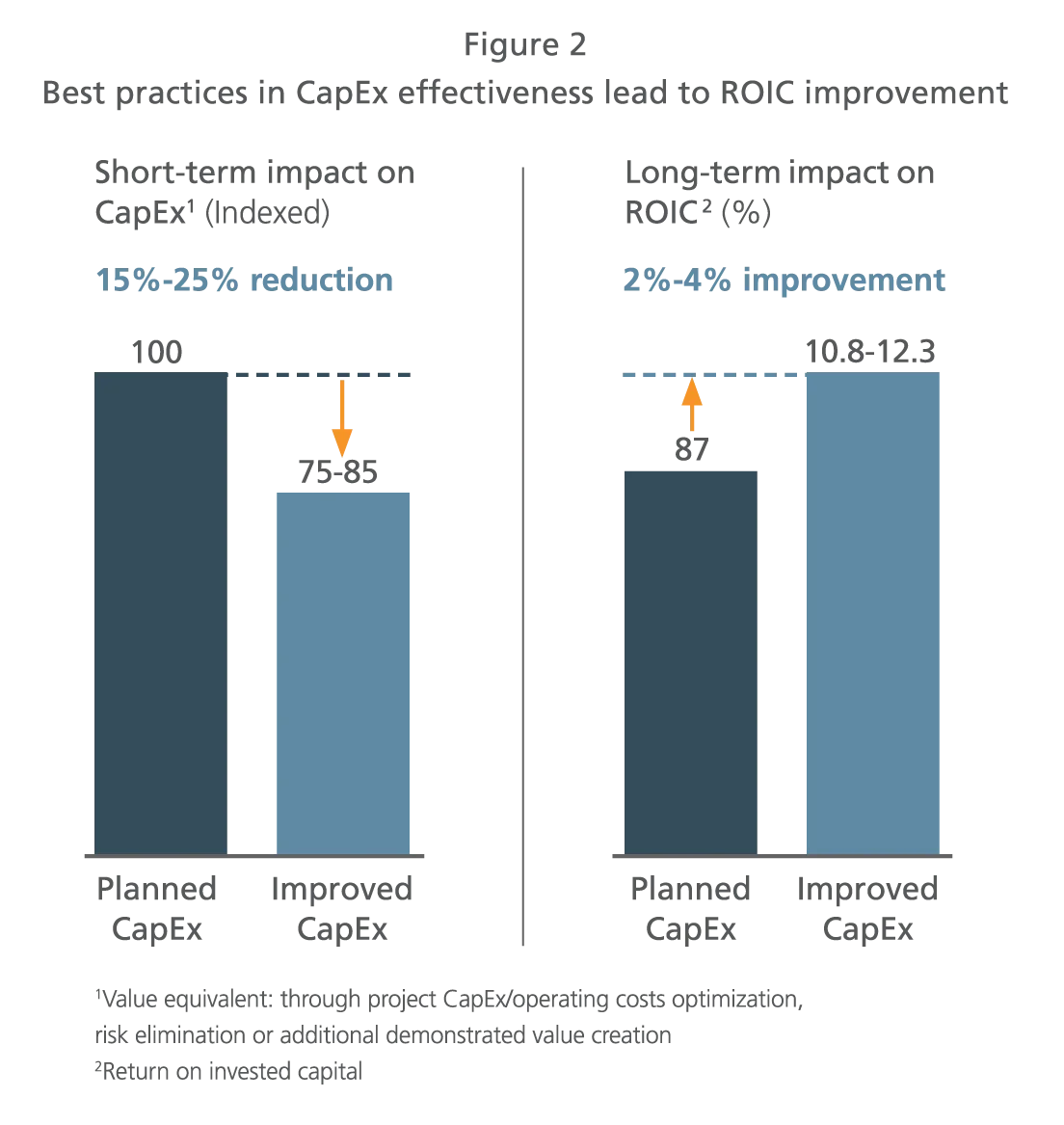
When a large project systematically relies on best practices of CapEx effectiveness, there is a prize to be captured. L.E.K.’s research points toward return on invested capital (ROIC) improvements of 2-4 percentage points in projects that leverage a new mindset toward CapEx programs (see Figure 2).
Image
Best practices in CapEx effectiveness lead to ROIC improvement
Image
Best practices in CapEx effectiveness lead to ROIC improvement

Furthermore, applying such techniques is proven to reduce the effects of uncertainty and volatility in a project’s outcome. Stage-gated development and approval processes, when followed by the book, reduce the variability of results in megaprojects by up to 20%.

We recommend an approach toward CapEx effectiveness that sustains itself in four key elements of the capital processes in any given organization (see Figure 3).

Image
Four key elements of CapEx effectiveness
Image
Four key elements of CapEx effectiveness

Capital allocation. We understand that capital allocation, especially in multibusiness corporations, is a difficult process, with no one-size-fits-all solution. Thus we developed proprietary knowledge that will allow boardrooms and C-level executives to (i) translate strategy into a target business footprint/ market(s); (ii) ensure the adoption of mechanisms that avoid distortions in decision-making; (iii) define the current risk/return profile and the group risk appetite; and (iv) determine capital headroom from existing business and allocate headroom to the target footprint/market(s).

Portfolio optimization. In general, 20%-40% of CapEx value in capital-intensive industries is spent on small and midsize projects, driven by the sustaining capital required to operate, which often represents more than 80% of the capital projects. While achieving excellence in planning and execution can translate to 2%-4% ROIC improvement for the company, management seldom gives these projects the proper attention. The most effective approach to portfolio optimization solves that problem by (i) verifying, probing and optimizing each project, and (ii) optimizing the portfolio for improved returns rather than simply CapEx reductions.

Megaproject optimization. Megaprojects often represent “bet the company” investment. Companies should conduct thorough due diligence before partnering with a consulting firm to provide equity investments advisory services and seek experts from the construction and engineering space to support megaprojects with design, procurement, contracting, construction planning and project management optimization.

Enablers. Sustaining impact is finally ensured through the design and implementation of foundational elements of organizational change in project and corporate structures, processes, systems, and mindsets and behaviors. By acting on these elements, companies are well-positioned to achieve positive impact in their CapEx efforts.

English