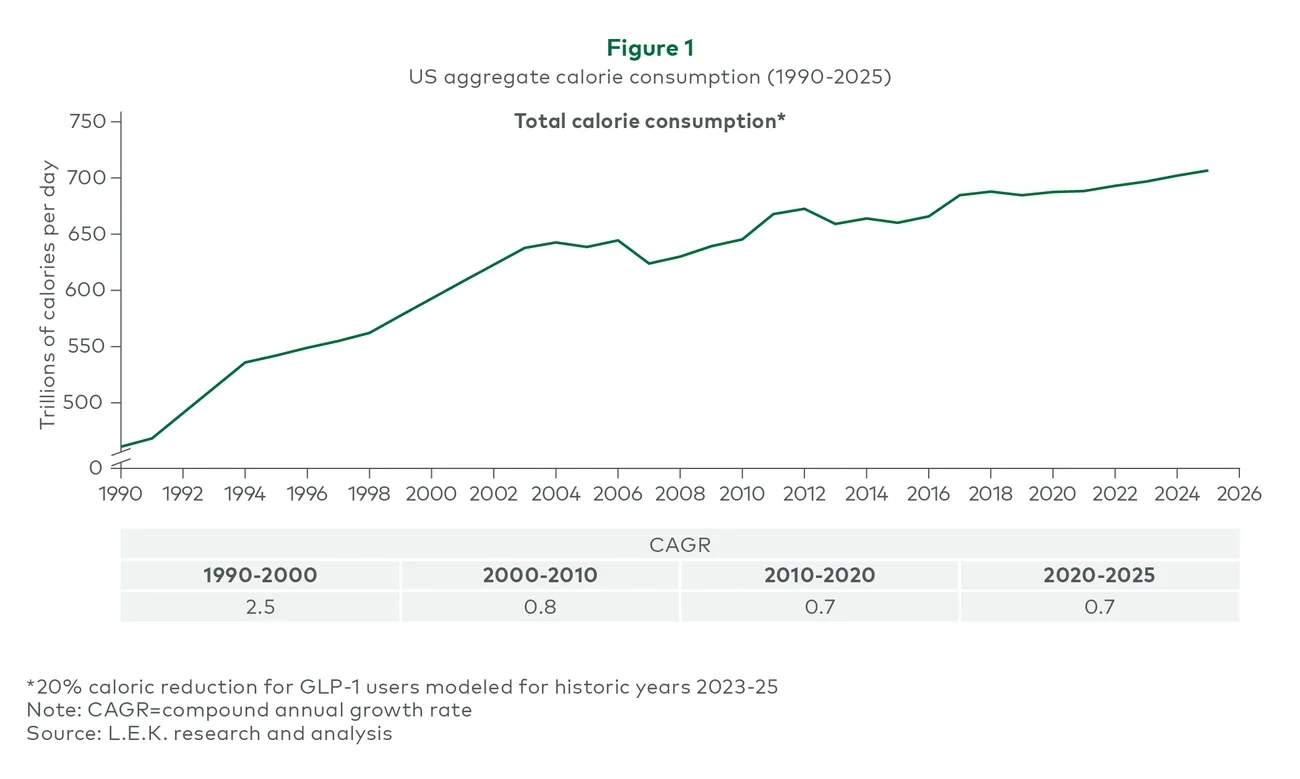
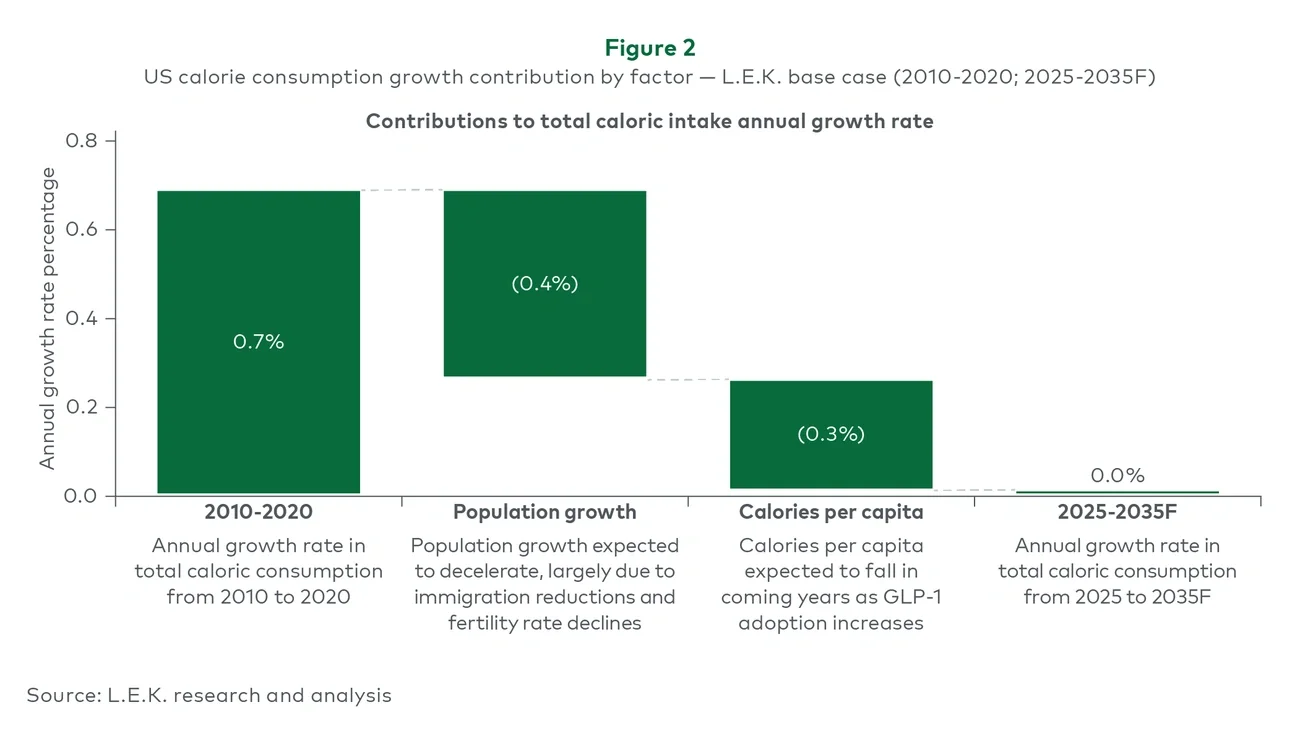
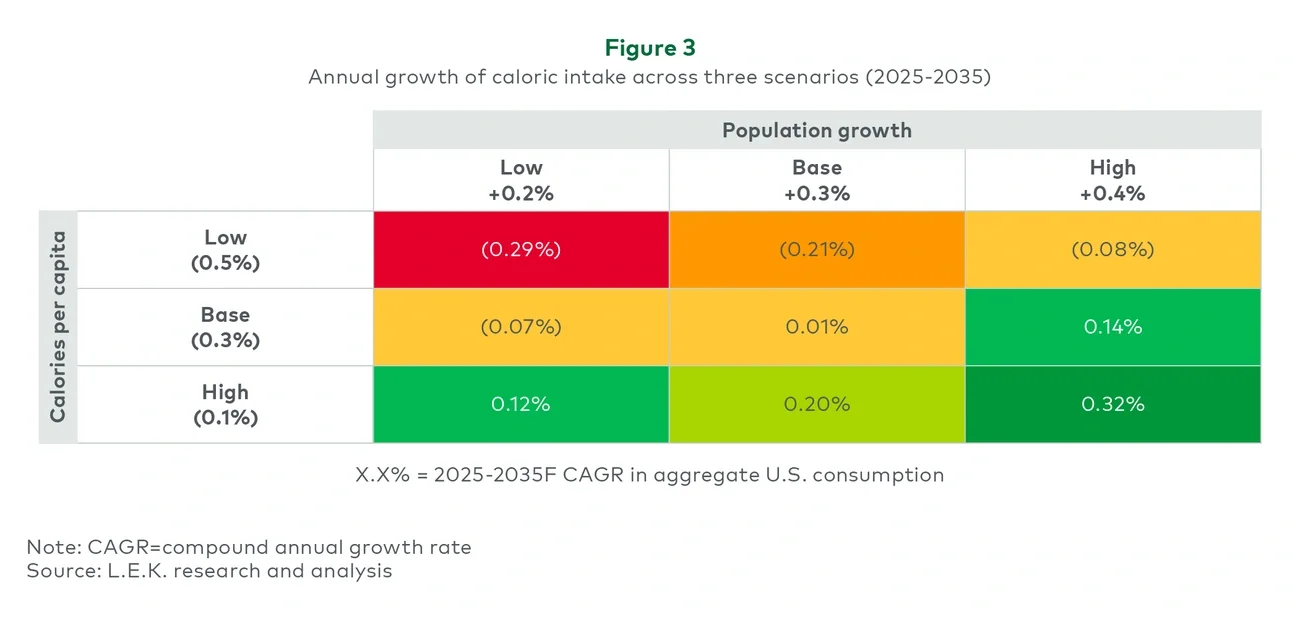
All scenarios point to the same conclusion. Total caloric consumption in the U.S. — and therefore F&B volume growth — is poised to level off over the next decade as demographic trends soften and appetite-reducing medications become more widespread. Said differently, we could soon hit “peak calorie,” and if you apply bearish assumptions, we may have hit the peak already.
Defining future strategies
Peak calorie doesn’t mean individual companies can’t grow. In the absence of steady volume increases, however, competition will heat up. Manufacturers and investors will have to actively differentiate to come out ahead in a market where aggregate demand is no longer rising. Below are a few strategies to consider.
Supply chain optimization
It’s no surprise that in a challenged top-line environment, consumer packaged goods (CPG) are increasingly turning toward solutions to grow the bottom line. In our experience, an effective way to drive profitability goals is to “simplify to grow.” Stamping out complexity across the supply chain has tremendous benefits when “synced up” with commercial priorities. To that end, best-in-class CPG are increasingly interconnecting their commercial and supply chain teams through a repeatable process in lockstep to achieve strategic bottom line goals.
Revenue growth management (RGM) and incrementality
The effectiveness and sophistication of RGM help drive profitable growth with price pack architecture, product pricing/elasticity, trade spend optimization, and product mix and assortment optimization. Price pack architecture drives profitable, incremental growth with surgical innovation on developing product benefits where consumers have a “higher willingness to pay” than the cost to produce — making every unit sold more valuable through RGM. Key RGM levers include refining price pack architecture, improving trade efficiency and managing the product mix to meet consumer preferences and profitability goals.
Drive GLP-1 friendly innovation
Alongside pricing and mix optimization, companies can capture incremental demand by marketing directly to GLP-1 consumer needs. Examples include products that are higher in protein, higher in fiber, more satiating or otherwise tailored to the evolving nutritional profiles of GLP-1 users.
Omnichannel excellence
Another approach is to meet customers and consumers where they are by rethinking the company’s route to market. As buying behaviors continue to evolve, omnichannel distribution will play a growing role in maintaining reach and relevance. Winning with Amazon, Walmart.com and Instacart is critical.
Modernize sleepy categories
Companies can modernize and refresh sleeping or underdeveloped categories using artificial intelligence-data-driven rapid innovation to meet the needs of consumers, retailers and the enterprise. Successful examples — such as Good Culture’s reinvention of cottage cheese and Dots’ breakout success in pretzels — show how thoughtful renovation can unlock meaningful growth even in mature spaces.
Ride the wave of winners
Although the overall “ocean of calories” is flat, there will always be pockets of growth within trend-forward categories and across fast-moving channels. Smaller entrepreneurial companies historically have grown faster than “big food.” While that trend was reversed during the COVID-19 pandemic with the flight to safety, scale, and big brands, our research shows that the share gain of small food brands has returned. Companies will need to sharpen their market-sensing and analytics capabilities to detect where volume is beginning to accelerate across “measured” and “unmeasured” channels, and then act decisively to capture it. This may involve organic initiatives or targeted mergers and acquisitions.
Success in a low-growth environment
U.S. F&B producers have benefited from a decades-long rise in aggregate caloric consumption. Now it looks as though we’ve reached the point where growth in total calories consumed is expected to slow significantly, if not flatten.
This slowdown marks a structural, not cyclical, turning point. Population growth, once the reliable foundation of industry expansion, will no longer drive the same uplift as a combination of reduced immigration and GLP-1 adoption takes hold. Even so, pockets of growth will continue to exist as new products and categories take a share of calories consumed. Future winners will excel through targeted innovation, pricing discipline and adaptive strategy rather than by counting on rising caloric demand.
For more information, please contact us.
L.E.K. Consulting is a registered trademark of L.E.K. Consulting LLC. All other products and brands mentioned in this document are properties of their respective owners. © 2026 L.E.K. Consulting LLC.