Three potential levers that convert time to money
1. Subscriptions and recurring revenue: a “wellness plan” for your car
The centerpiece is a membership that exchanges steady monthly spend for booking certainty and value clarity. The extended warranty and other finance & insurance (F&I) products are already well established in the industry but, beyond the dealership relationship, exist above the level of the individual service provider and are predominantly for new vehicles. Full warranties, however, are sold products and leave a gap in the mass middle of the market.
Enter the wellness plan construct where service providers could fill this gap:
- Basics are covered: periodic checkups, digital inspections, two oil changes a year, tire rotations, fluid top-offs
- Major work is subsidized, not free: a published copay schedule (e.g., first $200 covered on brake jobs, 15% labor discount on major repairs) that preserves economic discipline
- Priority access is ensured: earlier booking windows, fast-track diagnosis slots or members-only shoulder pricing
- Pricing certainty is explicit: a 12-month labor-rate freeze and waived diagnostic fee once per year for members
The benefits align with what consumers value (quality, fairness, transparency) and what operators need: recurring revenue, a higher visit cadence and structured authorization that reduces friction during repair-order build.
The key for any plan is to include the table stakes features that drive adoption, use the relationship to capture the larger “filler” that drives higher costs and avoid “killer” features that bloat the program.
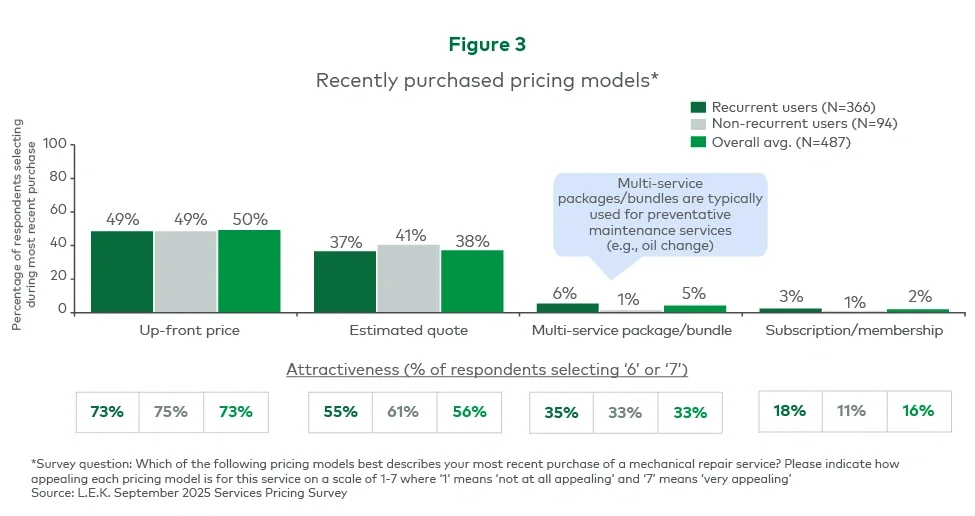
Of course, plans like this aren’t for everyone and would have to coexist with more transactional relationships, but the lifetime value benefits could be material, and our research suggests that as many as 18% of regular service users find it attractive, compared to 16% of average users finding subscriptions/memberships attractive.
2. Dynamic pricing and time-based scheduling: smoothing the bays
Technician hours are the perishable inventory. Demand clusters by day and season, with Mondays and Fridays often hot but midweek afternoons slack. The goal is not surge pricing but value-differentiated timing:
- Off-peak incentives for movable jobs (diagnostics, oil changes, alignments)
- Members-only shoulder pricing or extended “at the shop” time to nudge the actual work into slack windows
- Network-level routing (for MSOs) that offers earlier availability nearby, sometimes at a small price advantage
A small discount that fills an otherwise idle bay is pure contribution, and over a network, the impact compounds.
3. Ancillary revenue: making more of every visit
Multipoint inspections are already common in the industry as safety-critical work is surfaced and additional potential work identified. But maximizing the value here requires a suite of non-bay or short-bay services that add value without clogging technician time. If not already offering these, there are a number of products and services that may be relevant:
- Paintless dent repair, cosmetic touch-ups for wheels, headlight restoration, windshield chip repair
- Advanced driver-assistance system (ADAS) calibrations
- Retail consumables (wipers, filters, detailing kits)
These add-ons can lift the average ticket and, if done right, give consumers access to services they value and drive increased satisfaction.
The road ahead: Engineer predictability into an unpredictable business
Mechanical repair shops are effectively factories of skilled labor. Every hour is a perishable asset. When sold reactively, value leaks through idle bays and customer anxiety. The car wash industry solved a similar problem through tiering, subscriptions and transparent upsell.
The translation for mechanical repair is straightforward: assured access and coverage, value-differentiated timing and convenience-led ancillaries. MSOs can implement at scale with multisite memberships and network-aware scheduling. Dealerships can use the same principles to retain postwarranty customers. Even single-site independents can capture value through simpler versions.
The industry has invested in diagnostics, tooling and digital booking. The next differentiator is pricing intelligence, meaning the discipline to align perception, capacity and profitability. The car wash taught customers to subscribe to cleanliness. Mechanical repair can teach them to subscribe to confidence and, in so doing, turn unpredictability into a managed source of value creation.
Contact us to learn how smarter pricing models can help mechanical repair operators unlock capacity, strengthen margins and elevate customer value.
L.E.K. Consulting is a registered trademark of L.E.K. Consulting LLC. All other products and brands mentioned in this document are properties of their respective owners. © 2025 L.E.K. Consulting LLC