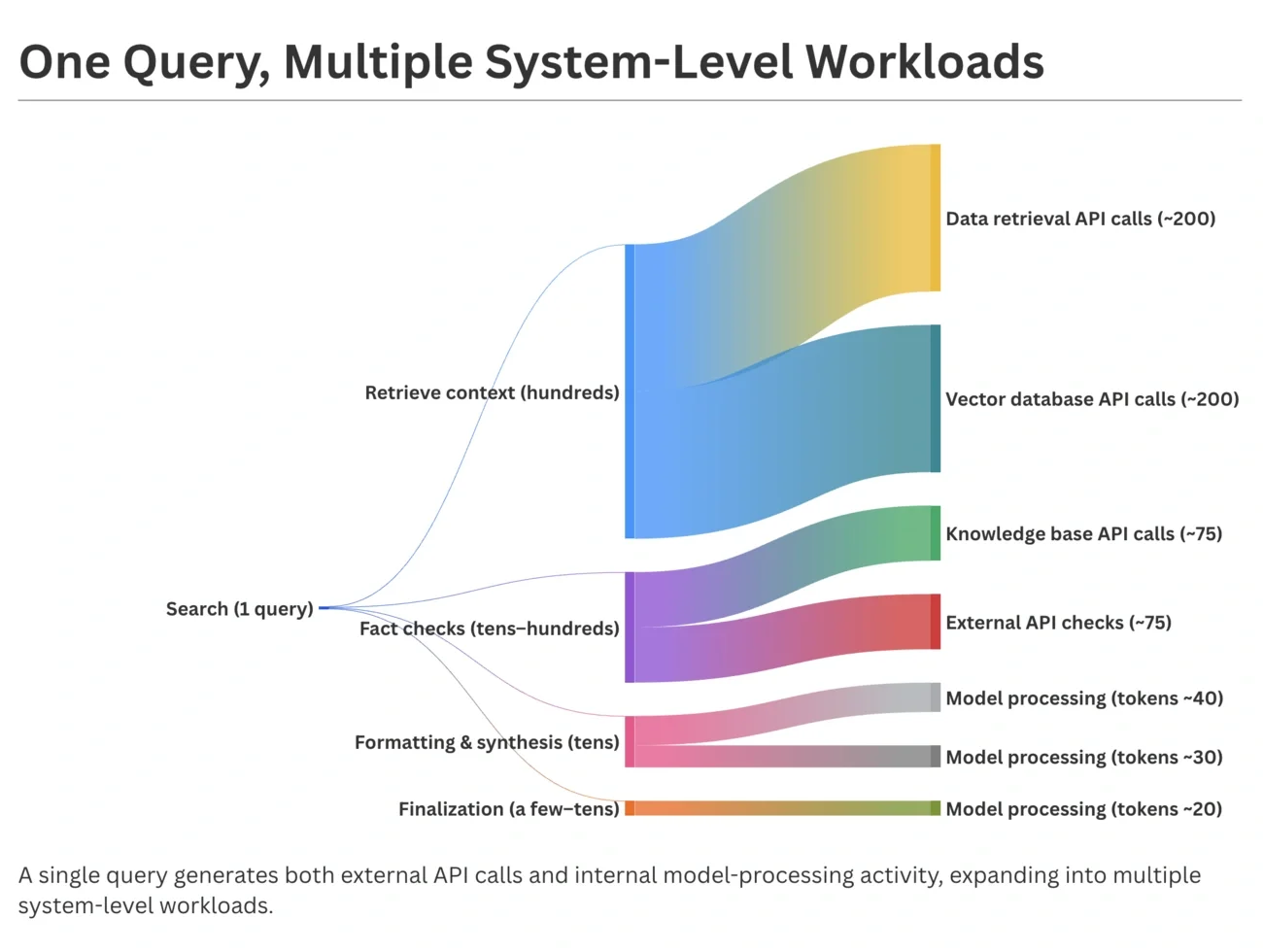
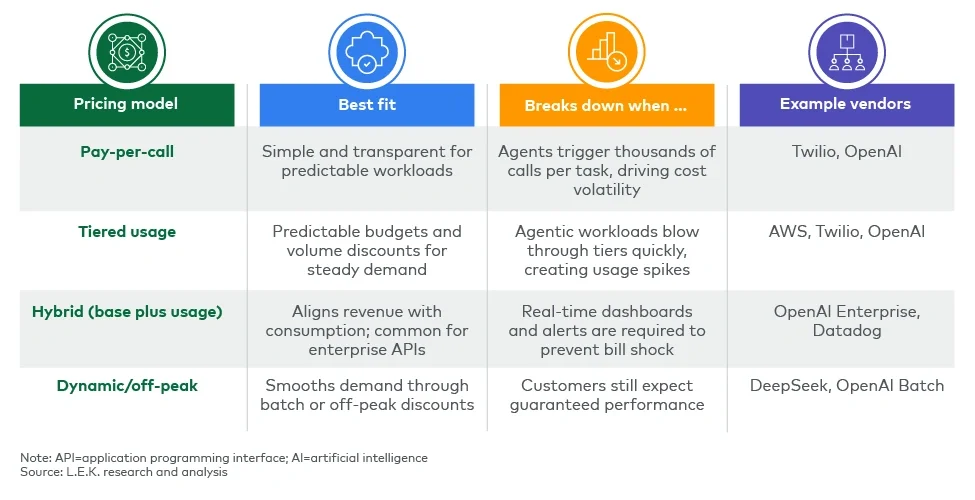
Most vendors evolve across these API pricing models as usage scales — from per-call pricing toward tiered, hybrid or dynamic structures to manage agent-driven variability.
Pay-per-call
Twilio built its business on this model, charging per message or minute. It remains one of the clearest ways to monetize APIs, but it breaks down under AI-scale workloads. A single agent workflow that would take a human five minutes can now generate thousands of automated requests.
Tiered usage
Stripe and AWS offer predictable, volume-based pricing through usage tiers and overage fees. AWS, for example, includes 1 million free API calls per month, which once provided healthy buffers for human-driven workloads. But an AI agent debugging code or researching a customer question can exhaust that free tier in hours.
Hybrid (base + usage)
Hybrid is now the most common model for enterprise APIs. Customers pay a base fee for platform access plus incremental usage charges. This model balances predictability and scalability but introduces complexity. Vendors need real-time dashboards, usage alerts, and soft caps to prevent cost surprises and maintain trust with customers.
Dynamic or off-peak pricing
This emerging method treats API capacity like airline seats: cheaper when idle, more expensive when demand surges. DeepSeek cut off-peak API rates by 75% to smooth traffic spikes, while OpenAI’s Batch API offers similar discounts for non-urgent jobs processed asynchronously.
Levers worth testing as agent traffic grows
As agentic usage grows, vendors are exploring new ways to differentiate between access types:
• Human vs. agent access pricing
• Off-peak vs. real-time rates
• Per-agent identity or license fees
• Tiered data-class pricing (e.g., compute-intensive or sensitive endpoints)
The next wave of innovation may come from assigning identity or licenses to AI agents themselves, charging per authorized agent rather than per human user. This shift blurs the line between API monetization and digital labor pricing; it will force vendors to decide whether to price by access, usage or even agent seats, and will require them to consider how each approach reshapes value capture.
Why API pricing models are failing under AI workloads
Companies are testing new models, but implementation is exposing critical gaps. The disconnect between how APIs are priced and how they’re consumed has never been wider. Four urgent problems have emerged:
- The profitability trap is persistent.
Cursor and Perplexity show how infrastructure costs can swallow revenue. xAI, Elon Musk’s AI startup, reportedly burns about $1 billion a month on infrastructure and operations — proof of how quickly back-end consumption can break even the strongest growth story.
- Credits confuse customers.
Many vendors defaulted to credit-based systems when launching AI features. As one head of product monetization told Metronome, “Our finance team likes it. Our customers don’t know what a credit does.” Salesforce’s Agentforce combines three pricing methods: per conversation, per lead and credits. Layer in required licenses and API allowances, and customers struggle to forecast total costs.
- Agentic workloads break assumptions.
An autonomous agent might make 100 API calls or 10,000. Carnegie Mellon research found that AI agents fail on roughly 70% of knowledge-work tasks, and Gartner predicts that more than 40% of agentic AI projects will be canceled by 2027 due to escalating costs.
- Infrastructure can’t keep up.
Most vendors maintain separate billing stacks for self-serve and enterprise sales. Neither handles dynamic usage well. A customer’s AI agent might burn through a month’s API allocation over a weekend, but billing systems can’t surface that in real time or trigger proactive alerts. Customers often need engineering support just to decode their bills.
Some companies are finding a path forward. Zapier bills for completed tasks rather than raw API calls. Paid.ai raised $33 million to build outcome-based pricing infrastructure. DeepSeek cut off-peak rates by 75% to smooth demand spikes. Companies that tie price directly to customer value are adapting. Those that cling to legacy models face mounting pressure.
We help companies navigate API pricing transformation
Value is shifting from the number of people using a system to the scale of machine-driven activity it supports. API monetization now demands the same strategic attention as product development or go-to-market planning. Getting it right requires balancing technical implementation, customer expectations and unit economics.
L.E.K.’s B2B pricing practice works with software companies to manage these complex pricing shifts. If your organization is grappling with API monetization, agentic workloads or the transition from seat-based to consumption pricing, our team can help you design models that capture value without creating customer friction.
For more information, please contact us.
L.E.K. Consulting is a registered trademark of L.E.K. Consulting LLC. All other products and brands mentioned in this document are properties of their respective owners. © 2026 L.E.K. Consulting LLC.