


Artificial intelligence — or AI for short — has captured the world’s attention in recent months. It has captured the attention of business leaders as well.
Why is AI suddenly in the spotlight? The upsurge in media coverage and boardroom conversation is thanks largely to the arrival of generative AI in early 2023. ChatGPT4, the best known example, quickly established the fastest-growing user base in tech history, according to UBS.
It’s no surprise that generative AI exploded on the scene. Its ability to generate text and graphics based on a few simple prompts makes it easy to grasp — and sparks concerns about its potential (somewhat exaggerated for now) to take the place of knowledge workers.
But AI itself is not new — more conventional artificial intelligence systems have been at work in business settings for years, analyzing data and creating efficiencies in a host of processes. Generative AI has captured attention and helped spotlight the broad potential of all AI for executive decision-makers. It may also serve to accelerate AI investment. At the same time, there is the risk that generative AI hype overshadows other forms of AI that are already deployed and creating value in multiple functions across multiple industries.
The central question — What is the impact of AI and what is its value in driving strategy and superior business outcomes? — is top-of-mind for leaders and organizations. What are they currently thinking about AI? How are they incorporating it into critical processes and operations? Where is it getting traction? What is its role in achieving business objectives?
To find out, L.E.K. Consulting surveyed 1,000 executives across multiple industries. Our goal was to take a deep dive in order to more fully understand both the full range and the nuance of AI’s impact. We focused on the here-and now — the current deployment of AI and its impact on performance. We asked: How are you measuring success? Are you meeting KPI targets or not? We also asked about the farther-reaching question of what’s next.
We questioned executives in more specific terms, asking them about the expected impact of AI — both generative and AI more broadly — on specific lines of business and on business functions. What functional areas and objectives are the focus of their AI investment? Are they using in-house AI tools or relying on third parties?
We were able to get to the core of what is happening in the market and really dig into the impact of AI on businesses’ strategies.
AI Has Already Established Strong Traction in Organizations
This is what we know, among the key takeaways:
-
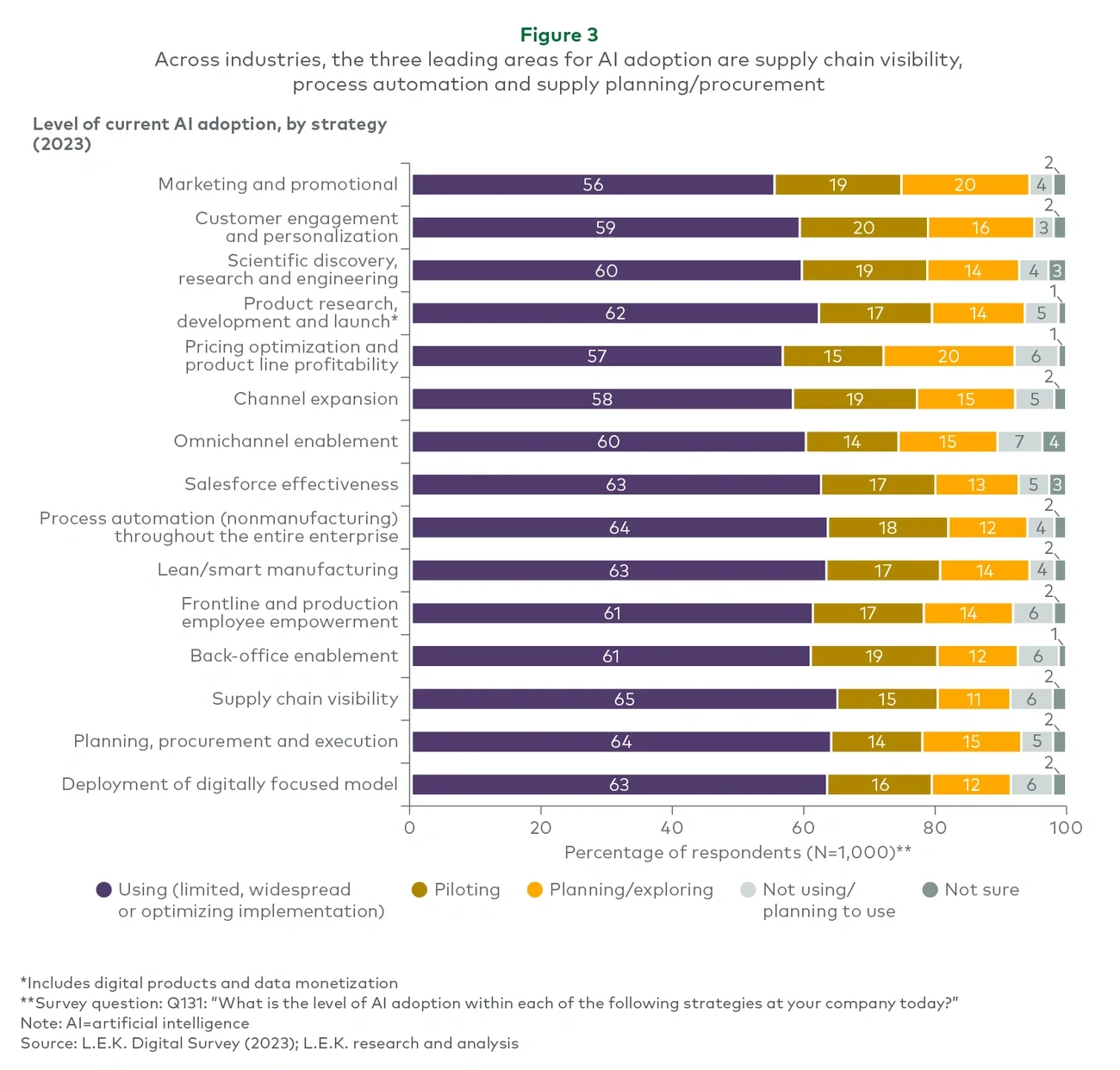
AI is not “on the horizon.” It is already well established. More than half the executives reported that their companies are already using AI across a wide range of functions.
-
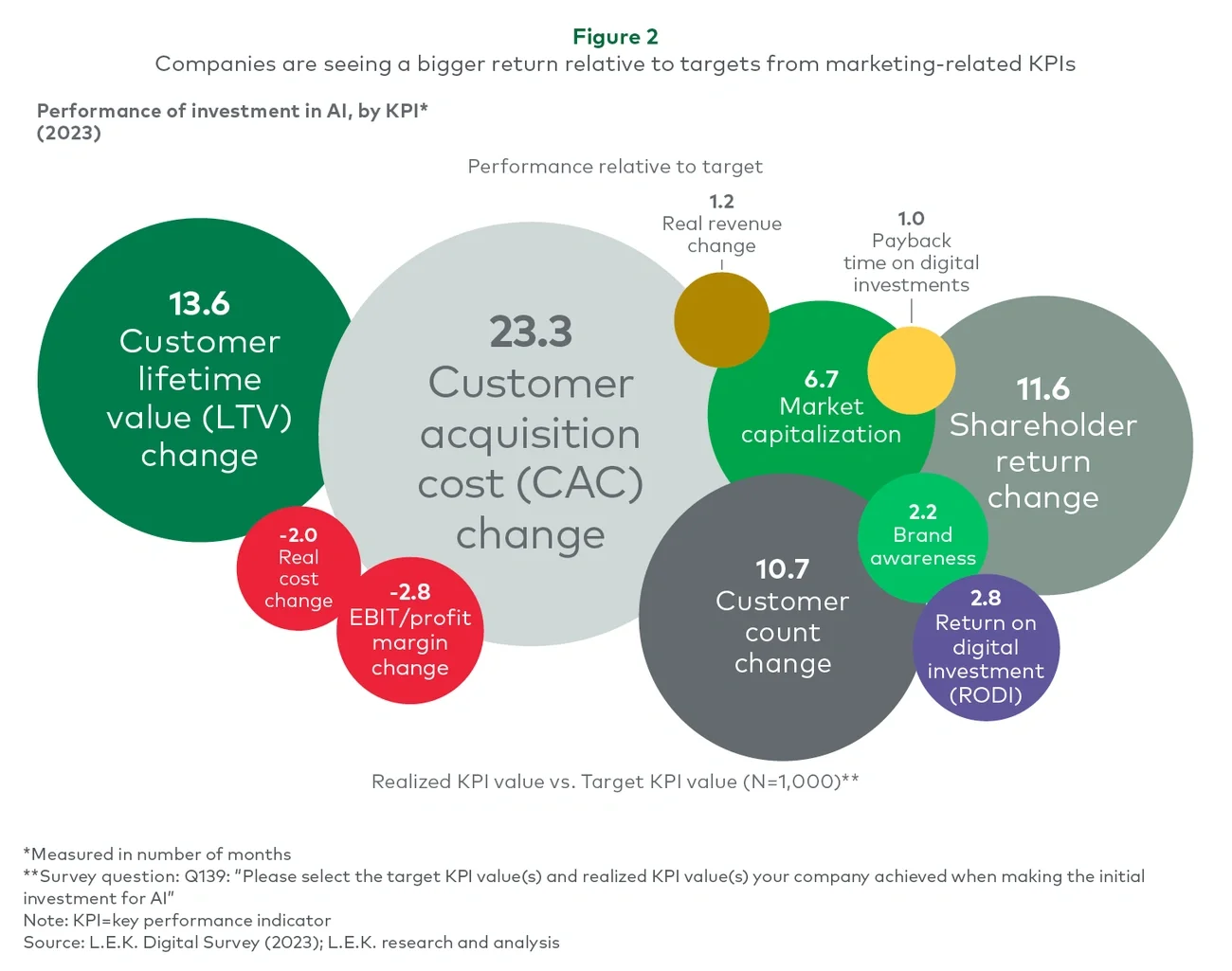
And it is having a measurable impact on performance. Executives reported that their AI investments have led to improvements in specific KPIs — including reduced customer acquisition cost (CAC), increased lifetime value (LTV), among others.
-
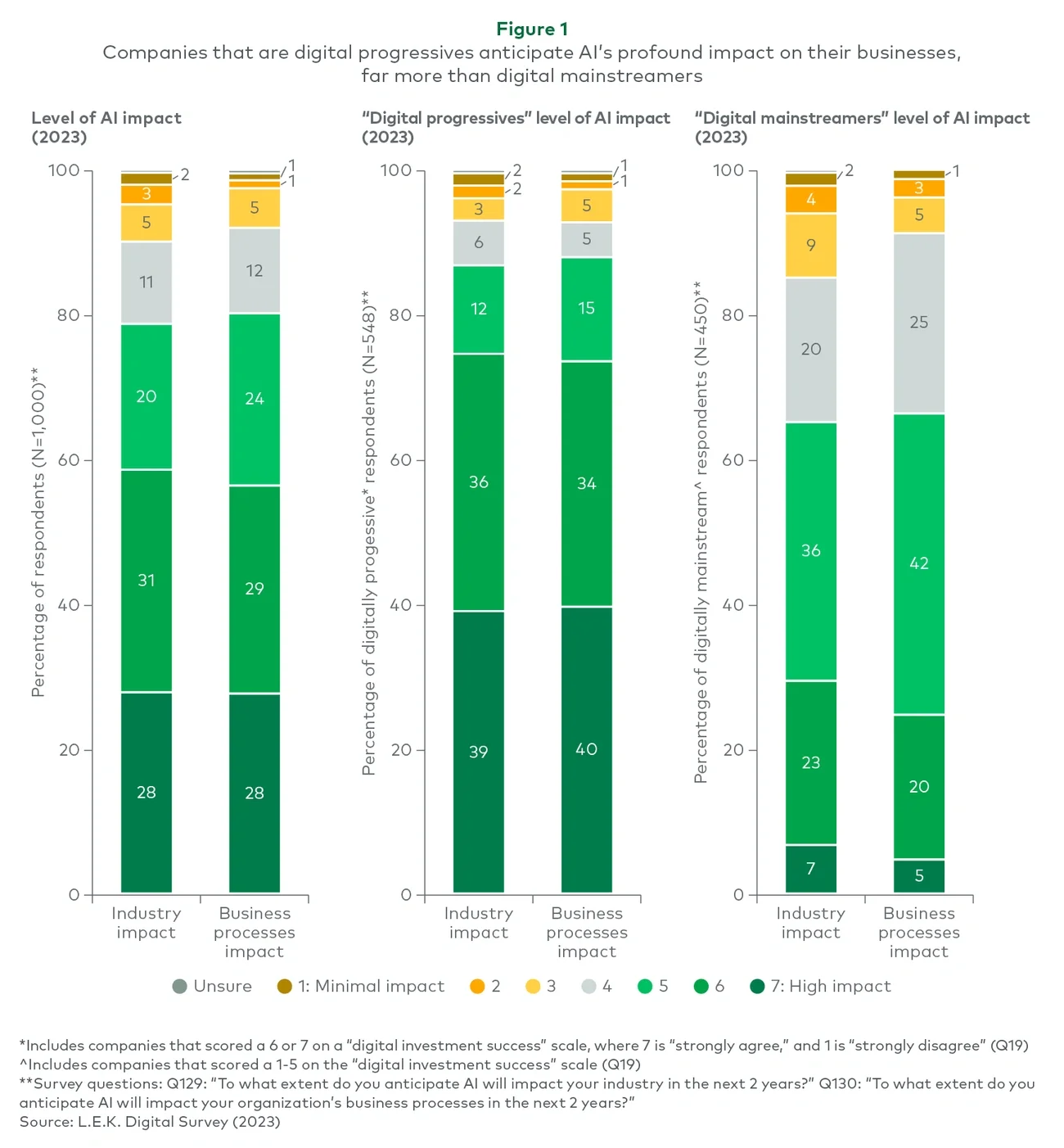
“Digital progressives” expect bigger business impact. Regardless of industry or size of business, companies that have proven success with prior digital initiatives — we call them "digital progressives" — are far more likely to expect AI to have a major impact on their industry and their business processes. The resulting imagination gap between this segment and other businesses — the "digital mainstream" — could be a major determinant of future winners and losers with respect to AI.
-
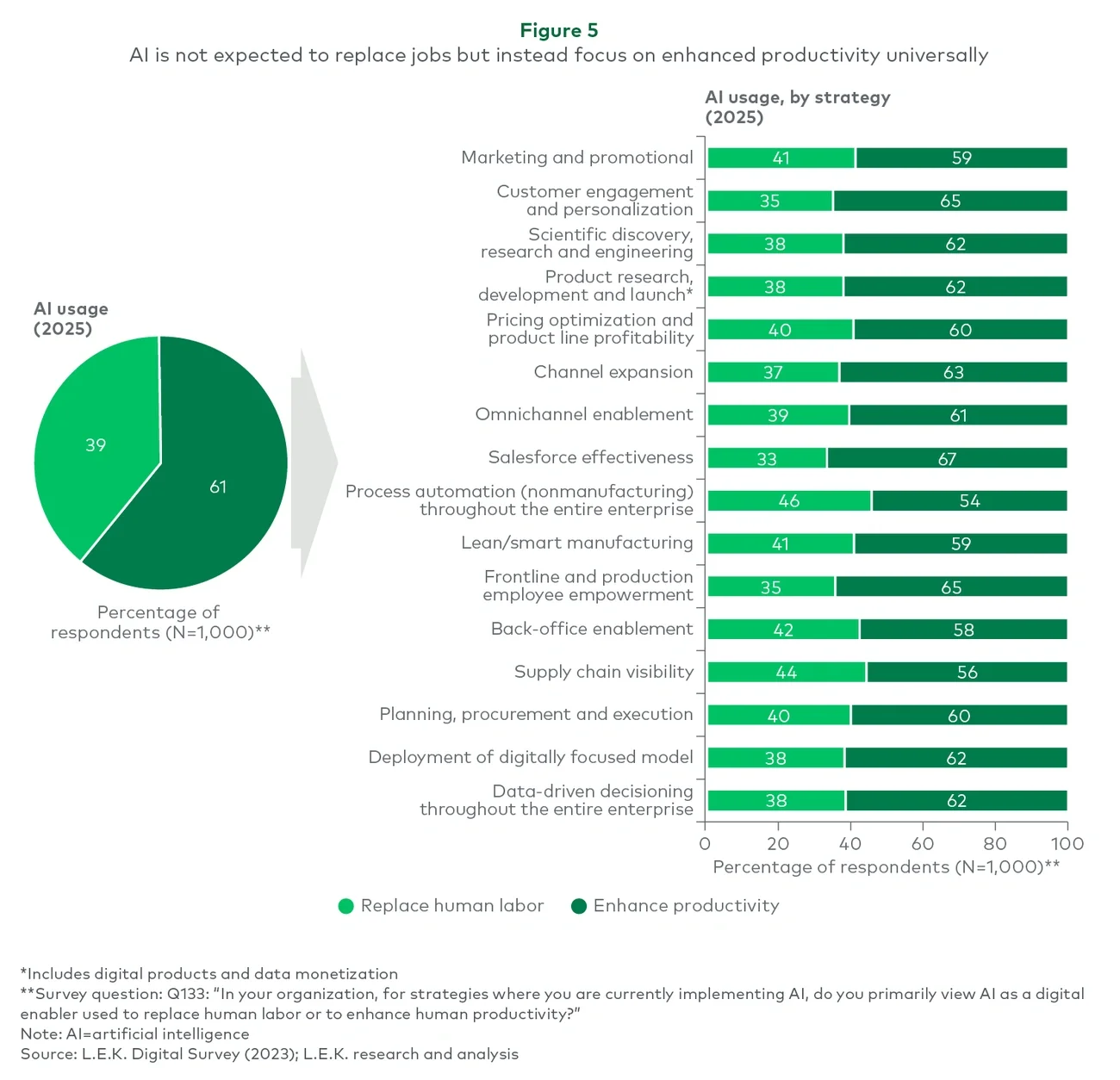
While some executives expect AI to replace jobs, more believe its primary impact will be to enhance productivity across the board.
-
AI's impact extends well beyond marketing and customer service. Hype about generative AI has focused, not surprisingly, on personalization, marketing and other forms of content generation. But in fact, AI (beyond generative AI) deployment is much more widespread — it has been deployed across a range of functions including supply chain management, planning and procurement. There is strong interest in marketing and pricing functions; however, they are a focus of testing.
-
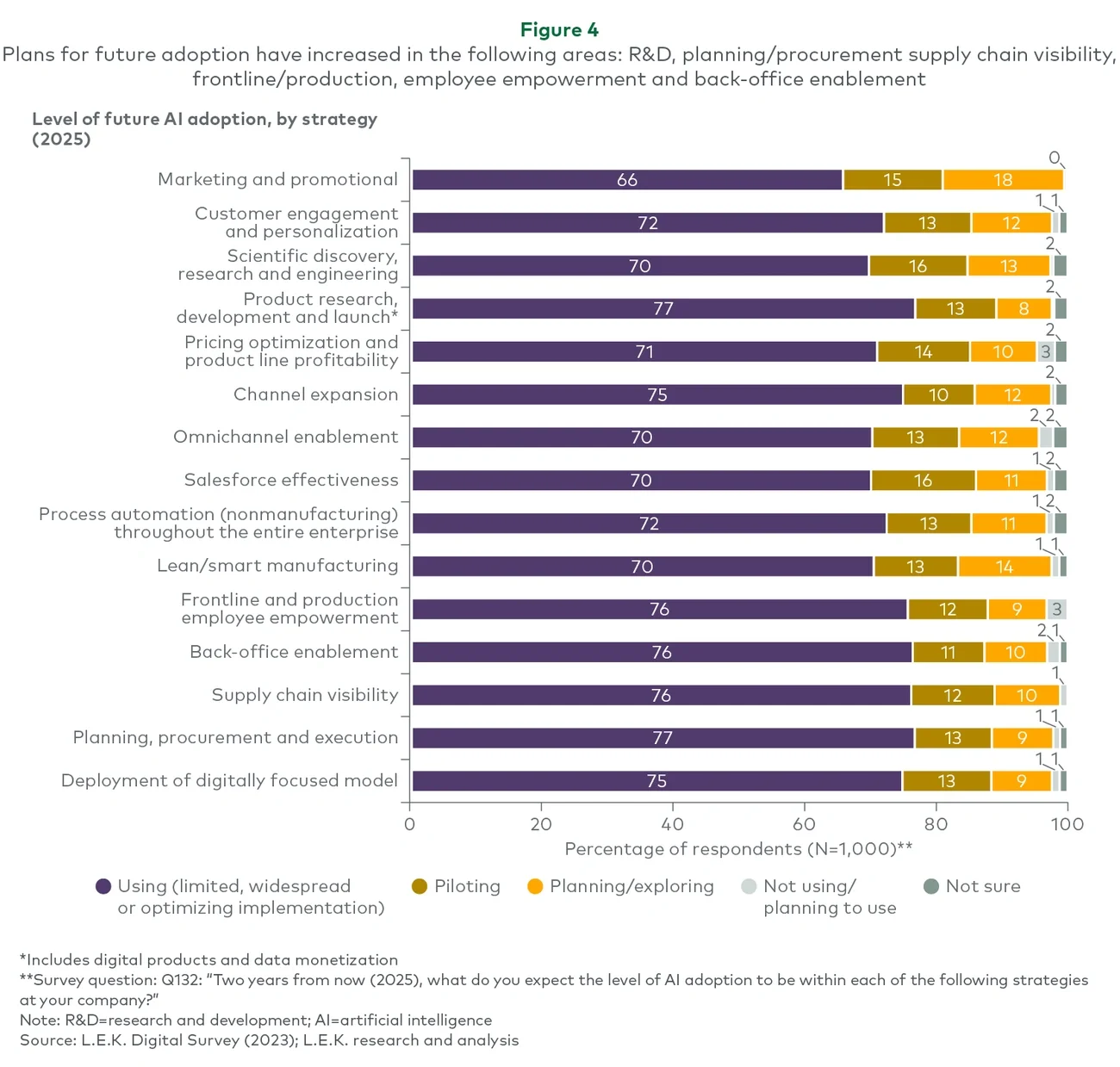
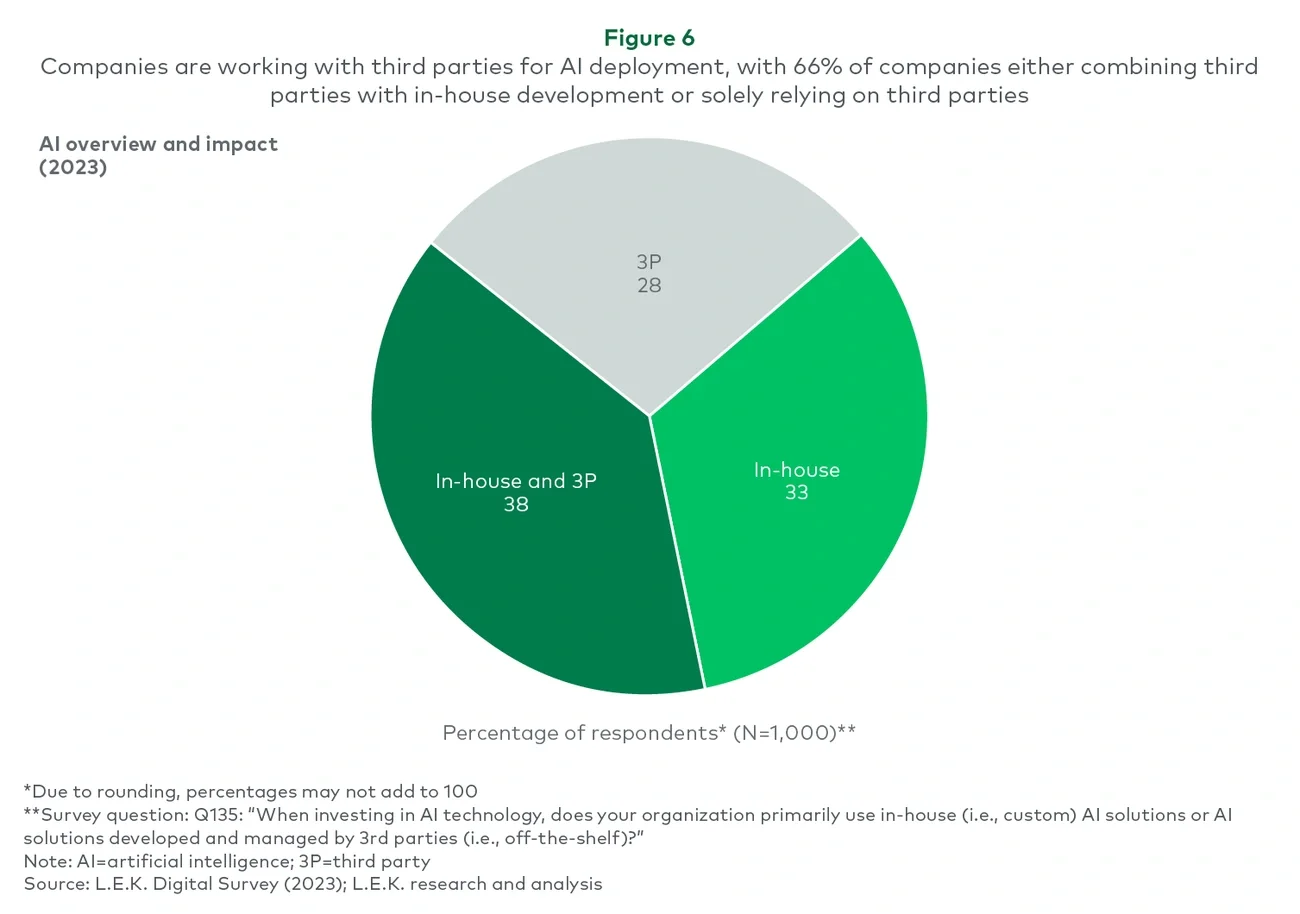
Companies plan to invest broadly in AI — and expand it across more functions. Leaders report they expect to make significant AI investments across all functional areas. They will develop in-house capabilities but also rely on third parties. Interestingly, digital progressives are five times more likely to deploy AI in-house, enhancing their expertise and capabilities more than the digital mainstream.
-
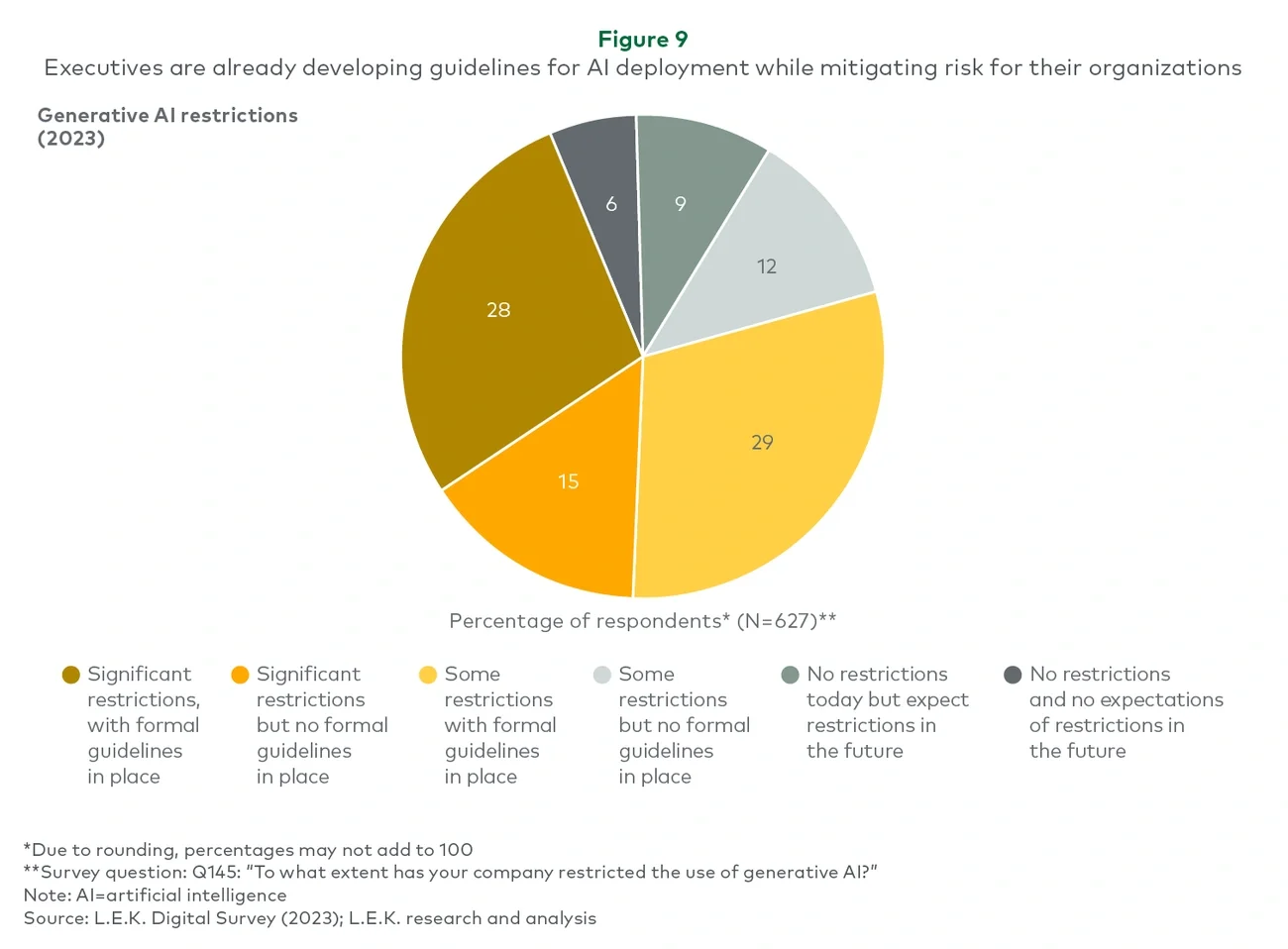
But there will not be an AI “wild west.” Most companies have already established guidelines and restrictions for AI development – and plan to increase restrictions in future. In fact, digital progressives are four times more likely to put significant restrictions on employees, meaning they see the most value but aren’t running fast and free.
-
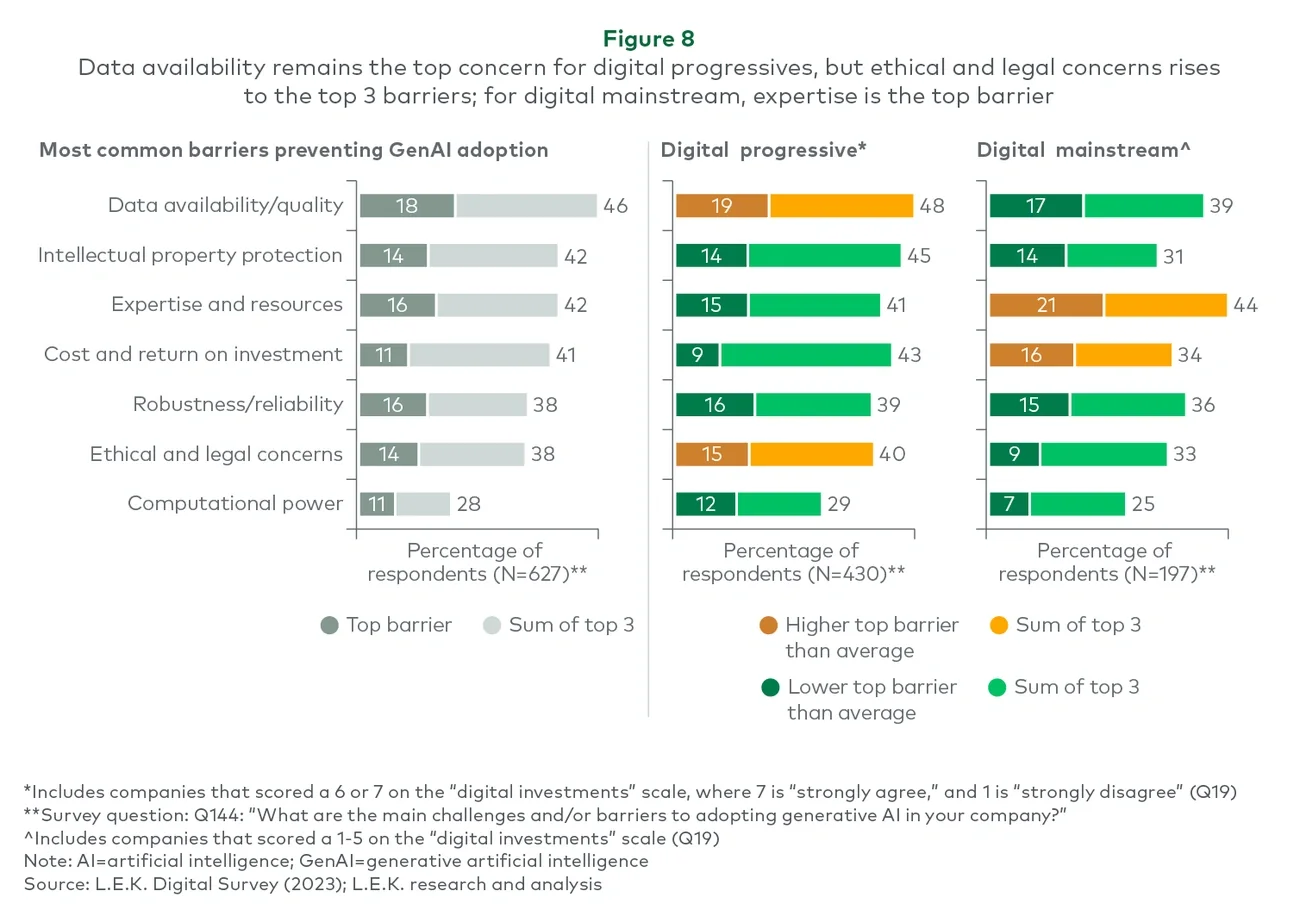
Barriers to generative AI adoption remain. Concerns about generative AI’s robustness and its reliability, as well as the availability of needed data and the challenge of access to necessary computational power, stand in the way of continued adoption.
Survey Results in Detail
Among the survey’s major findings:
“Digital progressives” — who regard their digital investments as a success — expect AI will have high impact on their businesses
Executives are convinced that AI will make a difference. A strong majority expect it to have a high impact on their industry (57% chose six or seven on an impact scale of 1-7) and on their business processes (57%).
But there was a sharp split between digital progressives — those that consider their digital investments a success — and the digital mainstream, who are less optimistic (selecting 1-5 on the scale of 1-7). Seventy-five percent of digital leaders expect AI will have a high impact on their industry, and 74% expect a high impact on their business processes.
By contrast, only 30% of the digital mainstream expect a high industry impact, and only 25% expect a high impact on business processes (see Figure 1).