Executive Insights

新冠疫情对维生素、矿物质和营养补充剂市场的影响

May 1, 2020

从商业的角度来看,新冠疫情的爆发使得商业活动显著减少,尤其是在消费领域。截至2020年4月20日,约95%的美国人受到居家令的限制,各类消费支出都被压缩。而唯一打破这一趋势的消费品类就是维生素、矿物质和营养补充剂产品。事实上,随着人们对整体健康状况越来越关注,消费者对不同VMS产品的需求都有所增加,且这一趋势在世界各国都有所体现。 我们预计VMS类别的产品在潜在的市场衰退压力中也将会保持其增长趋势。VMS类产品在过去经济低迷时期就已经表现出了十足的弹性,而最新的市场数据也显示出与当前趋势的相似之处。鉴于消费者对VMS的需求还将继续增长并超出历史水平,原料供应商、制造商和零售商应立刻着手为长期市场做准备。

消费者注重整体健康状况,免疫增强剂需求因此激增

 从2015年到2019年,美国的VMS市场连续每年增长约6%,超过了同期的功能性食品和饮料(2%-3%)和美国GDP(2%-3%)的增长(图1)。

Image
US VMS market
Image
US VMS market

除美国外,中国的VMS市场也充满了增长潜力与机遇。电商渠道的迅速崛起与监管环境的宽松化给中国市场的成长提供了足够的动能。目前,中国的保健食品市场规模为400亿美元,位居全球第二,且仍保持着接近两位数的年增长率。

在美国市场上,我们可以看到过去的两个月里,新冠疫情已经产生了重大影响,越来越多的消费者目光开始转向VMS,对这类产品的兴趣日益浓厚,接触增加。通过分析与VMS用例相关的社交媒体活动(图2)我们可以清楚地看到,随着消费者对通过改善整体健康状况来预防疾病越来越重视,消费者与VMS产品的接触不断增加。

Image
Reddit, Twitter, and blog post volume on VMS use cases
Image
Reddit, Twitter, and blog post volume on VMS use cases

在与VMS产品相关的社交媒体活动的分析中(图3)也能看到消费者与该类产品的接触有所增加。而在所有VMS产品中,几种提高免疫力、增强整体身体健康和缓解焦虑或压力的产品的增长最为明显。

Image
Reddit, Twitter and blog post volume on key vitamins
Image
Reddit, Twitter and blog post volume on key vitamins

L.E.K.近期与Civis Analytics合作进行的消费者调研(3月31日至4月2日)显示,消费者在社交媒体上表现出的对VMS的兴趣正在转化为消费行为。自新冠大流行开始以来,消费者平均每月在VMS产品上的支出增加了10-15%(图4)。

Image
Impact of COVID-19 on VMS spend
Image
Impact of COVID-19 on VMS spend

在2020年3月30日完成的另一项调查中,20%的未使用过补充剂的消费者表示会在未来三个月使用补充剂,这表明新的VMS消费者正在涌入1

大部分社交媒体的讨论毫不意外都与提高免疫健康的产品相关。消费者针对维生素C、维生素D、接骨木和紫锥花的讨论在3月份快速增加了3 -16倍。供应商表示需求增长超过了20%,这使得这些价值链上的制造商不得不进行拉动式生产。而令人意外的是,近期销售数据显示,除了与免疫健康相关的产品之外,其他种类的产品也实现了增长。美国营养保健期刊(NBJ)网站最近一次研讨会的数据表明,在3月的最后三周,所有种类的维生素和矿物质、食品补充剂、运动营养剂、助消化剂和酶以及氨基酸的周销售额都增长了约20-140%(图5)。

Image
US COVID-19 store sales in VMS
Image
US COVID-19 store sales in VMS

而在中国,市场和政策的进步也同样带来了一些全新的动态。我们观察到,品牌的创新速度已经摆脱了之前循序渐进的节奏而变得更加迅速,备案制的进一步放宽使得更多的海外品牌更快地进入到了国内市场的线上线下渠道,消费者的观念日新月异,且各个年龄段的消费者都对新兴的产品获取渠道和健康理念有了更高的接受程度。

此外在新冠疫情下,中国消费者对于VMS产品的关注度普遍提高,其中不乏疫情前对VMS产品持观察态度的年轻消费群体。在常见产品品类中,有助于提高免疫力、眼部健康、消化功能和睡眠质量的种类大受欢迎。草本类的产品也由于其自然健康的理念获得了显著的销量提升(图6)。在销售渠道方面,消费者群体已经开始由传统线下渠道向线上转移,各群体都在积极地适应疫情下的销售新模式。

Image
US VMS market
Image
US VMS market

面对各国迅速变化的市场环境,市场参与者需要考虑一些关键问题:

  1. 这些对VMS产品的需求中有多少是仅用于日常储备或只购买一次?这样的需求是否将持续存在?
  2. 如果宏观经济状况陷入长期衰退,需求是否会大幅下降?
  3. 公司应该采取哪些运营或商业措施针对VMS产品需求的增长来进行定位?

市场衰退环境中的可持续增长

VMS品类在过去经济低迷时期的强劲表现表明,尽管市场衰退压力不断增加,该品类产品的前景仍然十分光明。在2008-2009年的经济大衰退中,尽管同期美国整体的消费支出的增长明显放缓,但整个VMS市场得以保持弹性,在2008年实现了6.8%的增长,在2009年实现6.1%的增长(图7)。

Image
Impact of COVID-19 on retail channels
Image
Impact of COVID-19 on retail channels

2008-2009年的持续增长反映了VMS消费行为中的两个关键因素,预示2020年的市场需求将形成一个新的、更高的销售基础,VMS市场将在该基础之上实现增长。

首先,健康相关的支出,尤其是VMS产品在经济衰退时期一直属于消费者的优先支出选项,也是最后一个受到影响的可自由支配支出项。VMS产品相关的消费可能会增加,这是因为对于许多人来说使用VMS产品是一种具有成本效益的预防性措施,能够降低医院就诊的需求,从而避免更多的医疗支出,特别是在可支配收入下降和/或医疗保险报销减少的情况下。

其次,VMS品类在衰退期间和之后都保持了增长,到2019年为止平均每年增长5%。值得注意的是,在衰退期间,产品试用的方式吸引了很多新消费者进入,并后续转变成了持续购买者,这为VMS品类的增长建立了更高的消费者基础。鉴于当今消费者对健康的关注度显著增加,采取这样的措施尤为重要。

对当今维他命、矿物质和营养补充剂(VMS)市场参与者的启示

在VMS市场中,市场参与者们应思考如何为该类产品的长期销售增长做准备,包括原料供应商、合同委托制造商、消费品牌和零售商。对于价值链上的任何行业参与者而言,现在就开始准备就能够逐步优化价值创造的能力。

根据我们以往VMS消费者行为的经验,我们认为行业参与者需要考虑以下五个商业关键点:

  1. 稳固供应链和运营
  2. 改进和优化产品组合,以适应消费者的需求
  3. 在现在和未来建立稳健的多渠道销售能力
  4. 为自有品牌预期的需求增长制定战略
  5. 考虑建立能产生协同效应的个性化营养保健品合作伙伴关系

稳固供应链和运营

虽然市场对VMS产品的需求水平有所提高,零售商的供应存在上限。线上和实体零售商表示,随着新消费者进入市场,现有用户开始积累,商品供应开始出现短缺的情况。为了满足消费者的需求,生产商也面临着原材料涨价的问题和短缺的可能性

在短期内,确保供应链能够满足尽可能多的短期需求是至关重要的,这样才不会失去正在尝试该类产品的潜在新消费者。长远来看,由于新冠病毒在全球引起大流行,零售商和制造商应该对采购格外重视,以防范未来风险。减少对单一来源(供应商或地区)的依赖是降低运营风险和消除消费者对产品质量的潜在担忧的关键措施。

改进和优化产品组合,以适应消费者的需求

尽管几乎所有VMS细分市场的销售量都有所增长,但未来各类产品的需求增长预计将是不平衡的。美国营养保健期刊(NBJ)预计到2020年,所有保健品的年销售额将增长约5-8%,甚至更多;而针对感冒、流感和提高免疫力的保健品的销售额预计将同期增长25%以上2。尤其是对某些效果通常更为温和的产品的需求可能会大幅增加;例如,社交媒体平台上关于接骨木的讨论量增加了16倍,超过了关于维生素C和维生素D的讨论量的总和(图3)。

对于零售商和制造商来说,调整产品种类和生产资源以在不断变化的消费者需求中达到供求平衡将是一个挑战,也是最大限度地获取消费者价值和优化未来库存水平的重要因素。

在现在和未来建立稳健的多渠道销售能力

新冠病毒引起的大流行和后续采取的居家隔离措施使得品牌和零售商的多渠道销售能力和战略变得更加重要。在短期内,投资于线上和/或直接面向消费者(DTC)渠道的市场参与者从消费者需求中获得的收益是不成比例的(图8)。

Image
VMS by sales channel
Image
VMS by sales channel

展望未来,多渠道分销战略依然重要。在新冠爆发之前, VMS的线上销售自2015年以来一直保持两位数的速度增长(图9)。随着更多的消费者对在线和直接面向消费者(DTC)的分销模式越来越熟悉,向在线渠道过渡的趋势预计会加快,行业参与者制定和优化线上和直接面向消费者(DTC)的销售战略的需求只会越来越紧迫。

Chinese, Simplified
Executive Insights

新冠疫情下亚太地区数字医疗的加速发展

April 23, 2020

Julien de Salaberry
Julien de Salaberry

新冠病毒在全球范围内引起的大流行是一场前所未有的公共卫生危机,但此次疫情的爆发也正在成为促进数字医疗广泛使用的关键催化剂。医疗行业的利益相关者正在积极采取措施,包括迅速部署数字医疗工具来遏制病毒的传播,减轻医疗体系目前的负担,并最大限度地提高医疗系统的容量。

政府和监管机构还降低了消费者远程参与的门槛,使他们在保持社交疏离政策下也能够获得医疗服务,这一举措是非常有必要的。此外,世界卫生组织(WTO)于2020年4月1日发表了一份关于加强医疗系统,防控新冠病毒的技术指导文件。文件中指出,远程医疗可作为医疗服务的替代模式,以确保基本医疗服务的持续运行。1毫无疑问,这场大流行为已经高度制度化的传统医疗环境创造了以技术为基础的新的工作方式。

在未来几周甚至几个月中,随着医疗行业的利益相关者将会更加急迫的并且更少受到条条框框限制的 进行战略部署,以来遏制不断加剧的感染浪潮,医疗系统的数字化进程将会加速并到达一个新的水平。我们预测,在与抗击新冠疫情过程中形成和完善的新的工作方式和行为方式即便在疫情过后也不会轻易被“抛弃”。随着主要医疗行业的利益相关者(医疗服务提供者、制药公司和医疗技术公司等)开始重新思考新的工作方式,并且将会即便在疫情过后的“和平期”依然打造企业韧性,这样日益推进的数字化的进程将迫使卫生医疗生态系统的进入范式转变。

本文中,L.E.K.将与Galen Growth联手,共同探索亚太地区采取数字医疗紧急措施抗击新冠疫情将会如何加速更广范围的数字化转型,并针对医疗行业如何应对“新常态”提出关键考虑因素。

医疗体系受到冲击导致监管变化

放眼东方,中国很明显在这场危机开始之前就已经成为了技术领导者,并在数字医疗的应用方面远超全球范围的其他市场。例如,中国政府自2014年以来就一直在探索远程医疗的理念,其中包括发布一系列相关规定来推动远程医疗的发展。这些规定不仅使数字医疗相关的法规更加清晰,还扩大了远程医疗的报销范围。伴随着这些政策的落地,数字医疗方式逐渐被广泛采用。截至2019年,中国已经有94%的医疗专业人员使用例如电子病历和远程医疗等相关远程医疗工具。2, 3  
自新冠疫情爆发以来,中国有关部门采取了一系列的数字医疗紧急措施,以减轻大量患者的涌入所带给公共医疗系统的负担。随着疫情迅速扩散,中央政府开始定期发布相关“指导意见”(图1)。消费者也予以了积极的支持和良好的反应,例如平安好医生(中国最大的远程医疗公司之一)的报告称,在新冠疫情发生后,其平台的新注册用户增加了10倍。4

Image
regulatory policies announced by China’s government in light of COVID-19
Image
regulatory policies announced by China’s government in light of COVID-19

亚太和全球其他地区也纷纷效仿,迅速采取行动以提高医疗体系的承受能力,并通过数字化工具的创新来抗击疫情。澳大利亚联邦政府取消了对远程医疗服务的报销限制,允许全科医生和一些专科医生享受远程医疗补贴。5日本厚生劳动省则放宽限制,允许在线医疗咨询和处方药送货上门。6美国食品药品监督管理局(FDA)也声明并不打算对公众用来进行与新冠有关的监控和沟通的移动应用加以限制,而是让新的数字医疗技术来帮助应对这一流行病。7监管部门在疫情之前对数字医疗工具的态度一直模棱两可,对数据和隐私保护的担忧限制了数字医疗工具的发挥,而这些措施的实施则表明监管机构已经一改前态。这场危机所带来的影响是与现有利益相关者的利益相比,以病人为中心的原则占了上风,从而为先进数字医疗技术更广泛的采用打开了大门。

数字化的一切

数字医疗工具中的远程医疗在抗击新冠疫情方面扮演着十分关键的角色,8但事实上,数字医疗领域并不是只有远程医疗,其他工具和方式也正在不断扩展。新冠病毒感染率迅速上升,感染症状又与流感类似,这让医生很难将病毒感染者与寻常流感患者区分开来。目前新冠病毒危机价值链中存在严重未满足的需求,而接触者追踪以及早期症状和无症状的检测和隔离则是这条价值链中的关键点。这些环节出现任何失误都将使医疗体系面临超出负荷的危险。一旦医疗体系崩溃,疫情的持续时间将会被拉长,严重程度也会加剧。

利用数字化解决方案来应对新冠疫情涉及到不同的医疗技术能力(图2),并跨越对患者护理的所有阶段: 

药物研发: 

  • 北京的药物研究所一直在与加拿大生物技术公司Cyclica合作,通过其专门的深度学习机器配对器TM 9来发现和开发针对新冠病毒的抗病毒候选药物

预防: 

  • 在中国,用户可以通过微信和支付宝等应用扫描二维码进行注册,并查询自己是否与感染者有过密切接触10
  • 新加坡的接触者追踪应用TraceTogether则利用蓝牙技术来发现与感染者有过密切接触的人,一天之内该应用的下载量就超过了50万次11
  • 韩国地方政府通过闭路电视或信用卡交易实现对患者的追踪,发现检测呈阳性的居民时会发出警报,警报信息中包括详细记录了该居民在确诊前的日常活动的日志12

诊断:为了加快诊断过程,减轻工作负担,中国正在使用人工智能(AI)工具来对患者肺部进行计算机断层扫描(CT),这样的操作在不需要医疗人员的协助的情况下完成,避免了医患密切接触:

  • 北京推想科技有限公司的技术可以在10秒内诊断出感染新冠病毒的患者13
  • 感染患者在治疗过程中可能需要多次CT扫描,平安的智能图像读取系统能够通过人工智能技术分析病变本身的变化,有助于提高医院的护理能力14

治疗: 

  • 澳大利亚政府推出了居家买药服务,让有需求的弱势群体无需去药店就能远程订购处方药15
  • 新加坡正在鼓励针对糖尿病、抑郁症和双相情感障碍等慢性疾病使用远程医疗16

康复治疗/监测: 

  • 飞利浦正在提升其VitalWatch eICU关键项目的产量,该项目可以从监测中心对重症监护病房进行远程监控,从而帮助医院解决该地区目前临床医生短缺的问题17
  • 中国医疗技术供应商VivaLNK在上海公共卫生临床中心(一家新冠肺炎初级护理中心)部署了一款远程自动监测体温的工具18
Image
Emerging digital solutions during COVID-19
Image
Emerging digital solutions during COVID-19

由于疫情的爆发打破了医疗机构、企业和消费者的过往运营和行为方式,数字化创新因此也被用来缓解此次大流行对供应链和整个医疗行业价值链中企业对企业的工作方式的负面影响。在武汉实施封锁后,无人机技术被用于医院之间隔离检疫材料、医疗样本和用品的运输,这为传统运输方式提供了有效替代。19中国汽车制造商上汽通用五菱对其现有的装配线进行了重新设计,开始生产医用口罩,以帮助缓解全国医疗用品短缺的问题。20制药公司还将其关键的销售力量转移到网上,从而在避免让员工与一线的医生面对面接触的同时仍然保持与医生的互动频率。例如,诺华就增加了对医生的远程学术支持。与此同时,将富有创意的方式融入到在线互动过程中来防止促销疲劳也很重要。

临时举措的永久固化

有些人可能将数字医疗工具视为一种临时举措来减轻新冠疫情给医疗系统带来的压力,但我们预计许多因临时需要而产生的变化将长期存在。因为从历史经验来看,医疗系统受到的冲击往往是根深蒂固的。例如2003年的非典(SARS)就为亚洲国家敲响了警钟,让它们认识到积极主动的措施对未来任何一种传染病的防治都至关重要。非典过后,台湾建立了“国家卫生指挥中心”,它相当于公共卫生当局的中央指挥站,旨在以直接和透明的方式传播相关信息。新加坡和澳大利亚也认识到精简不同医疗利益相关者之间的信息交流的深远的重要性。这两国政府目前也都在通过广受欢迎的移动聊天应用WhatsApp向居民提供与新冠疫情相关的动态,后者正与软件公司Atlassian合作开发一款能够回答常见问题的WhatsApp聊天机器人。

在这场危机过去后,各国政府都将着眼于加强未来的卫生应急准备,因此对数字医疗有利的监管措施不太可能轻易被撤销,。大流行使公共卫生医疗系统在预算方面的挑战广受关注,这使得成为寻求更有效地管理和分配有限的医疗资源的一种手段的数字化医疗更加炙手可热。此外,随着其他利益相关者逐渐采用市场中过剩的数字医疗工具并提高服务水平,我们预计将看到一些行为方式永久性的改变,因为医疗服务提供者、医生和消费者可能会维持这种新的“监管惯性”,新冠病毒危机过去之后也不太会回到以前的行为模式。

企业发展重点的改变

鉴于数字医疗领域正在随着新冠疫情的发展而不断演变,企业可以通过重新思考产品服务创新、核心组织职能和工作方式等方面的战略来为即将到来的数字革命做好准备。由于各国政府和医疗行业的利益相关者已经决心调配所有可用的工具和资源来应对这一重大的公共卫生和宏观经济危机,限制数字医疗行业参与者自由运营的模糊的“许可空间”被迅速地搁置一边。

全世界都在医疗行业数字化转型的风口摇摆,关键的利益相关者可以采取通过积极的应对措施,实现与急剧变化和日益数字化的医疗行业的同步发展。

产品公司,包括制药公司、医疗器械和设备制造商都有机会将数字化嵌入到产品服务创新和各组织职能中,数字化还可以作为客户接触的一部分。例如:

  • 制药公司:数字工具可以通过以下方式增进患者和医生的接触: 
    • 专注于建立数字化路径,使患者在所有治疗路径(意识和预防、有效分诊、诊断和治疗)上都能获得所需的医生和药物支持;
    • 通过提高数字化意识(例如,通过关键意见领袖网络研讨会、在线科学社区、交互式临床试验演示等方式)或提供关键功能的无缝对接(例如,远程订购/库存)来加强与医生的数字化互动。

同时还利用这次宝贵的机会来评估对传统线下渠道(如销售团队)的依赖可以降低到何种程度。虽然在大流行期间,将数字化嵌入到商业模式方面已经取得了一些进展,但在大流行之后,是否对支持数字化互动的面对面销售团队加以控制将取决于对接触医疗人员的限制是否会持续下去或者周期性进行下去。

  • 医疗器械:数字技术通过创新新产品和服务,或者通过利用技术提高运营效率为医疗器械公司提供了获得重要提升的机会。例如:

其他医疗行业利益相关者也关注到更多的商业机会:

  • 医疗机构:为了防止过度拥挤并能触及到偏远地区的患者,医疗服务正在从传统的医院环境向其他替代场所过渡,这为医疗机构催生了使用和整合数字工具来管理和连接不同医疗服务场所的机会。
    • 使用分诊和门诊远程交互工具来减轻目前紧张的医疗服务和资源负担;
    • 增加电子病历的使用,让临床医生更好地了解患者的病史,并提供更加个性化的护理 ;
    • 采用可共同操作的临床管理系统以确保不同类型的医疗设施之间的无缝整合和对工作负荷更有效的管理。
  •  
  • 支付者:在利用数字化医疗管理工具来确保医疗保险理赔顺利进行并改善患者旅程方面,支付者相对会更加积极主动,但现有服务仍有巨大的复制和拓展潜力:
    • 为不同的程序分别制定统一的标准,以减少医疗服务提供者在开具帐单和理赔过程中的行政工作 ;
    • 通过推出在寻求医疗服务前进行自我分诊的数字工具(网站或移动应用程序)来增加患者触及度;
    • 增加与消费者的数字触及度,提高对现有医疗保险方案覆盖范围的了解 。

为数字未来做好准备

总之,亚太地区对数字医疗工具的广泛采用充分反映了新冠疫情指数级传播并将产生长期深远影响的现实。随着监管机构、医疗从业者、医疗机构和消费者联合动用一切可能的手段抗击危机,数字医疗的“许可空间”在一个季度内得到显著扩大。这些行为的转变将会加速,并且还会在这个独特的时间点催生新的业务模式和值得信赖的医疗服务提供者。新冠病毒危机和随之而来的数字医疗的加速应用也提供了一种视角,让我们了解到医疗系统中和消费者还有哪些尚未满足的关键需求,以及通过数字创新可以在哪些地方产生最大的价值。

世界正在快速发展并且不断数字化,制药公司、医疗设备公司、医疗机构和支付者必须先发制人,走在这些变化的前面。有计划、有目的地追求新的营运模式也可以使行业参与者拥有这些新模式可能具备的根本优势,包括以更低的成本提供产品和服务、更广泛地触及病人和客户、采取更具伸缩性的营运、快速适应危机或增长/下降的需求等。
未来的领导者也有各种各样的推进方法,例如内部产品开发和创新、建立合作伙伴关系来利用外部能力及其协同效应、并购等。目前的势头还可以作为催化剂来激活“数据游戏”,而数据往往与数字产品携手并进,并能确保长期价值的产生。那些没有积极加入到当前行业发展势头,也没有对标消费者、医生、医疗系统和政府的核心需求和期望的参与者会发现自己在未来可能没有一席之地。

病毒最初爆发在亚太地区,这些针对该地区所得出的观察结果和启示可能会扩展并适用于其它地区,因为这场大流行给全球医疗系统带来的压力十分类似,即遏制病毒的传播并延展医疗系统的容量。L.E.K.正在对新冠病毒引起的大流行的全球性影响进行评估,后续将以同样的角度持续探讨疫情对世界其他地区的影响,敬请关注。

尾注
[1] World Health Organization – Strengthening the Health System Response to COVID-19: https://euro.sharefile.com/share/view/sbc0659718fd4c8aa
[2] https://images.philips.com/is/content/PhilipsConsumer/Campaigns/CA20162504_Philips_Newscenter/Philips_Future_Health_Index_2019_report_transforming_healthcare_experiences.pdf
[3] APAC Hospital Priorities 2019 Survey: https://www.lek.com/sites/default/files/insights/pdf-attachments/2203-APAC-2019-Hospital-Priorities-Report.pdf
[4] https://www.scmp.com/business/article/3050074/ping-good-doctor-chinas-largest-health-care-platform-reports-jump-users
[5] https://thenewdaily.com.au/life/tech/2020/03/30/telehealth-australia-bulk-billed/
[6] https://project.nikkeibp.co.jp/behealth/atcl/feature/00009/022700048/?P=1
[7] https://www.fda.gov/medical-devices/digital-health/digital-health-policies-and-public-health-solutions-COVID-19
[8] Care at a Distance: Telehealth Expanding Beyond Borders: https://www.lek.com/insights/care-distance-telehealth-expanding-beyond-borders 
[9] https://www.businesswire.com/news/home/20200305005764/en/China%E2%80%99s-Institute-Materia-Medica-Partners-Cyclica-Innovative
[10] http://www.xinhuanet.com/english/2020-02/10/c_138770415.htm
[11] https://www.cnbc.com/2020/03/25/coronavirus-singapore-to-make-contact-tracing-tech-open-source.html
[12] https://www.nature.com/articles/d41586-020-00740-y?
[13] https://www.thelancet.com/journals/landig/article/PIIS2589-7500(20)30054-6/fulltext
[14] https://www.mobihealthnews.com/news/asia-pacific/ping-s-COVID-19-smart-image-reading-system-speeds-diagnoses-and-treatment
[15] https://www.psa.org.au/coronavirus/#1584418401991-f559436b-9e6a
[16] www.go.gov.sg/extension31mar
[17] https://www.usa.philips.com/a-w/about/news/archive/standard/news/press/2020/20190322-philips-ramps-up-production-of-critical-health-technology-products-in-response-to-COVID-19-pandemic.html
[18] http://www.vivalnk.com/covid-19
[19] https://www.gpsworld.com/china-fights-coronavirus-with-delivery-drones/
[20] http://www.xinhuanet.com/english/2020-03/18/c_138891223.htm
[21] https://www.mobihealthnews.com/content/philips-eicu-technology-saved-emory-46m-cms-report-finds

Chinese, Simplified
Executive Insights

中国肿瘤市场的机遇和患者洞察

January 10, 2020

Bin Zhou
Bin Zhou
Kaishen Chen
Kaishen Chen

China is now the second largest pharmaceutical market in the world.1 China’s oncology market alone represents 37% of all lung cancer, 44% of stomach cancer and 52% of liver cancer patients globally.2 Large multinational pharma companies are carrying out initiatives to succeed in the market, and more biotech companies are entering China through either partnerships or greenfield strategies.3 Diagnosis and treatment patterns in China continue to be diverse due to the variation among different levels of hospitals. A comprehensive view of the oncology market is needed to design a winning strategy. In this introduction, we highlight opportunities for international market entrants and provide an overview of the patient and physician landscape in China using LinkDoc’s disease database. The lung cancer market is featured as an illustrative example.

China has led emerging markets in oncology therapeutics spending and growth, growing by 24% in 2018 to reach U.S. $9 billion in spending.4 Furthermore, China has the largest number of cancer patients globally, with 4 million newly diagnosed cancer cases per year in 2018, more than double the number of new cases per year in the U.S.2 In addition, China’s cancer mortality rate is 40% higher than that of the U.S.5 Lung cancer rate, and is the most common cancer type in China, with an overall five-year survival rate of 36%.6 This results in an urgent medical need and continued demand for better lung cancer treatment options in China.

Innovation and reimbursement trends

To address the high cancer disease burden, China has made efforts to drive innovative oncology drug development, which have seen significant results:

  • More than 700 cancer therapeutics from international companies and local Chinese companies underwent nearly 1,500 clinical trials in China between 2009 and 2018.7 Approximately 40% of these cancer therapeutics are targeted small molecules, similar to global market trends.4,7
     
  • Although China had only 10% of the clinical trial volume of the U.S. over the past nine years and its immuno-oncology therapeutics development outside of PD-1/PD-L1 targets is lagging behind the global landscape, recent China policies that enable innovative drug development are expected to further increase the number of clinical trials and innovative immuno-oncology drugs in the future.7,8
     
  • More International Multicenter Clinical Trials are being registered and conducted in China for parallel drug launch in the U.S. and China market.9 Pharma companies now leverage patient resources in China to accelerate enrolment.

As top clinical sites and principal investigators are in high demand, pharma companies need to think about how to strategically design drug development pathways to launch in the China market with first-mover advantage.

Significant increase in volume can take place after reimbursement. For instance, Roche’s revenue has grown at ~28% from 2017 to 2018 with the inclusion of three key products (Herceptin, Avastin and MabThera/Rituxan) on the NRDL in 2017. However, not every reimbursed drug can reach the sales volume necessary to offset the sharp price decline. Therefore, pharma companies with innovative drugs in the China market need to define an appropriate pricing strategy for reimbursement and identify how to optimize the drug’s value proposition after entering the reimbursement list.

Targeting patients

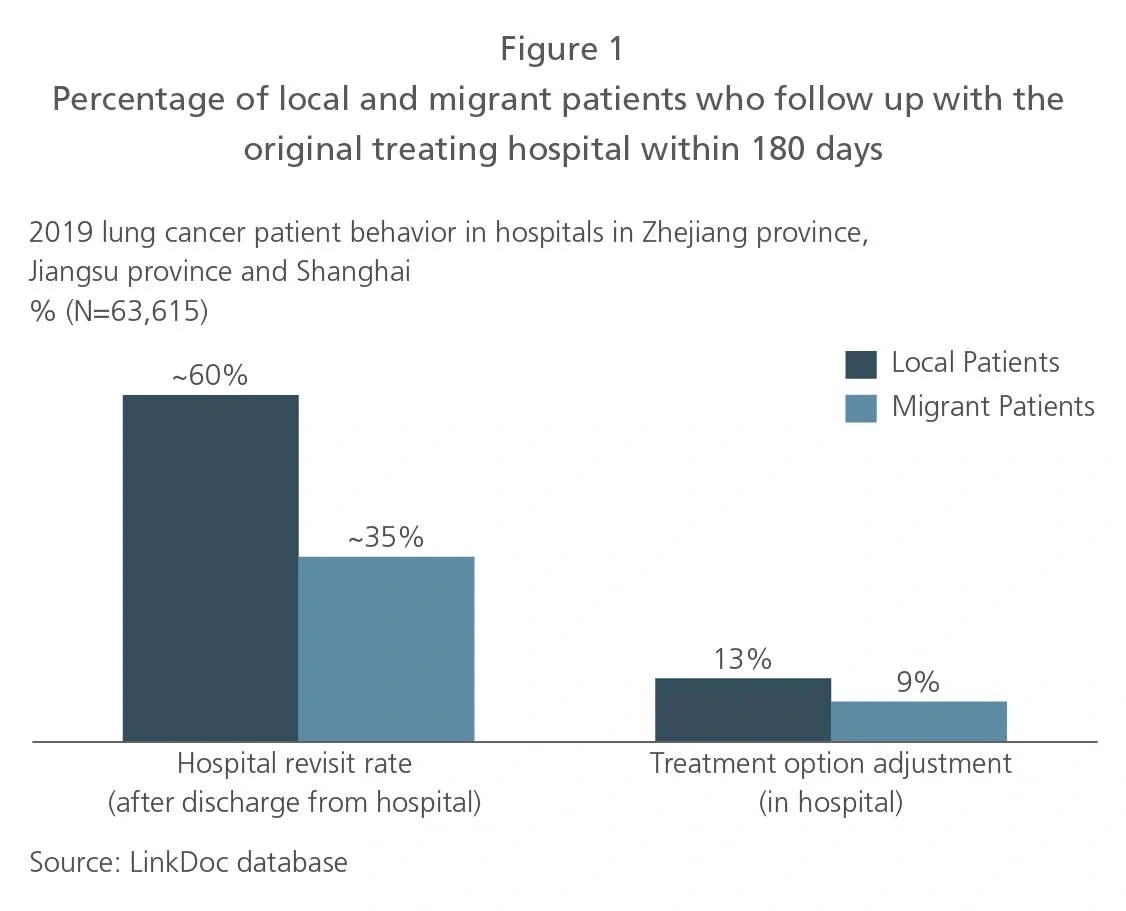
To optimize the value proposition, pharma companies need to be aware of where their target patients are. Given the unequal distribution of healthcare resources in China, lung cancer patients typically go to affluent cities with better hospitals for initial diagnosis and treatment. In Beijing and Shanghai, for example, about 70% and 45% of the respective patient populations are nonresidents.11 Most patients subsequently return to their hometown for ongoing treatment. The percentage of on-time follow-up visits is significantly lower for migrant patients than for local patients (see Figure 1).

Image
migrant patients who follow up with the original treating hospital
Image
migrant patients who follow up with the original treating hospital

To ensure patient compliance and to maximize drug efficacy, companies and hospitals need to work together on continuous follow-up with patients, both inside and outside the hospital.

We further examined the patient flow and treatment paradigm for lung cancer. China’s lung cancer patients are diagnosed and treated in different departments, mainly the departments of respiratory medicine, thoracic surgery and oncology. Although physicians in top-tier hospitals are more likely to prescribe Western medicine, it is common for physicians to prescribe traditional Chinese medicine (TCM) to complement Western medicine. Advanced non-small cell lung cancer (NSCLC) patients often receive TCM concurrently with Western medicine, with TCM adoption at a high rate of about 90%. Pharma companies need to be aware of the prescribing practices, particularly because there is a lack of robust clinical studies that examine how TCM may affect the efficacy of Western cancer therapies.

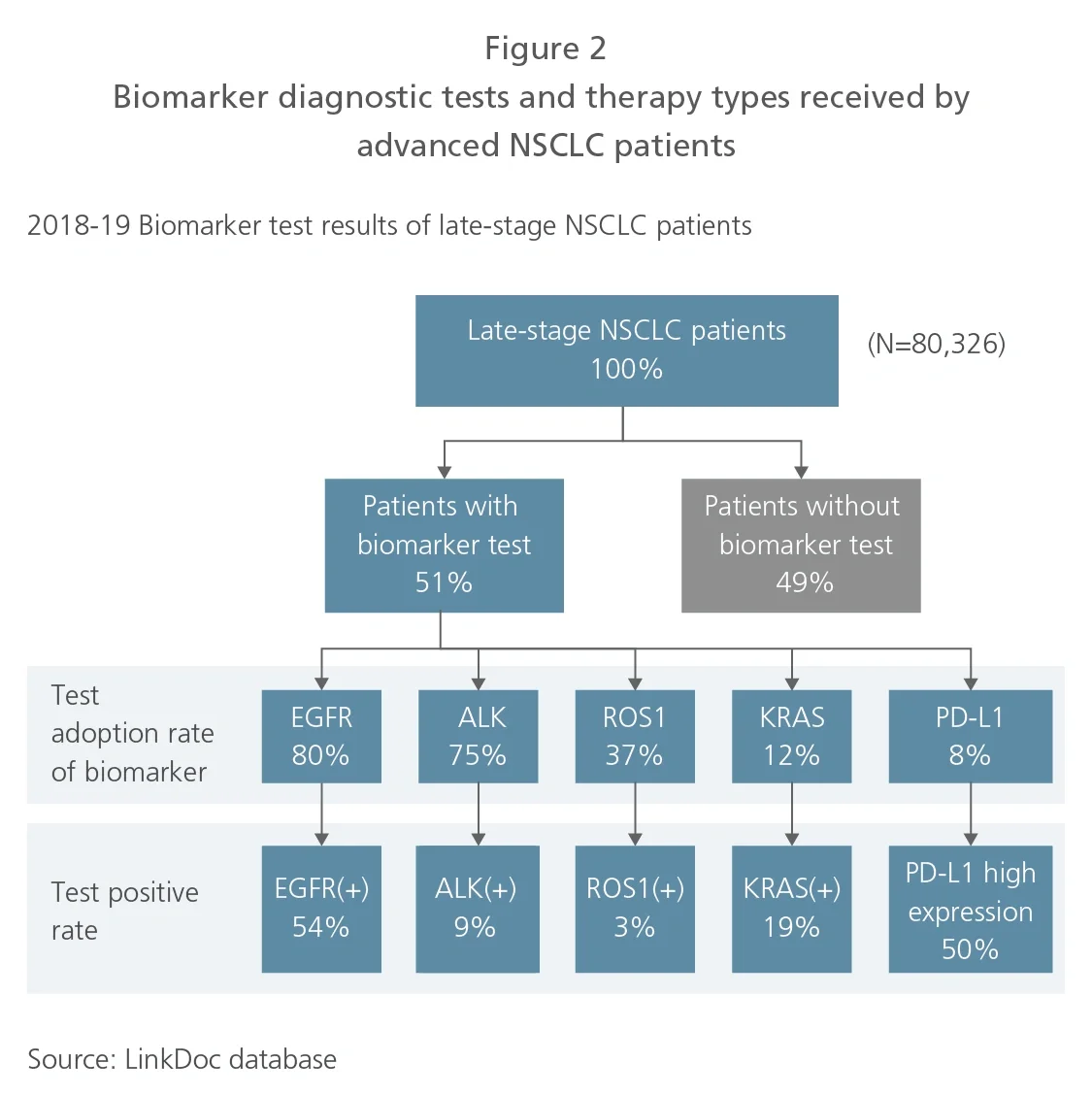
With the national precision medicine initiative, physicians also have increased adoption of biomarker testing prior to prescribing targeted or immuno-oncology therapies.12,13 Physicians in leading hospitals decide on the treatment option after evaluating the biomarker test results. However, in lower-level hospitals where the biomarker test adoption rate is low, physicians may prescribe drugs without considering the gene mutations (see Figure 2).

Image
Biomarker diagnostic tests and therapy types received by advanced NSCLC patients
Image
Biomarker diagnostic tests and therapy types received by advanced NSCLC patients

The lack of national reimbursement for biomarker tests has been the primary cause of low adoption rates. Promisingly, Beijing’s Medical Security Bureau announced official policies in 2019 to reimburse cancer biomarker testing and other cities may eventually follow suit, with national reimbursement expected in the longer term.14 This may drive higher adoption rates in the future.

Taking the first step

With a significant market size and policies that are increasingly favorable for innovative oncology therapeutics, China presents attractive opportunities for international companies. Although there are some challenges in patient access to and physician awareness of biomarker testing in lower-tier cities, the overall oncology market environment in China continues to mature and improve. To seize the business opportunities in China, innovators should consider the following:

  • How should we organize our drug development strategy in China?
  • Which patient segments should we target based on China’s competitive landscape and our portfolio mix?
  • Which hospitals and physician segments should we prioritize in our go-to-market strategy?
  • How do we optimize drug accessibility and affordability for our target patient population?
  • How do we improve biomarker testing adoption of our companion diagnostics to ensure our therapeutics are reaching the appropriate patient population?
  • What types of real-world evidence are needed to expand the usage of our therapeutic across indications, differentiate itself from existing drugs, and influence key opinion leaders’ behavior?
  • How can we optimize pricing strategies, design of Patient Assistance Programs, and set NRDL negotiation tactics to maximize revenue potential?
  • What is the best mode of entry for a company that is not yet present in the market?


Endnotes
1The Global Use of Medicine in 2019 and Outlook to 2023, IQVIA, 2019 
2Global Cancer Observatory (GLOBOCAN), 2018 
3Heading East: Biopharma International Expansion to China and Asia”, L.E.K. Consulting, 2018 
4Global Oncology Trends 2019: Therapeutic, Clinical Development and Health System Implications, IQVIA, 2019 
5Current Cancer Situation in China: Good or Bad News from the 2018 Global Cancer Statistics?”, Cancer Communications, 2019 
6LinkDoc lung cancer database 
7Changes in Clinical Trials of Cancer Drugs in Mainland China Over the Decade 2009–18: A Systematic Review, The Lancet Oncology, 2019  
8L.E.K. analysis of data from Clinicaltrials.gov over 2009-2018 
9Center for Drug Evaluation (CDE) of National Medical Products Administration (NMPA)
10State Medical Insurance Administration (SMIA) 
11LinkDoc analysis of proprietary Clinical Data
12The Promise of Precision Medicine in Asia-Pacific”, L.E.K. Consulting, 2019
13Unlocking the Opportunities for Companion Diagnostics in Asia-Pacific”, L.E.K. Consulting, 2019
14Announcement on Price Regulations for Medical Services Including Pathology”, Beijing Medical Security Bureau, 2018

Chinese, Simplified
Executive Insights

新视角:如何跟上VR/AR发展的步伐?

March 3, 2019

Jason He
Jason He

From internet to mobile internet to VR (virtual reality) and AR (augmented reality), a new technology revolution has arrived. Both leading companies and startups are positioning themselves to take advantage of emerging opportunities. As the competition gradually heats up, developing the right strategies is a priority to succeed in the VR/AR market. Who will be the winner in the VR/AR era?

What is the outlook for the VR/AR market?

Continuous global investment has characterized VR/AR in the past five years

The VR/AR market has been in full swing in the past five years — a number of companies have rushed into the market.

In 2017, global investments in VR/AR hit a record of nearly $2.3 billion. The United States is the largest VR/AR market, accounting for approximately 45% of the global investment; China is the runner-up, accounting for 25%.

After rapid development in 2016-2017, the global AR/VR industry entered a correction phase in 2018, and L.E.K. Consulting expects the growth rate of related investments to decline. At the same time, as investors become more rational, the industry’s focus has shifted from concepts to commercial applications. We believe that in the next two to three years, the market will maintain steady growth, driven by the gradual maturity of content development and industry applications.

VR/AR tools and basic technologies account for 40% of total investment, whereas hardware accounts for 35% and enterprise/vertical applications for 8%. The remaining investment went to games, entertainment an other applications.

In terms of deal numbers, enterprise/vertical applications have quintupled in the past two years and become the most active areas for investors. In the content markets such as games and entertainment, investors have become more conservative, and the deals are concentrated among the leading players in each category.

Image
VR/AR global investment history 2013-18E
Image
VR/AR global investment history 2013-18E

A viable technology development road map has been defined

Key technologies of VR (near-eye display, rendering processing, etc.) already have a clear development path. The maturity of sensing technology and the interactive sensing experience has greatly enriched VR use cases.

AR technology has also made great progress on multichannel interaction and network transmission. However, AR is more complicated, with simultaneous localization and mapping (SLAM) algorithms and relevant peripherals and optical displays; thus, its technology maturity is lagging by one to two years.

Image
VR/AR technology maturity road map
Image
VR/AR technology maturity road map

Global VR/AR market growth will see an inflection point in 2019-2020

According to L.E.K. research, in the first half of 2018, mobile AR, AR glasses, all-in-one VR and PC-VR equipment all enjoyed a more than 50% growth rate. L.E.K. expects the inflection point of the VR/AR market will arrive in 2019-2020 and the market will reach $145 billion by 2025.

Image
Global VR/AR market size forecast 2013-18E
Image
Global VR/AR market size forecast 2013-18E

We estimate that shipments of PC-host VR and all-in-one VR will reach 14 million units by 2021 and will reach 62 million units by 2025.

Image
VR global shipment prediction 2017, 21F, 25F
Image
VR global shipment prediction 2017, 21F, 25F

The main drivers of the VR market right now are the business markets of education and retail. With VR technology maturing and price declining, consumers will present an even bigger market.

Image
AR global shipment prediction 2017, 21F, 25F
Image
AR global shipment prediction 2017, 21F, 25F

The more complex AR technology will likely be ready by 2023. AR shipments will reach 32 million units by 2025. Business applications will dominate the market in early years. With major internet companies such as Google, Facebook, Microsoft and Apple driving the market, consumer adoption will accelerate.

Who will lead VR/AR development?

Leading global technology companies, including Google, Microsoft, and Baidu, Alibaba and Tencent in China, are investing in and leading B2C-end.

The VR/AR value chain is a diverse ecosystem that begins with hardware and moves through operating systems and development tools to applications, content, sales and distribution.

Image
VR/AR value chain
Image
VR/AR value chain

Leading internet companies such as Facebook, Google and Microsoft cover the complete value chain, from interactive devices, terminal platforms and developer tools to distribution platforms.

Powerful developer tools and distribution platforms attract many third-party providers to develop content for them and in turn build a complete ecosystem.

For these leading internet companies, the consumer market represents greater opportunities. Many of them have invested heavily in both software and hardware. They will likely dominate the consumer market through defining and standardizing the application architecture of VR/AR, and by customizing software services and solutions.

Diverse demands from business customers will provide opportunities for emerging players

The business market consists of diverse segments and requires integration with domain knowledge. Current VR applications in business are limited to weak-interaction services such as education and tourism.

VR/AR solution companies should refer to application scenarios and embed industry logic in their solutions. They can enhance their control of the value chain and become the provider of integrated solutions to further address the needs of business customers.

As an example of AR’s application in industries, the method for steel plate inspection and grading differs depending on downstream application. Though experienced workers are able to perform visual grading, it is rather time-consuming and labor-intensive. AR solution companies can collect steel plate grading rules through AI learning and computer vision and embed this rule base into software products. This can create a high technical barrier to additional market entrants.

Image
Diversity of AR/VR B2B applications
Image
Diversity of AR/VR B2B applications

How to evaluate VR/AR companies

Consumer segments are likely to be controlled by the leading technology companies due to their technical prowess and significant resources. More opportunities exist in B2B segments. To evaluate a potential target, it is imperative to verify three aspects.

First, the company has the capability of “software and hardware integration.” In other words, it can customize and optimize the underlying software based on hardware/firmware characteristics.

The B-end of VR/AR covers various industries. There are multiple use cases in each industry, and the configuration of hardware devices may be different for different use cases. However, open source operating systems such as Android do not provide complete support for different mobile chip instruction sets. VR/AR B-end software products require secondary development to be compatible with different hardware or to achieve optimal performance. The excellent B-end AR/VR company needs to work closely with hardware manufacturers to ensure product portability and performance.

Second, the company has a clear industry focus and has accumulated rich experiences.

Customer acquisition in B2B is costly, but the switching cost is equally expensive. B-end software companies often carry out large amounts of communication, research and development, product iteration, and debugging work with their customers. The learning curve is steep. AR/VR software companies with deep experience and knowledge in a specific industry often establish brand reputation and certain technical capabilities. They often have more control of the value chain and can capture a bigger profit share.

Third, the company’s solution offerings are well-thought-out and focused on business markets where it can differentiate.

Development of the AR/VR industry is still in the initial stage. The technology’s application in many industries and fields is still in the concept stage. The business model and profitability also need to be verified. Blindly carrying out cross-industry expansion not only is unconducive to its own technology and product capabilities, but also has a high opportunity cost.

Chinese, Simplified

风起云涌的动力电池市场:如何能够脱颖而出?(EN)

September 17, 2018

Chinese, Simplified
Executive Insights

解读液体活检:临床应用,技术以及企业

January 10, 2018

Image
Liquid biopsy applications
Image
Liquid biopsy applications

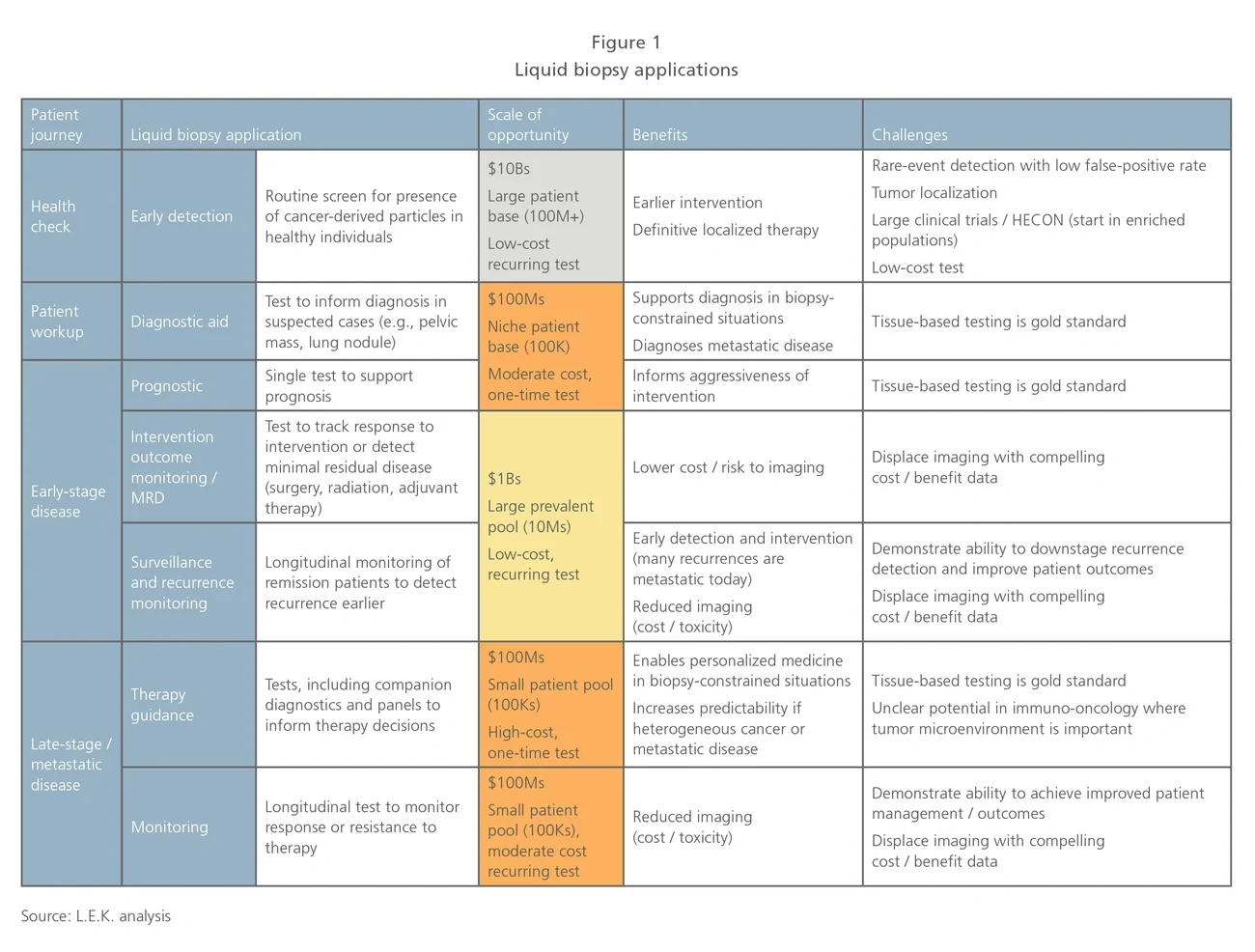
While therapy guidance is the leading application today, monitoring and early detection are expected to represent the most sizable and impactful applications in the future. Early detection has the potential to downstage cancer detection, enabling definitive intervention (e.g., full tumor resection), and could become a routine part of health checks, similar to mammograms and colonoscopies. Monitoring applications are myriad and have the potential to reduce the current dependence on imaging, as well as potentially detect recurrence or resistance earlier than traditional approaches, again enabling earlier intervention or changes in management.

In aggregate, analysts estimate the market potential for liquid biopsy applications to represent tens of billions of dollars, making liquid biopsy one of the most scalable opportunities diagnostic companies have encountered in decades.

Multiple liquid biopsy techniques exist

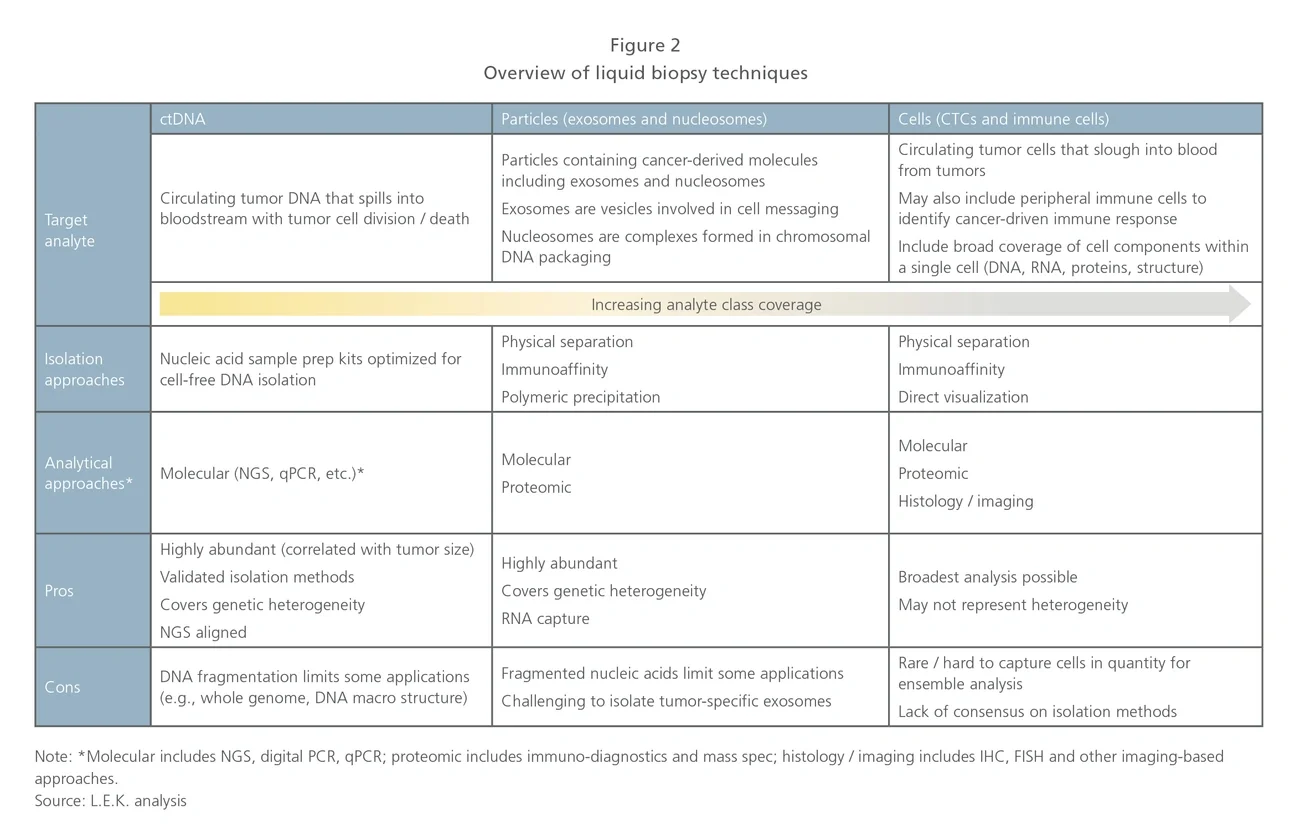
Central to liquid biopsy techniques is the capture and analysis of tumor-derived particles, which may include nucleic acids, proteins, exosomes, nucleosomes and cells. Since tumors divide, die, communicate and migrate, it is possible to find traces of their existence in biofluids. However, since these tumor-derived particles are typically rare, analytical approaches require very high sensitivity (NGS or digital PCR) or upfront enrichment (e.g., CTC cell capture).

There are multiple technologies used in liquid biopsy (enrichment and analysis), and it appears diverse approaches (and combinations thereof) may be required to address the breadth of potential applications (see Figure 2). Among all techniques, the combination of deep sequencing circulating tumor DNA or “ctDNA” using next-generation sequencing (NGS) represents the majority of current activity, but targeted (qPCR, digital PCR) approaches to measuring ctDNA are also being leveraged.

Image
Overview of liquid biopsy techniques
Image
Overview of liquid biopsy techniques

Beyond ctDNA, there is also significant activity in capturing and analyzing exosomes (vesicles involved in cell messaging), nucleosomes (chromosomal DNA packaging units) and circulating tumor cells (CTCs), as these contain a broader selection of tumor-derived analytes — including DNA, RNA and proteins — and may bring deeper insight into cancer biology versus ctDNA alone. While not based on detecting tumor-derived particles, capturing and analyzing immune cells is also emerging as a complementary technique in liquid biopsy and may be relevant in early cancer detection, as well as in guiding and managing patients on immunotherapy.

The competitive landscape is broad and dynamic

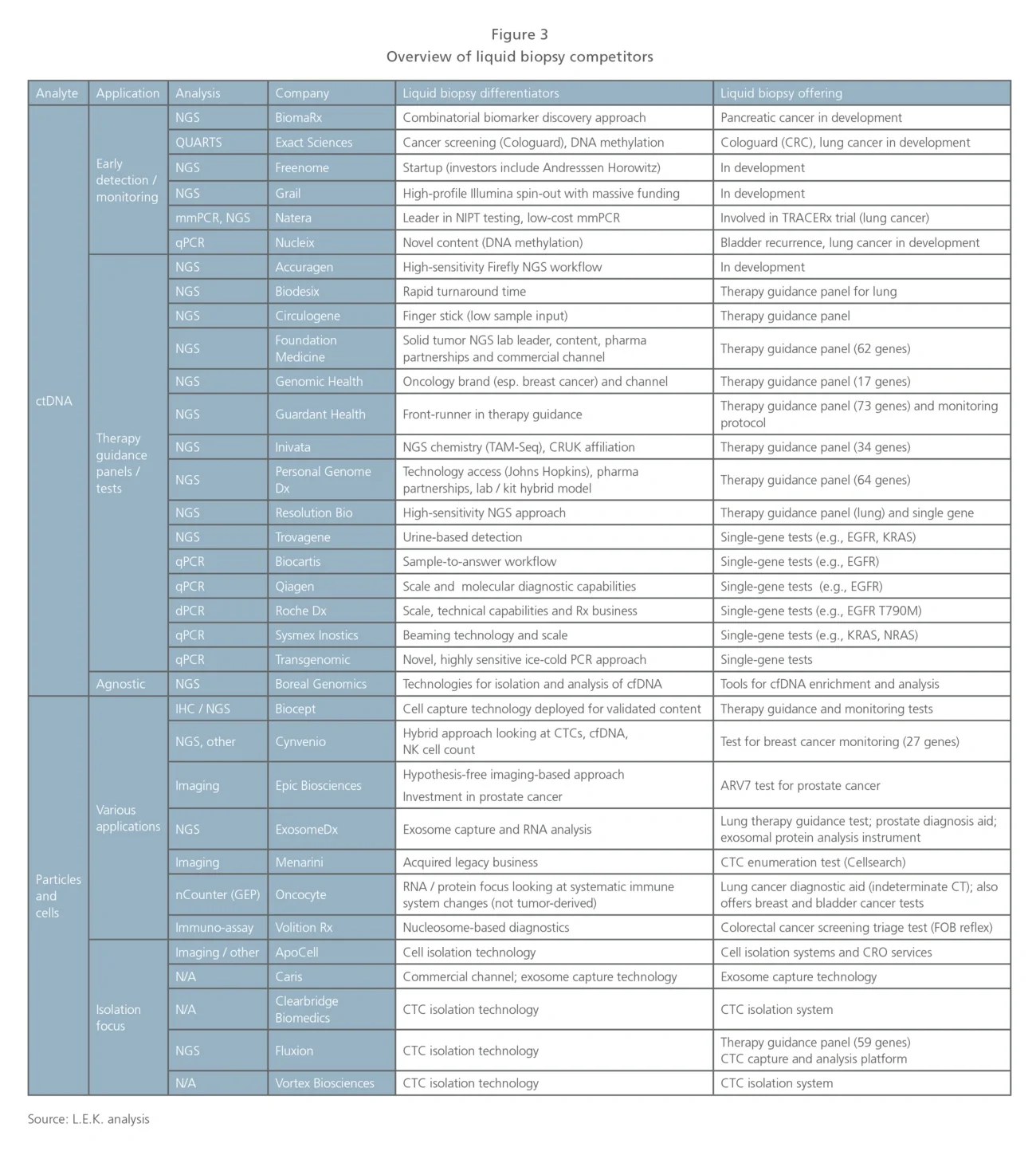
To date, we have identified over 30 different liquid biopsy competitors (see Figure 3). And while each competitor may have unique differentiators and offerings, we have attempted to categorize them into distinct segments based on a mix of technique/technology and current application focus.

Image
overview of liquid biopsy competitors
Image
overview of liquid biopsy competitors

Differentiation in the nascent clinical liquid biopsy space today appears to be driven by a mix of technology (e.g., sequencing chemistry, cell capture technology and informatics) and investment in clinical trials/data to support utility. Commercial differentiation is minimal as few companies have reached the scale where this represents a meaningful differentiator. The intellectual property landscape is also dynamic and expected to support company differentiation in the future.

Looking across the competitive landscape, we define the following clusters:

Early detection using ctDNA. Probably the most exciting segment (given its potential to impact health screening in the general population) includes various players seeking to develop offerings in early cancer detection and screening.

Competitors in this segment are expected to differentiate with clinical data to support test utility. Clinical studies for the general screening population are likely to be massive (~100K patients) in scale and require significant longitudinal analysis.

Grail is the poster child in the early detection space, having raised $1 billion in VC funding and recently embarked on a 120,000 patient study for early breast cancer detection. Many others are eyeing the early detection space, and some may ease their way into the general population applications through trials in at-risk patients, or as a reflex to other screening methods (e.g., low-dose CT, fecal occult blood).

Therapy guidance using ctDNA. This segment is the most crowded and is seeing actual clinical application today in metastatic patients. There is a core group of players deploying NGS-based liquid biopsy panels to support therapy guidance in biopsy-constrained situations. The clear front-runner here is Guardant Health, but many other competitors — several of which also play in the solid-tumor panel NGS space (e.g., Foundation Medicine, Personal Genome Dx) or have some differentiating technology enabling higher sensitivity or smaller sample input amounts — are also present.

Many traditional oncology diagnostics companies (e.g., Roche, Qiagen) have targeted single-gene tests based on PCR in the therapy guidance space, including regulated kits for companion diagnostic biomarkers such as EGFR. Players in this space are also likely to transition into monitoring applications for tested patients (looking at resistance or recurrence in treated metastatic patients).

Particles and cells (exosomes, nucleosomes, CTCs and immune cells). This is a heterogeneous segment developing varied clinical applications based on analysis of captured particles or cells. In some instances, competitors are enabling existing biomarkers to be measured from blood (e.g., Biocept, Exosome Dx) whereas others are developing novel content (e.g., Epic in prostate cancer and Cynvenio in breast cancer).

Epic is unique in that they do not enrich CTCs; rather, they image cells in a monolayer. Epic has focused efforts on prostate cancer and recently launched an ARV7 test to guide prostate cancer treatment. Cynvenio is interesting in that they are combining multiple techniques for their breast cancer recurrence monitoring test, which includes ctDNA and CTC DNA sequencing, as well as NK cell enumeration. Oncocyte is focused on blood-based immune cell function analysis. Another group of competitors in this space offers tools for CTC capture using various approaches, but is not focused on specific applications.

Significant opportunities lie ahead

The market opportunity associated with liquid biopsy represents one of the largest and most dynamic diagnostics/healthcare opportunities. While we are excited about the market potential and clinical utility, we urge pharma stakeholders, tools companies, diagnostic developers and other market stakeholders to carefully consider the impact liquid biopsy may have on the oncology landscape and what it will take to play and win.
Chinese, Simplified
Subscribe to