From internet to mobile internet to VR (virtual reality) and AR (augmented reality), a new technology revolution has arrived. Both leading companies and startups are positioning themselves to take advantage of emerging opportunities. As the competition gradually heats up, developing the right strategies is a priority to succeed in the VR/AR market. Who will be the winner in the VR/AR era?
What is the outlook for the VR/AR market?
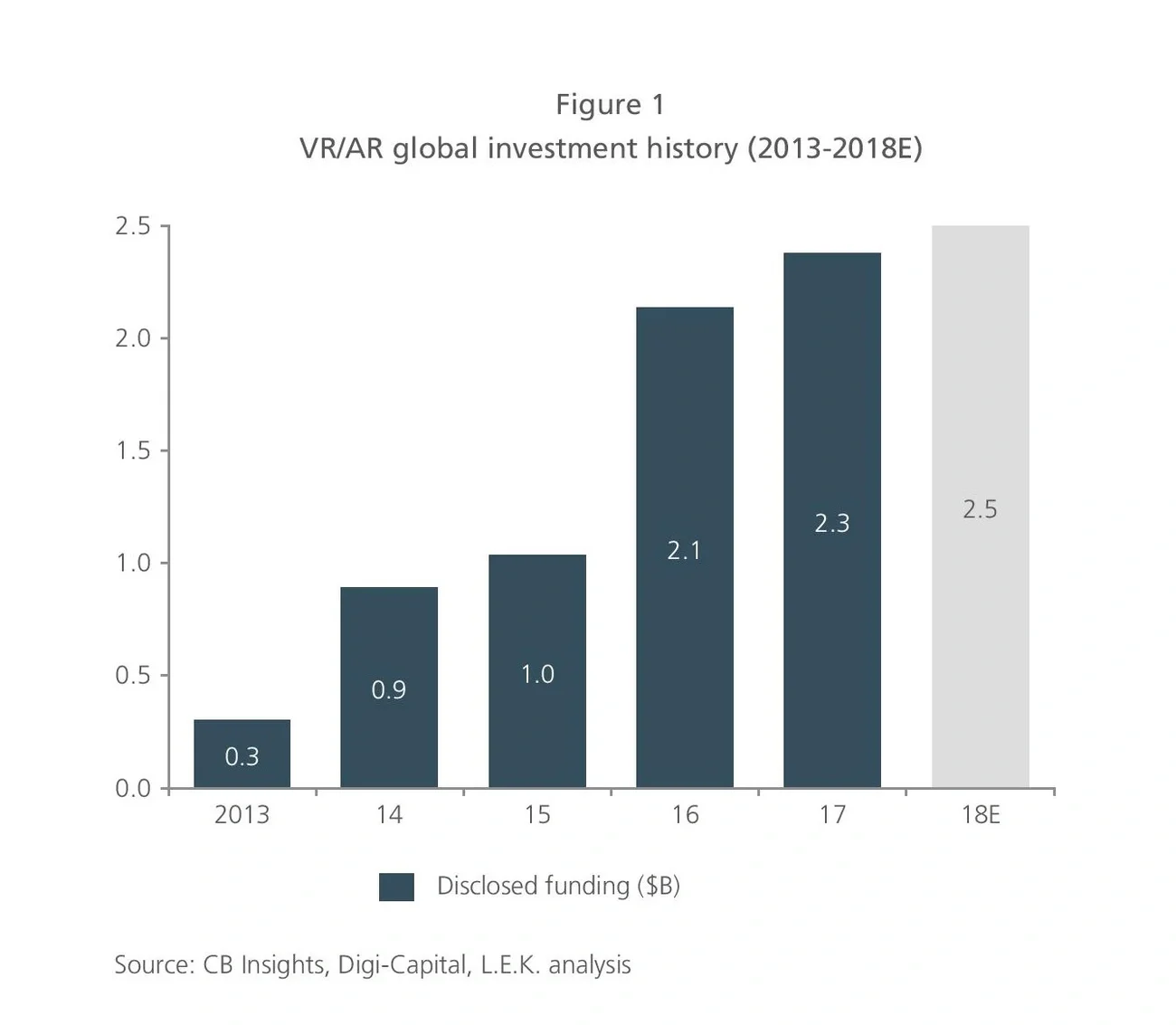
Continuous global investment has characterized VR/AR in the past five years
The VR/AR market has been in full swing in the past five years — a number of companies have rushed into the market.
In 2017, global investments in VR/AR hit a record of nearly $2.3 billion. The United States is the largest VR/AR market, accounting for approximately 45% of the global investment; China is the runner-up, accounting for 25%.
After rapid development in 2016-2017, the global AR/VR industry entered a correction phase in 2018, and L.E.K. Consulting expects the growth rate of related investments to decline. At the same time, as investors become more rational, the industry’s focus has shifted from concepts to commercial applications. We believe that in the next two to three years, the market will maintain steady growth, driven by the gradual maturity of content development and industry applications.
VR/AR tools and basic technologies account for 40% of total investment, whereas hardware accounts for 35% and enterprise/vertical applications for 8%. The remaining investment went to games, entertainment an other applications.
In terms of deal numbers, enterprise/vertical applications have quintupled in the past two years and become the most active areas for investors. In the content markets such as games and entertainment, investors have become more conservative, and the deals are concentrated among the leading players in each category.