

Society is on the verge of a global social and economic change with the mass introduction of commercially viable connected and autonomous vehicles (CAVs) and the continued expansion of the shared economy into urban transport. These trends are expected to drive profound changes to public and private transport in our cities. They will also influence many other parts of the economy, including civic infrastructure, logistics, service delivery, legislation and real estate development.
While CAVs will not be the dominant mode of road transport for several decades, driverless cars are already here. Earlier this year Waymo launched a service in Phoenix, Arizona, and customers can now book a self-driving car using the Lyft app.
The Phoenix launch is a key juncture for the CAV industry. After billions of dollars of research and development, companies are testing society’s readiness for CAVs, with regard to both their capability on real-world roads and their value for everyday users.
While it is uncertain when CAVs will be commercially available on our roads, we do know that they are coming — and that when they do, there will be significant implications for the use of major infrastructure assets (such as roads, toll roads, rail, large car parks and mass transit) and for infrastructure investors making long-term capital decisions about these assets.
This paper addresses two key questions:
- What is the potential capability of CAV technology (particularly, its impact on demand for road space and capacity implications for the existing road network)?
- How will consumers adopt CAVs?
Understanding the potential of CAV technology, in conjunction with likely consumer reactions, reveals the potential impact of this technology on demand for existing road and transit networks. L.E.K. Consulting has been working with clients to develop early perspectives on these questions, to help narrow the uncertainty about CAV technology in the context of major capital investment decisions.
To understand how these questions will shape and be shaped by human behaviours, L.E.K conducted sophisticated statistical analysis (choice modeling) on roughly 2,000 people in Sydney, Australia. This shed light on what sort of behavioural changes could be associated with the introduction of CAVs, supporting our understanding of how consumers are likely to interact with the emerging technology.
We have identified four key impacts of CAV technology. Infrastructure investors need to keep these in mind when considering long-term capital decisions for assets potentially affected by CAV technology.
Improved road network capacity
CAVs appear capable of drastically reducing headways and will significantly eliminate human error, the primary cause of road accidents. CAVs will, however, take time to be the dominant mode of road transport, and the realisation of these benefits will depend on customer willingness to accept the technology.
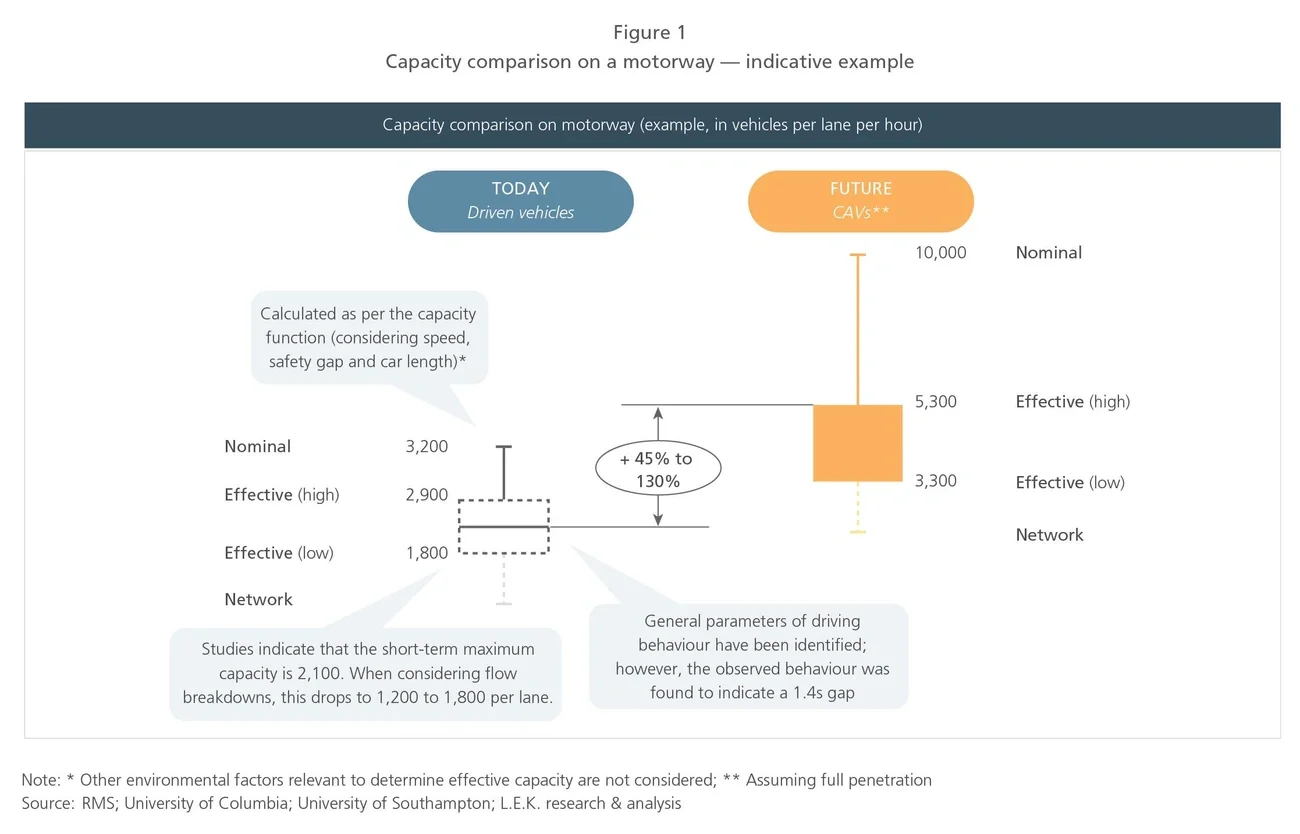
CAVs are expected to improve road capacity, driven by technology-enabled reduction in the safety gap (i.e. vehicle headway), from around 0.9 seconds (s) to about 0.2s and eliminate accidents related to human error. When taking human comfort into account, researchers estimate the minimum tolerable safety gap to be around 0.5s between vehicles. The result of this improvement is an estimated effective capacity between 3,300 and 5,300 vehicles per lane hour (Figure 1) — an increase of 45% to 130% in vehicles per lane hour compared with today1 but still less than what the technology is capable of delivering.
The wide forecast range is driven by the selection of an appropriate baseline and uncertainty in the degree to which technology capabilities will be applied in the future. Despite this, a number of sources point towards estimated effective CAV capacity uplifts in the range of 60% to 80% in vehicles per lane hour.
The period in which the CAV fleet shares the roads with human-driven vehicles may see certain additional safety measures imposed, such as conservative programming of CAVs. These safety measures are expected to cause a reduction in capacity, compared with today, until the majority of the fleet has successfully transitioned to CAVs.
Induced or new demand for the road network
Market research completed by L.E.K. suggests that new trips made in CAVs will add between 5% and 15% to total traffic levels.
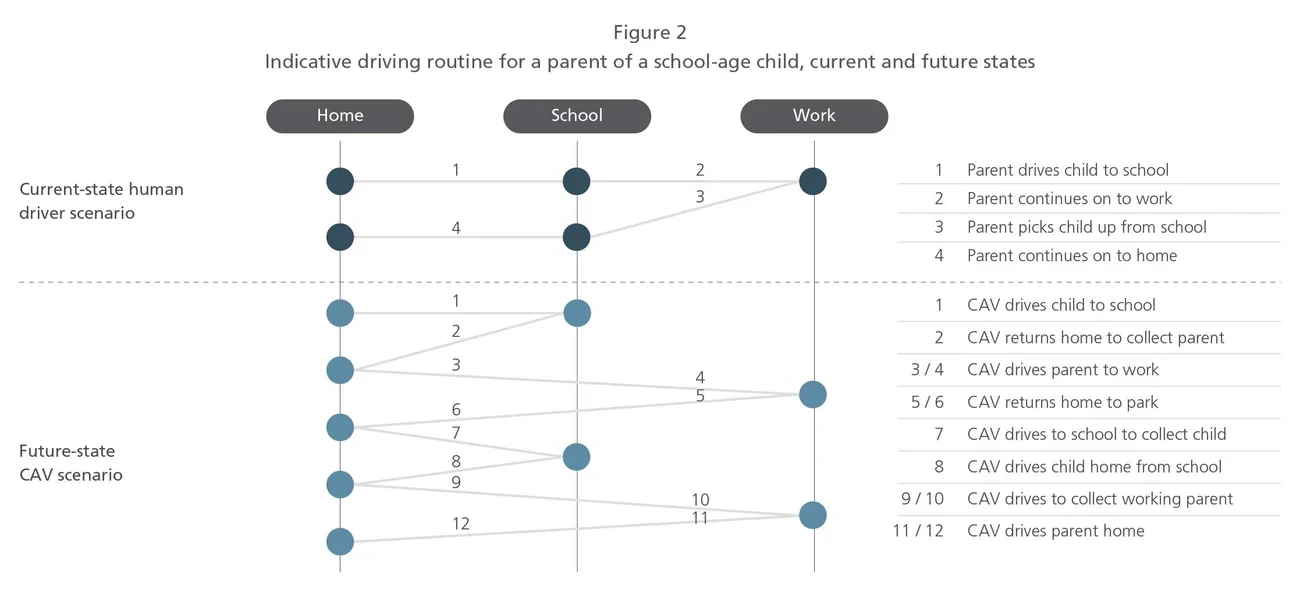
New (or induced) demand is expected to be concentrated in three main areas: new trips taken by the general population, the disaggregation of existing single trips into multiple future trips and new demand from population segments currently facing barriers to travel (e.g. children, the elderly and people with disabilities).
The added convenience of CAVs and their anticipated cost-effectiveness is expected to increase discretionary leisure trips in particular by c.5% to 20%.
The adoption of CAVs through new or induced demand will no doubt face barriers. For example, regulations may be placed on children riding alone, certain groups of people may feel unsafe in ‘pooled’ scenarios and some individuals may retain the desire to drive their own vehicles for the sheer pleasure of it. Nevertheless, anticipating that most barriers to adoption can be overcome, L.E.K. found that new (or induced) demand could stimulate an uplift of c.5% to 15% in average vehicle trips per person in comparison to current levels.
Trip intensity
A trip multiplier could also come into effect with single trips that currently serve multiple purposes being disaggregated into two or more trips in the future. L.E.K. research suggests that this trip multiplier could have the most significant impact on education trips, which could increase by up to c.100%.