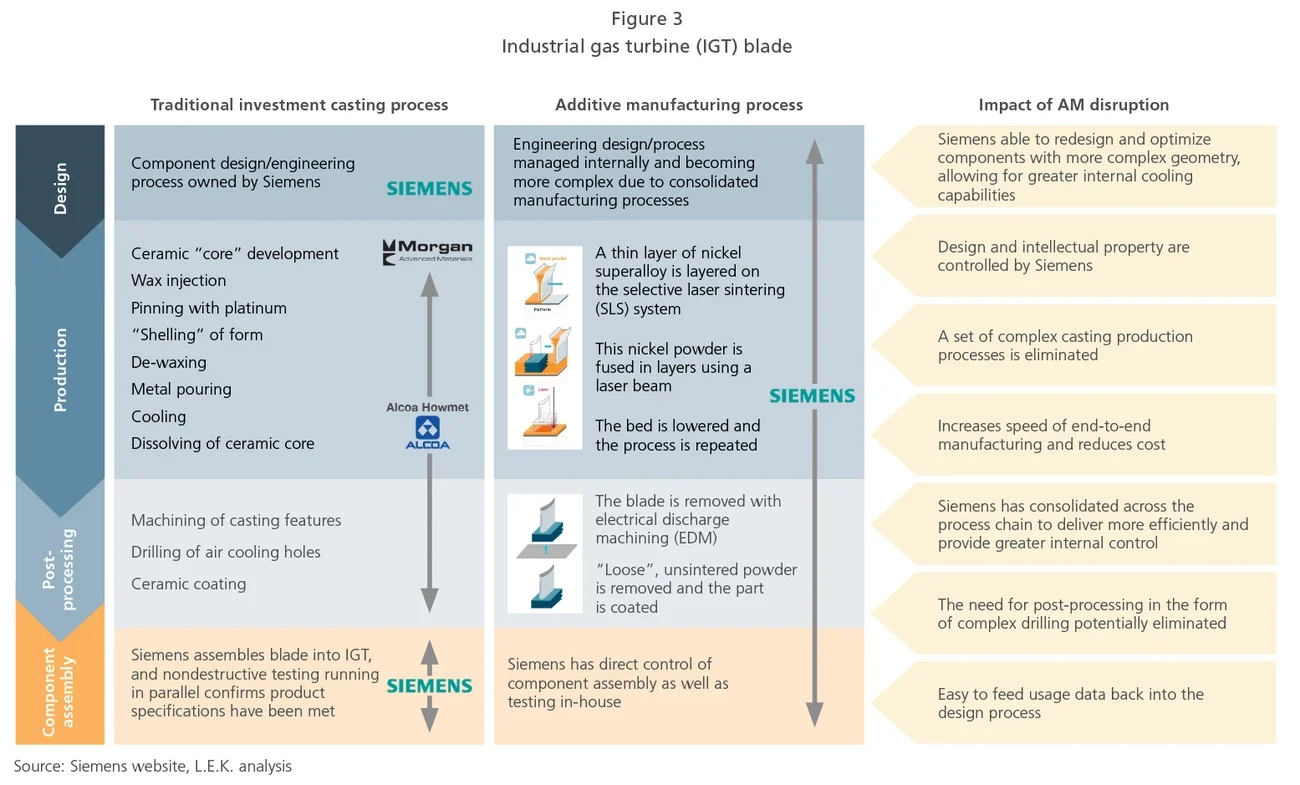
The company developed the prototype turbine blade to test the ability of AM-manufactured parts to withstand high stress loads (including physical pressure, temperatures and rotational forces). It was successful in installing and testing the blade in a turbine, and now produces the product commercially for its turbine aftermarket.
Through using AM and keeping the entire process in-house, Siemens generated multiple benefits:
- Able to easily redesign the blade until its performance was optimized
- Full control of intellectual property
- Eliminated the multistep casting process of traditional manufacturing and the need for complex drilling post- processing
- Internalized supplier margins
The entire process was complete in just 18 months — far faster than would be possible using traditional manufacturing methods. In addition, Siemens is now able to feed its parts usage knowledge back to its engineering and design departments to further optimize its future AM processes.
Siemens has also successfully used metal AM to maintain turbine burner heads. Previously, the company repaired worn heads by removing a large part of the product before rebuilding it with traditional methods. Now, using AM, Siemens removes just a fraction of the head and prints the replacement material onto the burner. This process has reduced repair time from 44 to four weeks, increasing customers’ efficiency and reducing their maintenance costs.
GE is another company that is pioneering the use of AM through full process integration. It has invested $1.5 billion in the technology, including $50 million in a factory in Alabama to print fuel nozzles for its LEAP jet engines (anticipating 35,000 nozzles a year by 2020). The new single-unit product replaces earlier versions of the nozzle, which used 20 components and were 25% heavier and 500% less durable. This reduction in weight has resulted in airline customers benefiting significantly from reduced fuel bills.
Innovation driving AM adoption
While the metal AM market is nascent, GE, Siemens and Michelin/Fives with AddUp are not the only examples of innovative manufacturing. A variety of metals are used in a wide range of applications across aerospace, automotive, maritime, medicine and dentistry, and many other industries.
However, most metal-based AM has focused on complex and high-value small to medium-size parts that do not need to be printed in volume — parts like those in the GE and Siemens examples.
One of the main reasons for this is the dominance of powder bed fusion within AM, whereby thermal energy fuses regions of a metal powder bed. This technology represents the majority (about 80%) of the installed metal AM printers.
But a newer printing technology, known as direct energy deposition (in which products are created by melting the metal), is becoming increasingly available. Enabling faster production and the printing of bigger and more complex units at a lower cost than powder bed fusion, this technology is acting as a catalyst for further innovation in metal AM usage.
Mass production of industrial metal parts by AM may not be here for some time, and it is unlikely to lead to the wholesale replacement of traditional manufacturing, but technology developments are opening up a broad range of possibilities. There will be significant disintermediation as the multiple steps necessary for traditional manufacturing are reduced.
For OEMs, ownership of highly sophisticated software will be critical for the optimization of product design and process control. Increased integration of capabilities across the value chain will also be vital, and much of this can be achieved through strategic partnering.
This is a market of evolution, not revolution, and one that requires manufacturers to revisit their business model and define the core capabilities needed to successfully develop an AM operation.