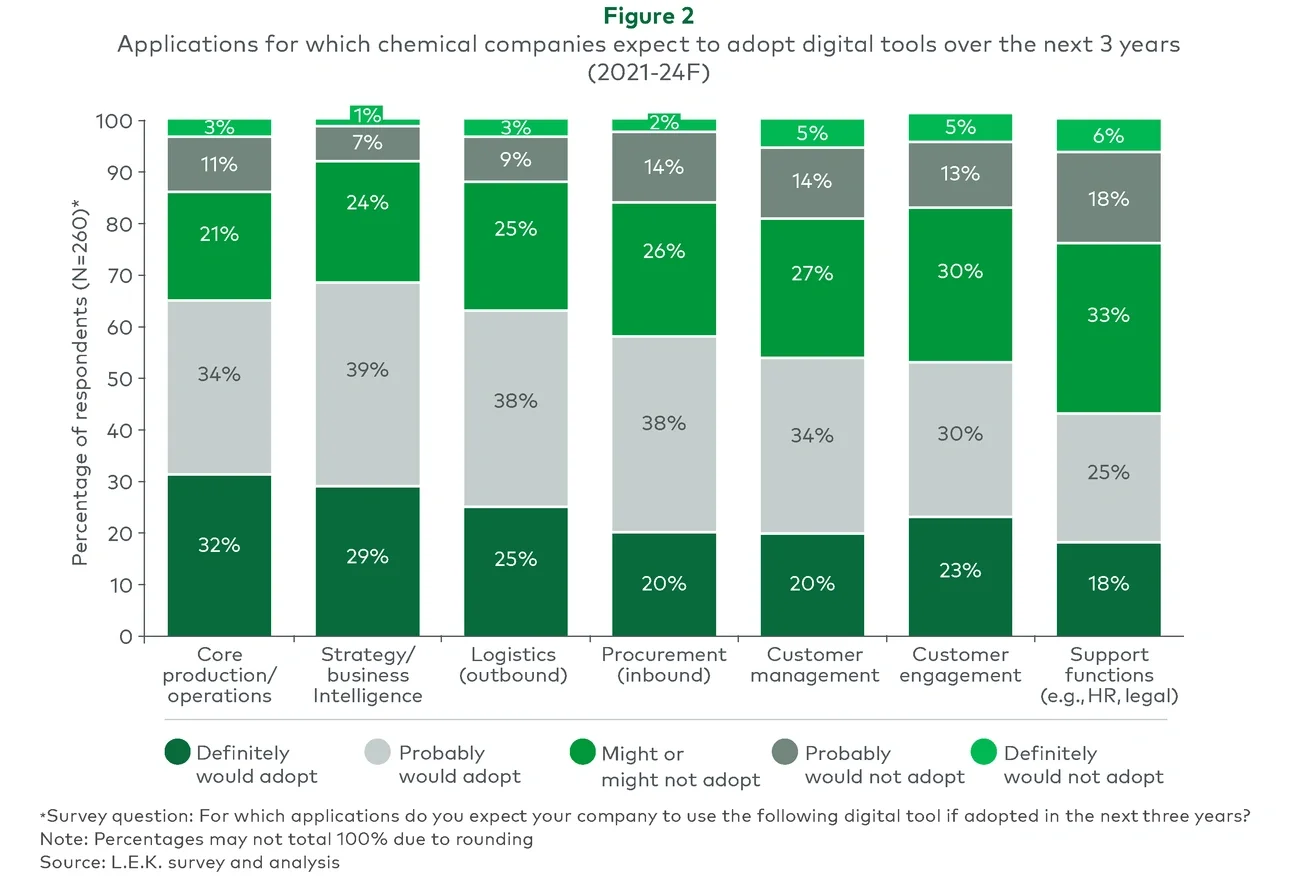


Chemicals companies are moving more aggressively to further digitize and embed digitization within their organizations. While sales and customer relations were the initial focus for digitization efforts, chemicals industry professionals now expect to adopt digital solutions for core activities — production and operations, strategy and business intelligence, and outbound logistics.
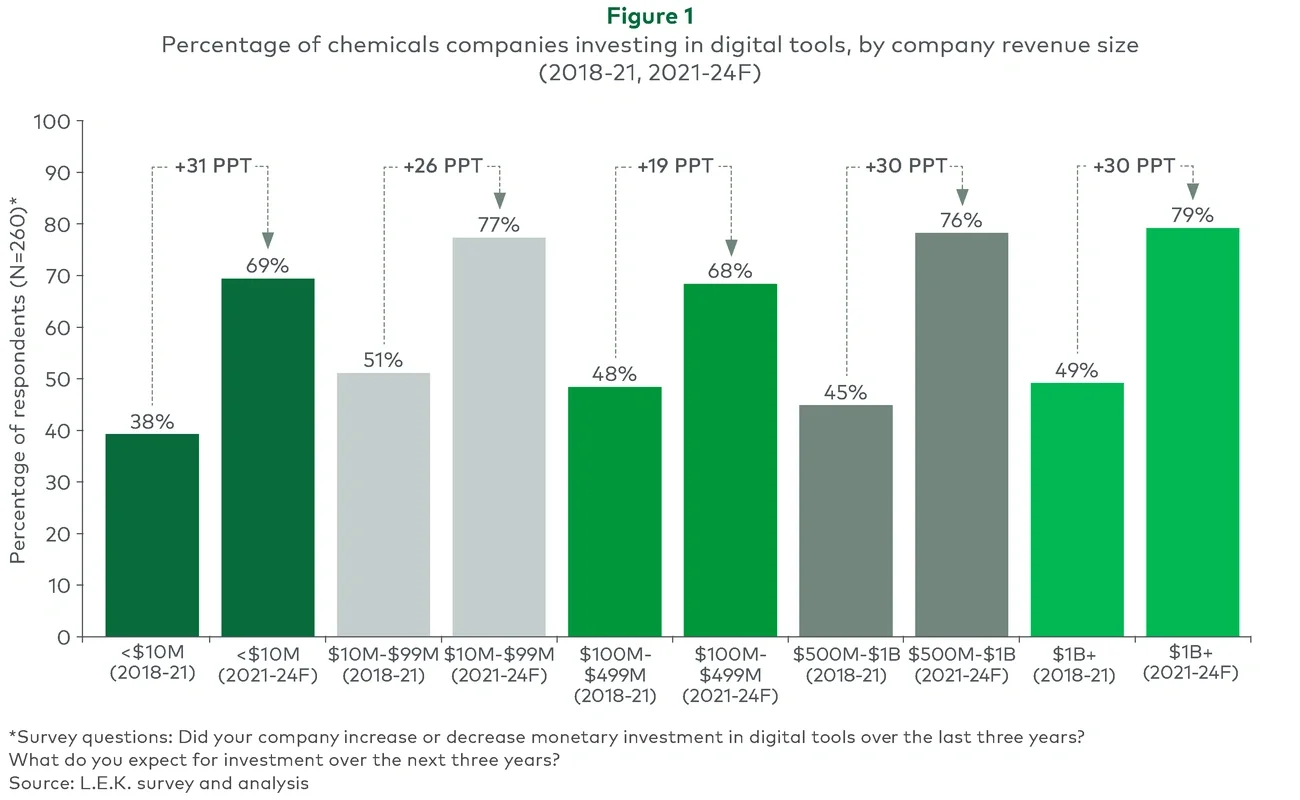
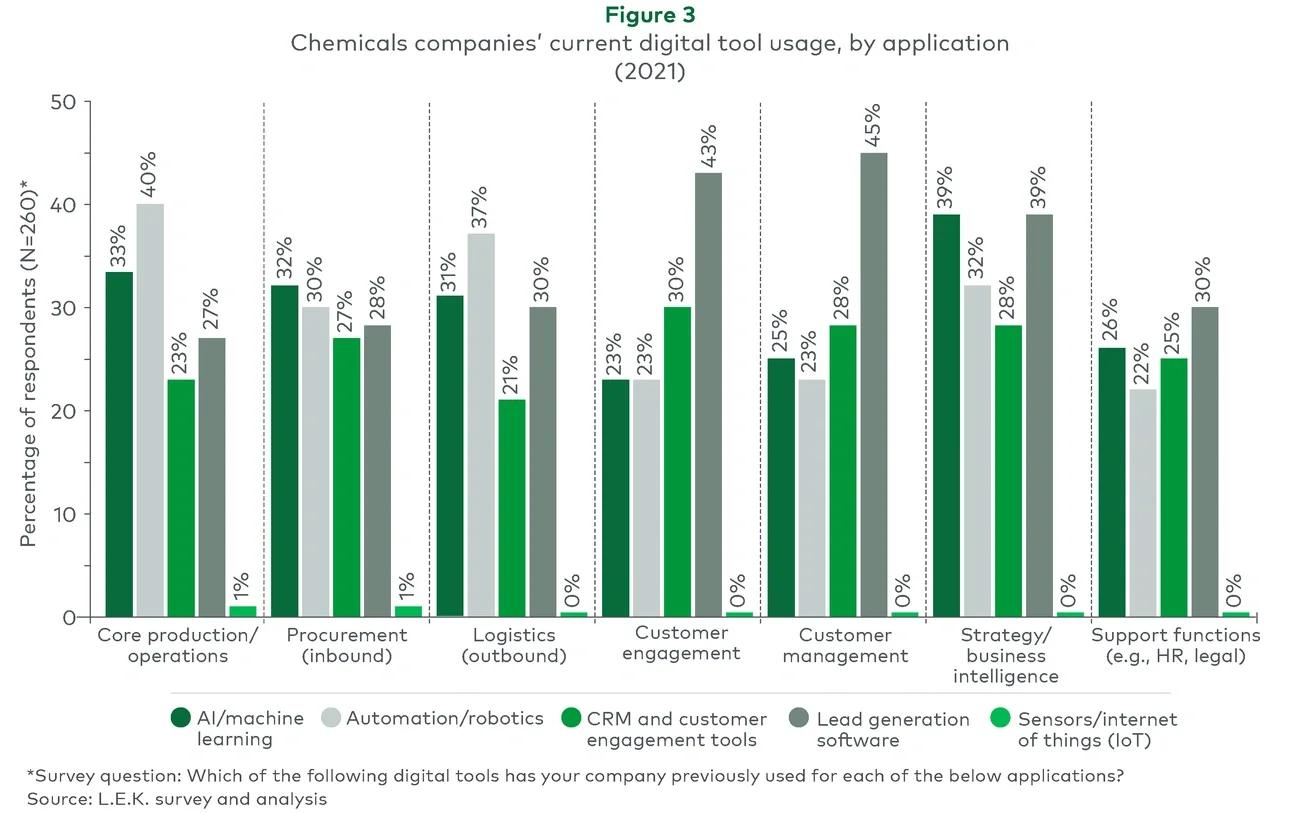
Spending on digital is becoming more widespread. About half of chemicals manufacturers and distributors across agrichemicals, industrial specialty chemicals and consumer specialty chemicals increased investment in digital tools over the past three years, and ~75% are expected to increase investment in digital initiatives over the next three years. Companies of all sizes are now recognizing that competing effectively in a changing landscape requires tools such as artificial intelligence (AI) and automation, in addition to customer relationship management (CRM) and lead generation software.
These findings on digitization trends in the chemicals industry are sourced from L.E.K. Consulting’s 2021 U.S. Specialty Chemicals survey that polled 260 chemicals sector professionals across a broad range of industries and executive functions in late 2021. The first-annual survey examined how the industry is addressing pressing concerns including the supply chain, sustainability and market disruptions in the wake of COVID-19 and ongoing global upheaval.
Below, we describe what chemicals companies’ leaders had to say about their past and planned future investments in digital tools and which tools are being most utilized and for what applications.
Digital tools investment is up across companies of all sizes
Industry professionals report they are increasing investment in digital tools and will continue to do so. About 50% of survey respondents increased digital investment from 2018 to 2021, while about 75% expect to increase investment by 2024. This is true for companies of all sizes, although the increased investment is driven by companies at opposite ends of the spectrum, in particular — both small companies making under $10 million in annual revenue and large corporations making more than $500 million expect to increase digital adoption equally, by 31 and 30 percentage points, respectively, over the next three years. Companies across both segments appear to recognize the need for digital capabilities in order to remain competitive and help their businesses scale. The middle market expects to increase its spend as well, but not by as much — 26 percentage points for $10 million-$99 million in revenue and 19 percentage points for $100 million-$499 million (see Figure 1).