


Why Channel Strategy Is Becoming the Defining Value Lever in Spanish Dermocosmetics

June 10, 2026

The Spanish dermocosmetics market continues to attract strong investor interest, supported by resilient category growth, premium positioning and favourable consumer trends. Yet many evaluation frameworks still underemphasise one of the most important drivers of long-term value creation: channel positioning.

While brands increasingly operate across multiple routes to market, channel strategy remains central to competitive advantage, shaping pricing discipline, consumer trust, recommendation dynamics and margin resilience. As the market becomes more crowded and omnichannel expansion accelerates, the ability to manage channel architecture effectively is emerging as a critical differentiator between high-quality assets and average transactions.

The Spanish skincare market grew at approximately 7% annually between 2022 and 2025, outpacing the broader beauty and personal care sector, and is forecast to sustain c.4%-5% annual growth through 2030. Ecommerce remains the fastest-growing channel at c.12% annually, while pharmacies continue to represent c.15%-20% of the market, reflecting their enduring role in recommendation-led purchasing.

Three developments are reshaping competitive dynamics across the category.

First, the “skincare as healthcare” trend has broadened the consumer base well beyond traditional pharmacy shoppers. Younger consumers are entering the category through digital channels with high ingredient literacy and strong exposure to influencer-led discovery.

Second, the competitive landscape has become increasingly fragmented. Pharmacy shelves once dominated by a limited number of established brands now face competition from a growing number of credible local and international players.

Third, and most importantly for investors, channel conflict has become a defining strategic challenge. Brands that expanded distribution without preserving pricing discipline or channel differentiation have, in some cases, weakened pharmacist recommendation rates and undermined brand credibility.

Channel positioning shapes long-term value

Many investors continue to prioritise brand equity over the economics of the channels through which that equity is monetised. However, channel architecture increasingly determines the sustainability of growth, pricing power and competitive defensibility.

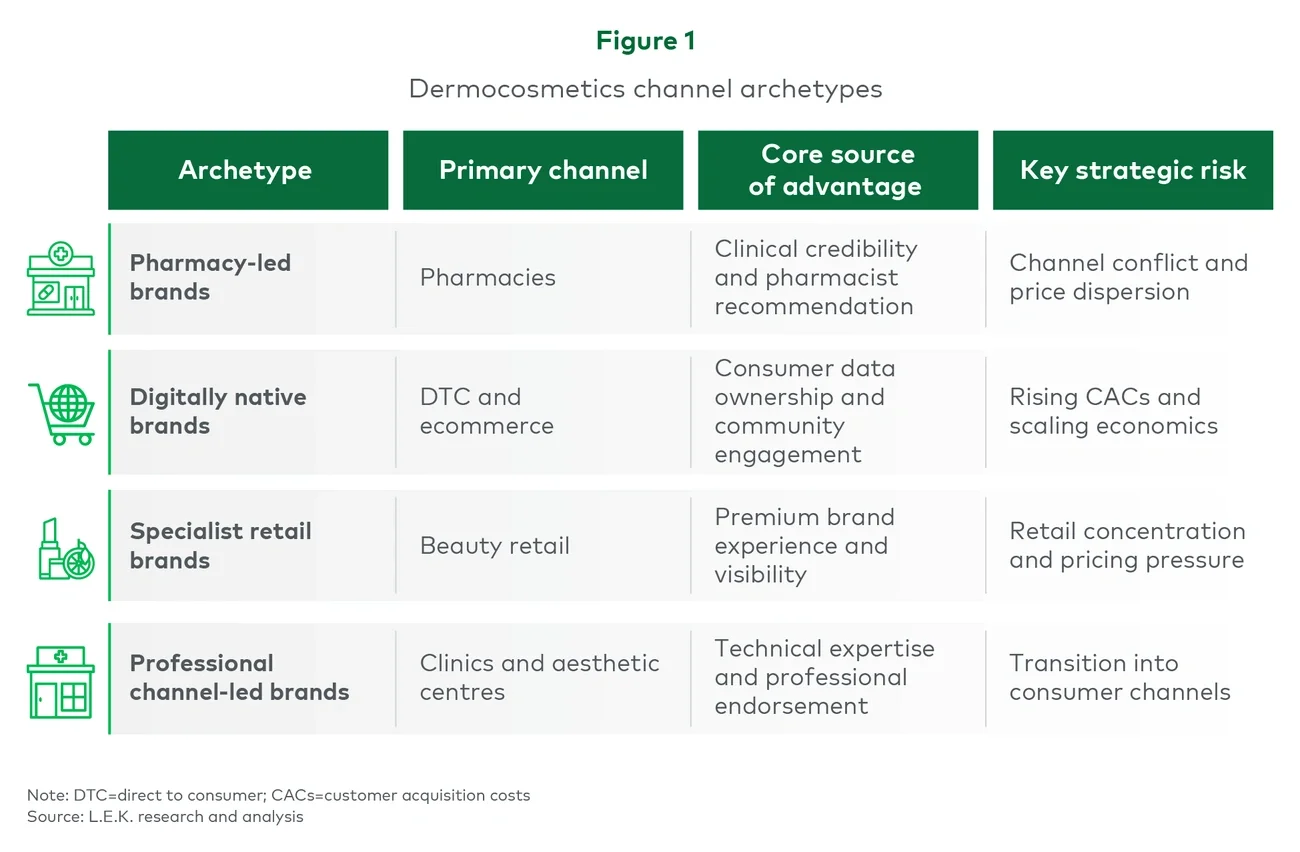
Four broad archetypes continue to define the Spanish dermocosmetics landscape. While the boundaries between them are becoming less distinct, each structural characteristic is rooted in its original channel strategy (see Figure 1).
Image
Figure 1: Dermocosmetics channel archetypes
Image
Figure 1: Dermocosmetics channel archetypes

Pharmacy-led brands: Strong equity built on trust and execution

Brands such as ISDIN, Cantabria Labs and Sesderma have historically built their position through pharmacies, where recommendations and credibility remain critical drivers of purchases.

Their competitive advantage rests on clinical positioning, dermatologist endorsement and long-term pharmacist relationships supported through training, point-of-sale activation and product education. These factors create meaningful barriers to displacement when executed effectively.

ISDIN demonstrates the strength of this model through disciplined channel management, including differentiated product ranges, limited price dispersion across channels and pharmacy exclusivity periods for selected launches. Cantabria Labs has similarly maintained strong positioning through focused pharmacy execution and dermatologist endorsement.

The risks emerge when channel discipline weakens. Selling identical stock keeping units across pharmacies, retail, marketplaces and direct-to-consumer (DTC) channels without differentiation can create pricing pressure and undermine pharmacist confidence. Brands with significant price dispersion across channels often experience deterioration in recommendation dynamics that can take years to rebuild.

For investors, pharmacy-led brands with strong channel discipline continue to command premium valuations because their scientific authority can support expansion into adjacent channels and geographies. However, brands facing channel conflict and inconsistent commercial execution warrant greater caution.

Digitally native brands: High growth with scalability questions

Digitally native brands such as Freshly, The Niche Beauty Lab, Coconut and Lico built their initial consumer base through social media, DTC channels and digitally led engagement strategies.

Their proposition typically combines ingredient transparency, accessible pricing and strong community engagement. Operationally, these brands often benefit from a sophisticated understanding of customer behaviour, cohort economics and direct consumer engagement.

The investment appeal is clear: rapid growth, consumer data ownership and relatively asset-light infrastructure. However, international experience from the UK and US beauty markets has demonstrated that customer acquisition costs often rise materially as brands scale. Growth models driven initially by organic acquisition can become significantly more challenging once paid acquisition becomes the primary growth engine.

The key strategic question is whether digitally native Spanish brands can transition successfully into broader omnichannel distribution without diluting the positioning that supported early growth. Entering the wrong channel too early can alter consumer perception and compress pricing.

Investors therefore need to assess not only current growth rates but also the sustainability of customer acquisition economics and the credibility of the brand’s broader channel expansion strategy.

Specialist retail brands: Growing opportunity with active management requirements

Brands operating through specialist beauty retail channels such as Druni, Primor, Sephora and El Corte Inglés continue to benefit from increasing consumer interest in premium skincare.

However, the Spanish specialist retail market remains relatively concentrated, with negotiating leverage sitting among a limited number of major accounts. In addition, dermocosmetics penetration within specialist retail remains lower than in more developed European markets.

Despite these constraints, the channel continues to offer an attractive route for brands capable of maintaining a differentiated premium positioning. Several brands have navigated this successfully by preserving a clear consumer proposition while avoiding excessive distribution expansion.

Professional channel-led brands: Clinical authority with expansion potential

Brands such as Mesoestetic, HBA and Germaine de Capuccini originated within clinics and professional treatment environments, where technical expertise and practitioner endorsement underpin brand credibility.

These businesses are increasingly extending across the consumer journey through pre- and post-treatment product ranges, often supported by ecommerce platforms, owned clinics or expansion into adjacent retail channels.

The opportunity is significant, but execution remains critical. Consumer-facing formulations must preserve the efficacy narrative associated with the professional channel, while expansion into pharmacy or specialist retail requires commercial capabilities that many professional-channel businesses historically did not need to develop.

For investors, the central question is whether these brands can broaden their consumer presence without weakening the professional endorsement that originally differentiated them.

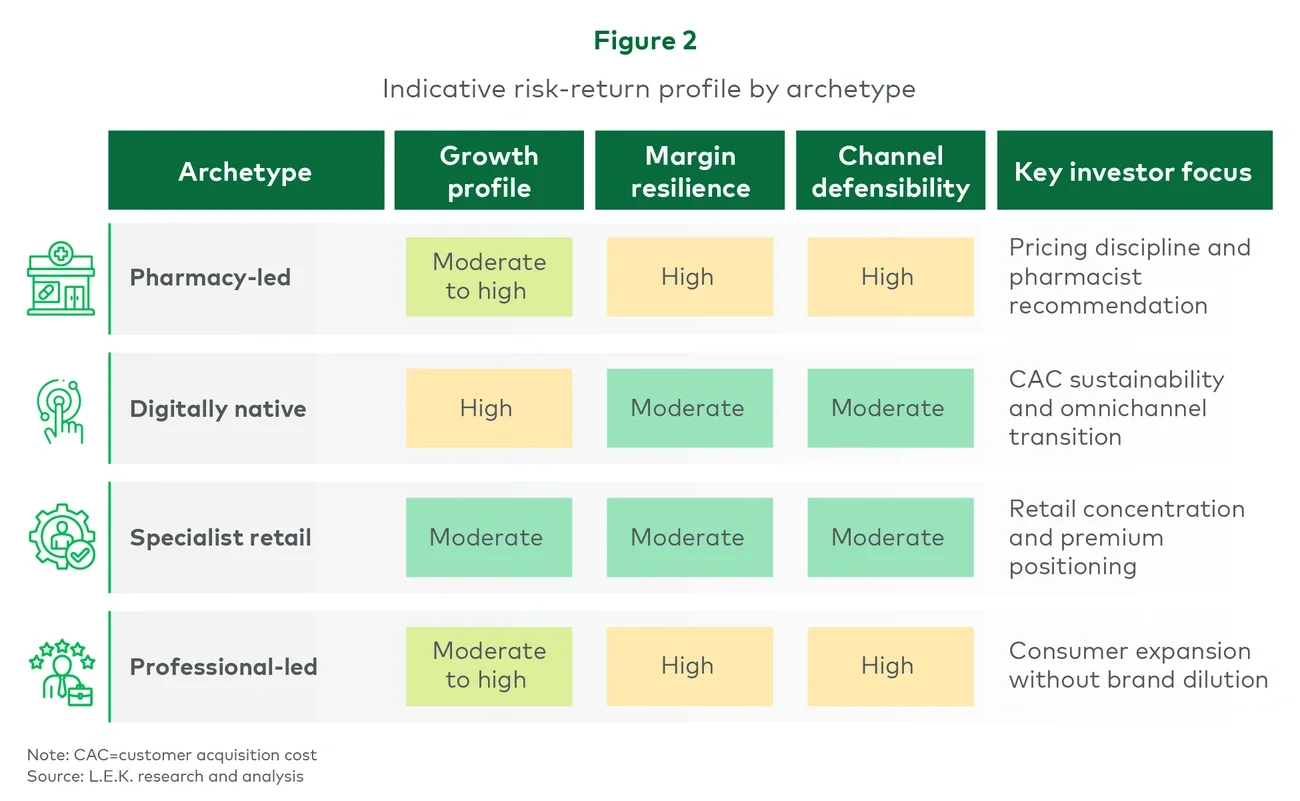
These structural differences translate into materially different growth, margin and defensibility profiles across archetypes (see Figure 2).

Image
Fig 2: Indicative risk-return profile by archetype
Image
Fig 2: Indicative risk-return profile by archetype

Implications for investors

As competition intensifies, channel strategy should become a core diligence priority rather than a secondary commercial consideration.

Several areas warrant particular attention:

  • Assess pricing dispersion across channels. Significant variation between pharmacy, retail, Amazon and DTC pricing can indicate weakening channel discipline and future margin pressure. In practice, weaker performers often exhibit price dispersion exceeding 20% across channels versus closer to 10% for leading brands with stronger pricing control.
  • Separate consumer awareness from recommendation strength. Pharmacist endorsement remains a critical indicator of brand health for pharmacy-led businesses, particularly in a market where pharmacies still represent approximately 15%-20% of skincare sales and continue to play an important role in recommendation-led purchasing.
  • Stress-test customer acquisition assumptions for digitally native brands. International experience has shown that customer acquisition costs can rise materially as brands scale, particularly once organic growth gives way to paid acquisition. In several international DTC beauty models, conversion economics that appeared attractive below €30 million of revenue deteriorated significantly beyond €50 million as brands exhausted their organic audience and competed for increasingly expensive performance marketing inventory.
  • Evaluate international expansion potential carefully. Pharmacy-led Spanish brands with strong clinical positioning and dermatologist relationships may have meaningful expansion opportunities in Latin America, particularly in Mexico, Colombia and Peru.
  • Prioritise channel strategy early in ownership. Brands that successfully recover from channel conflict typically move quickly to reinforce pricing architecture and portfolio differentiation before existing distribution agreements renew. Delayed intervention can embed 12-18 months of avoidable margin pressure.

The Spanish dermocosmetics market remains attractive, but it is not a homogeneous category. It consists of structurally different business models with distinct economic characteristics, risk profiles and competitive advantages.

The brands most likely to create durable value over the next decade will be those that maintain disciplined channel positioning while building the commercial infrastructure required to support long-term expansion. For investors, understanding channel architecture is becoming increasingly important in distinguishing genuinely defensible assets from businesses benefiting primarily from short-term category momentum.

L.E.K. Consulting advises investors and consumer brands on growth strategy, channel optimisation and value creation across the beauty and personal care sector. To discuss these themes further, contact our Consumer practice team.

L.E.K. Consulting is a registered trademark of L.E.K. Consulting. All other products and brands mentioned in this document are properties of their respective owners. © 2026 L.E.K. Consulting

English